DEF 14A0001090727falseups:shareiso4217:USDxbrli:sharesiso4217:USDxbrli:pure00010907272025-01-012025-12-310001090727ups:CarolTomeMember2025-05-090001090727ups:BrianDykesMember2025-05-090001090727ups:NandoCesaroneMember2025-05-090001090727ups:KateGutmannMember2025-05-090001090727ups:BalaSubramanianMember2025-05-0900010907272025-05-0900010907272024-01-012024-12-3100010907272023-01-012023-12-3100010907272022-01-012022-12-3100010907272021-01-012021-12-310001090727ecd:EqtyAwrdsInSummryCompstnTblForAplblYrMemberecd:PeoMember2025-01-012025-12-310001090727ecd:EqtyAwrdsAdjsExclgValRprtdInSummryCompstnTblMemberecd:PeoMember2025-01-012025-12-310001090727ecd:EqtyAwrdsInSummryCompstnTblForAplblYrMemberecd:PeoMember2024-01-012024-12-310001090727ecd:EqtyAwrdsAdjsExclgValRprtdInSummryCompstnTblMemberecd:PeoMember2024-01-012024-12-310001090727ecd:EqtyAwrdsInSummryCompstnTblForAplblYrMemberecd:PeoMember2023-01-012023-12-310001090727ecd:EqtyAwrdsAdjsExclgValRprtdInSummryCompstnTblMemberecd:PeoMember2023-01-012023-12-310001090727ecd:EqtyAwrdsInSummryCompstnTblForAplblYrMemberecd:PeoMember2022-01-012022-12-310001090727ecd:EqtyAwrdsAdjsExclgValRprtdInSummryCompstnTblMemberecd:PeoMember2022-01-012022-12-310001090727ecd:EqtyAwrdsInSummryCompstnTblForAplblYrMemberecd:PeoMember2021-01-012021-12-310001090727ecd:EqtyAwrdsAdjsExclgValRprtdInSummryCompstnTblMemberecd:PeoMember2021-01-012021-12-310001090727ups:EquityAwardsGrantedDuringTheYearMemberecd:PeoMember2025-01-012025-12-310001090727ups:EquityAwardsGrantedDuringTheYearMemberecd:PeoMember2024-01-012024-12-310001090727ups:EquityAwardsGrantedDuringTheYearMemberecd:PeoMember2023-01-012023-12-310001090727ups:EquityAwardsGrantedDuringTheYearMemberecd:PeoMember2022-01-012022-12-310001090727ups:EquityAwardsGrantedDuringTheYearMemberecd:PeoMember2021-01-012021-12-310001090727ups:OptionsGrantedDuringYearMemberecd:PeoMember2025-01-012025-12-310001090727ups:OptionsGrantedDuringYearMemberecd:PeoMember2024-01-012024-12-310001090727ups:OptionsGrantedDuringYearMemberecd:PeoMember2023-01-012023-12-310001090727ups:OptionsGrantedDuringYearMemberecd:PeoMember2022-01-012022-12-310001090727ups:OptionsGrantedDuringYearMemberecd:PeoMember2021-01-012021-12-310001090727ecd:AggtChngPnsnValInSummryCompstnTblForAplblYrMemberecd:PeoMember2025-01-012025-12-310001090727ecd:AggtChngPnsnValInSummryCompstnTblForAplblYrMemberecd:PeoMember2024-01-012024-12-310001090727ecd:AggtChngPnsnValInSummryCompstnTblForAplblYrMemberecd:PeoMember2023-01-012023-12-310001090727ecd:AggtChngPnsnValInSummryCompstnTblForAplblYrMemberecd:PeoMember2022-01-012022-12-310001090727ecd:AggtChngPnsnValInSummryCompstnTblForAplblYrMemberecd:PeoMember2021-01-012021-12-310001090727ecd:AggtPnsnAdjsSvcCstMemberecd:PeoMember2025-01-012025-12-310001090727ecd:AggtPnsnAdjsSvcCstMemberecd:PeoMember2024-01-012024-12-310001090727ecd:AggtPnsnAdjsSvcCstMemberecd:PeoMember2023-01-012023-12-310001090727ecd:AggtPnsnAdjsSvcCstMemberecd:PeoMember2022-01-012022-12-310001090727ecd:AggtPnsnAdjsSvcCstMemberecd:PeoMember2021-01-012021-12-310001090727ecd:YrEndFrValOfEqtyAwrdsGrntdInCvrdYrOutsdngAndUnvstdMemberecd:PeoMember2025-01-012025-12-310001090727ecd:ChngInFrValOfOutsdngAndUnvstdEqtyAwrdsGrntdInPrrYrsMemberecd:PeoMember2025-01-012025-12-310001090727ecd:VstngDtFrValOfEqtyAwrdsGrntdAndVstdInCvrdYrMemberecd:PeoMember2025-01-012025-12-310001090727ecd:ChngInFrValAsOfVstngDtOfPrrYrEqtyAwrdsVstdInCvrdYrMemberecd:PeoMember2025-01-012025-12-310001090727ecd:FrValAsOfPrrYrEndOfEqtyAwrdsGrntdInPrrYrsFldVstngCondsDrngCvrdYrMemberecd:PeoMember2025-01-012025-12-310001090727ecd:EqtyAwrdsAdjsMemberecd:PeoMember2025-01-012025-12-310001090727ecd:YrEndFrValOfEqtyAwrdsGrntdInCvrdYrOutsdngAndUnvstdMemberecd:PeoMember2024-01-012024-12-310001090727ecd:ChngInFrValOfOutsdngAndUnvstdEqtyAwrdsGrntdInPrrYrsMemberecd:PeoMember2024-01-012024-12-310001090727ecd:VstngDtFrValOfEqtyAwrdsGrntdAndVstdInCvrdYrMemberecd:PeoMember2024-01-012024-12-310001090727ecd:ChngInFrValAsOfVstngDtOfPrrYrEqtyAwrdsVstdInCvrdYrMemberecd:PeoMember2024-01-012024-12-310001090727ecd:FrValAsOfPrrYrEndOfEqtyAwrdsGrntdInPrrYrsFldVstngCondsDrngCvrdYrMemberecd:PeoMember2024-01-012024-12-310001090727ecd:EqtyAwrdsAdjsMemberecd:PeoMember2024-01-012024-12-310001090727ecd:YrEndFrValOfEqtyAwrdsGrntdInCvrdYrOutsdngAndUnvstdMemberecd:PeoMember2023-01-012023-12-310001090727ecd:ChngInFrValOfOutsdngAndUnvstdEqtyAwrdsGrntdInPrrYrsMemberecd:PeoMember2023-01-012023-12-310001090727ecd:VstngDtFrValOfEqtyAwrdsGrntdAndVstdInCvrdYrMemberecd:PeoMember2023-01-012023-12-310001090727ecd:ChngInFrValAsOfVstngDtOfPrrYrEqtyAwrdsVstdInCvrdYrMemberecd:PeoMember2023-01-012023-12-310001090727ecd:FrValAsOfPrrYrEndOfEqtyAwrdsGrntdInPrrYrsFldVstngCondsDrngCvrdYrMemberecd:PeoMember2023-01-012023-12-310001090727ecd:EqtyAwrdsAdjsMemberecd:PeoMember2023-01-012023-12-310001090727ecd:YrEndFrValOfEqtyAwrdsGrntdInCvrdYrOutsdngAndUnvstdMemberecd:PeoMember2022-01-012022-12-310001090727ecd:ChngInFrValOfOutsdngAndUnvstdEqtyAwrdsGrntdInPrrYrsMemberecd:PeoMember2022-01-012022-12-310001090727ecd:VstngDtFrValOfEqtyAwrdsGrntdAndVstdInCvrdYrMemberecd:PeoMember2022-01-012022-12-310001090727ecd:ChngInFrValAsOfVstngDtOfPrrYrEqtyAwrdsVstdInCvrdYrMemberecd:PeoMember2022-01-012022-12-310001090727ecd:FrValAsOfPrrYrEndOfEqtyAwrdsGrntdInPrrYrsFldVstngCondsDrngCvrdYrMemberecd:PeoMember2022-01-012022-12-310001090727ecd:EqtyAwrdsAdjsMemberecd:PeoMember2022-01-012022-12-310001090727ecd:YrEndFrValOfEqtyAwrdsGrntdInCvrdYrOutsdngAndUnvstdMemberecd:PeoMember2021-01-012021-12-310001090727ecd:ChngInFrValOfOutsdngAndUnvstdEqtyAwrdsGrntdInPrrYrsMemberecd:PeoMember2021-01-012021-12-310001090727ecd:VstngDtFrValOfEqtyAwrdsGrntdAndVstdInCvrdYrMemberecd:PeoMember2021-01-012021-12-310001090727ecd:ChngInFrValAsOfVstngDtOfPrrYrEqtyAwrdsVstdInCvrdYrMemberecd:PeoMember2021-01-012021-12-310001090727ecd:FrValAsOfPrrYrEndOfEqtyAwrdsGrntdInPrrYrsFldVstngCondsDrngCvrdYrMemberecd:PeoMember2021-01-012021-12-310001090727ecd:EqtyAwrdsAdjsMemberecd:PeoMember2021-01-012021-12-310001090727ecd:EqtyAwrdsInSummryCompstnTblForAplblYrMemberecd:NonPeoNeoMember2025-01-012025-12-310001090727ecd:EqtyAwrdsAdjsExclgValRprtdInSummryCompstnTblMemberecd:NonPeoNeoMember2025-01-012025-12-310001090727ecd:EqtyAwrdsInSummryCompstnTblForAplblYrMemberecd:NonPeoNeoMember2024-01-012024-12-310001090727ecd:EqtyAwrdsAdjsExclgValRprtdInSummryCompstnTblMemberecd:NonPeoNeoMember2024-01-012024-12-310001090727ecd:EqtyAwrdsInSummryCompstnTblForAplblYrMemberecd:NonPeoNeoMember2023-01-012023-12-310001090727ecd:EqtyAwrdsAdjsExclgValRprtdInSummryCompstnTblMemberecd:NonPeoNeoMember2023-01-012023-12-310001090727ecd:EqtyAwrdsInSummryCompstnTblForAplblYrMemberecd:NonPeoNeoMember2022-01-012022-12-310001090727ecd:EqtyAwrdsAdjsExclgValRprtdInSummryCompstnTblMemberecd:NonPeoNeoMember2022-01-012022-12-310001090727ecd:EqtyAwrdsInSummryCompstnTblForAplblYrMemberecd:NonPeoNeoMember2021-01-012021-12-310001090727ecd:EqtyAwrdsAdjsExclgValRprtdInSummryCompstnTblMemberecd:NonPeoNeoMember2021-01-012021-12-310001090727ups:EquityAwardsGrantedDuringTheYearMemberecd:NonPeoNeoMember2025-01-012025-12-310001090727ups:EquityAwardsGrantedDuringTheYearMemberecd:NonPeoNeoMember2024-01-012024-12-310001090727ups:EquityAwardsGrantedDuringTheYearMemberecd:NonPeoNeoMember2023-01-012023-12-310001090727ups:EquityAwardsGrantedDuringTheYearMemberecd:NonPeoNeoMember2022-01-012022-12-310001090727ups:EquityAwardsGrantedDuringTheYearMemberecd:NonPeoNeoMember2021-01-012021-12-310001090727ups:OptionsGrantedDuringYearMemberecd:NonPeoNeoMember2025-01-012025-12-310001090727ups:OptionsGrantedDuringYearMemberecd:NonPeoNeoMember2024-01-012024-12-310001090727ups:OptionsGrantedDuringYearMemberecd:NonPeoNeoMember2023-01-012023-12-310001090727ups:OptionsGrantedDuringYearMemberecd:NonPeoNeoMember2022-01-012022-12-310001090727ups:OptionsGrantedDuringYearMemberecd:NonPeoNeoMember2021-01-012021-12-310001090727ecd:AggtChngPnsnValInSummryCompstnTblForAplblYrMemberecd:NonPeoNeoMember2025-01-012025-12-310001090727ecd:AggtChngPnsnValInSummryCompstnTblForAplblYrMemberecd:NonPeoNeoMember2024-01-012024-12-310001090727ecd:AggtChngPnsnValInSummryCompstnTblForAplblYrMemberecd:NonPeoNeoMember2023-01-012023-12-310001090727ecd:AggtChngPnsnValInSummryCompstnTblForAplblYrMemberecd:NonPeoNeoMember2022-01-012022-12-310001090727ecd:AggtChngPnsnValInSummryCompstnTblForAplblYrMemberecd:NonPeoNeoMember2021-01-012021-12-310001090727ecd:PnsnAdjsSvcCstMemberecd:NonPeoNeoMember2025-01-012025-12-310001090727ecd:PnsnAdjsSvcCstMemberecd:NonPeoNeoMember2024-01-012024-12-310001090727ecd:PnsnAdjsSvcCstMemberecd:NonPeoNeoMember2023-01-012023-12-310001090727ecd:PnsnAdjsSvcCstMemberecd:NonPeoNeoMember2022-01-012022-12-310001090727ecd:PnsnAdjsSvcCstMemberecd:NonPeoNeoMember2021-01-012021-12-310001090727ecd:YrEndFrValOfEqtyAwrdsGrntdInCvrdYrOutsdngAndUnvstdMemberecd:NonPeoNeoMember2025-01-012025-12-310001090727ecd:ChngInFrValOfOutsdngAndUnvstdEqtyAwrdsGrntdInPrrYrsMemberecd:NonPeoNeoMember2025-01-012025-12-310001090727ecd:VstngDtFrValOfEqtyAwrdsGrntdAndVstdInCvrdYrMemberecd:NonPeoNeoMember2025-01-012025-12-310001090727ecd:ChngInFrValAsOfVstngDtOfPrrYrEqtyAwrdsVstdInCvrdYrMemberecd:NonPeoNeoMember2025-01-012025-12-310001090727ecd:FrValAsOfPrrYrEndOfEqtyAwrdsGrntdInPrrYrsFldVstngCondsDrngCvrdYrMemberecd:NonPeoNeoMember2025-01-012025-12-310001090727ecd:EqtyAwrdsAdjsMemberecd:NonPeoNeoMember2025-01-012025-12-310001090727ecd:YrEndFrValOfEqtyAwrdsGrntdInCvrdYrOutsdngAndUnvstdMemberecd:NonPeoNeoMember2024-01-012024-12-310001090727ecd:ChngInFrValOfOutsdngAndUnvstdEqtyAwrdsGrntdInPrrYrsMemberecd:NonPeoNeoMember2024-01-012024-12-310001090727ecd:VstngDtFrValOfEqtyAwrdsGrntdAndVstdInCvrdYrMemberecd:NonPeoNeoMember2024-01-012024-12-310001090727ecd:ChngInFrValAsOfVstngDtOfPrrYrEqtyAwrdsVstdInCvrdYrMemberecd:NonPeoNeoMember2024-01-012024-12-310001090727ecd:FrValAsOfPrrYrEndOfEqtyAwrdsGrntdInPrrYrsFldVstngCondsDrngCvrdYrMemberecd:NonPeoNeoMember2024-01-012024-12-310001090727ecd:EqtyAwrdsAdjsMemberecd:NonPeoNeoMember2024-01-012024-12-310001090727ecd:YrEndFrValOfEqtyAwrdsGrntdInCvrdYrOutsdngAndUnvstdMemberecd:NonPeoNeoMember2023-01-012023-12-310001090727ecd:ChngInFrValOfOutsdngAndUnvstdEqtyAwrdsGrntdInPrrYrsMemberecd:NonPeoNeoMember2023-01-012023-12-310001090727ecd:VstngDtFrValOfEqtyAwrdsGrntdAndVstdInCvrdYrMemberecd:NonPeoNeoMember2023-01-012023-12-310001090727ecd:ChngInFrValAsOfVstngDtOfPrrYrEqtyAwrdsVstdInCvrdYrMemberecd:NonPeoNeoMember2023-01-012023-12-310001090727ecd:FrValAsOfPrrYrEndOfEqtyAwrdsGrntdInPrrYrsFldVstngCondsDrngCvrdYrMemberecd:NonPeoNeoMember2023-01-012023-12-310001090727ecd:EqtyAwrdsAdjsMemberecd:NonPeoNeoMember2023-01-012023-12-310001090727ecd:YrEndFrValOfEqtyAwrdsGrntdInCvrdYrOutsdngAndUnvstdMemberecd:NonPeoNeoMember2022-01-012022-12-310001090727ecd:ChngInFrValOfOutsdngAndUnvstdEqtyAwrdsGrntdInPrrYrsMemberecd:NonPeoNeoMember2022-01-012022-12-310001090727ecd:VstngDtFrValOfEqtyAwrdsGrntdAndVstdInCvrdYrMemberecd:NonPeoNeoMember2022-01-012022-12-310001090727ecd:ChngInFrValAsOfVstngDtOfPrrYrEqtyAwrdsVstdInCvrdYrMemberecd:NonPeoNeoMember2022-01-012022-12-310001090727ecd:FrValAsOfPrrYrEndOfEqtyAwrdsGrntdInPrrYrsFldVstngCondsDrngCvrdYrMemberecd:NonPeoNeoMember2022-01-012022-12-310001090727ecd:EqtyAwrdsAdjsMemberecd:NonPeoNeoMember2022-01-012022-12-310001090727ecd:YrEndFrValOfEqtyAwrdsGrntdInCvrdYrOutsdngAndUnvstdMemberecd:NonPeoNeoMember2021-01-012021-12-310001090727ecd:ChngInFrValOfOutsdngAndUnvstdEqtyAwrdsGrntdInPrrYrsMemberecd:NonPeoNeoMember2021-01-012021-12-310001090727ecd:VstngDtFrValOfEqtyAwrdsGrntdAndVstdInCvrdYrMemberecd:NonPeoNeoMember2021-01-012021-12-310001090727ecd:ChngInFrValAsOfVstngDtOfPrrYrEqtyAwrdsVstdInCvrdYrMemberecd:NonPeoNeoMember2021-01-012021-12-310001090727ecd:FrValAsOfPrrYrEndOfEqtyAwrdsGrntdInPrrYrsFldVstngCondsDrngCvrdYrMemberecd:NonPeoNeoMember2021-01-012021-12-310001090727ecd:EqtyAwrdsAdjsMemberecd:NonPeoNeoMember2021-01-012021-12-31000109072712025-01-012025-12-31000109072722025-01-012025-12-31000109072732025-01-012025-12-31000109072742025-01-012025-12-31000109072752025-01-012025-12-31
UNITED STATES
SECURITIES AND EXCHANGE COMMISSION
Washington, D.C. 20549
SCHEDULE 14A
Proxy Statement Pursuant to Section 14(a) of the
Securities Exchange Act of 1934 (Amendment No. )
| | | | | | | | | | | |
| ☑ | Filed by the Registrant | ☐ | Filed by a party other than the Registrant |
| | | | | |
CHECK THE APPROPRIATE BOX: |
☐ | Preliminary Proxy Statement |
☐ | Confidential, for Use of the Commission Only (as permitted by Rule 14a-6(e)(2)) |
☑ | Definitive Proxy Statement |
☐ | Definitive Additional Materials |
☐ | Soliciting Material under §240.14a-12 |
United Parcel Service, Inc.
(Name of Registrant as Specified In Its Charter)
(Name of Person(s) Filing Proxy Statement, if other than the Registrant)
| | | | | |
PAYMENT OF FILING FEE (CHECK ALL BOXES THAT APPLY): |
☑ | No fee required |
☐ | Fee paid previously with preliminary materials |
☐ | Fee computed on table in exhibit required by Item 25(b) per Exchange Act Rules 14a-6(i)(1) and 0-11 |
| | | | | |
United Parcel Service, Inc.
55 Glenlake Parkway, N.E.
Atlanta, GA 30328 March 19, 2026 Dear Fellow Shareowners, | |
|
It is my pleasure to invite you to attend the 2026 UPS Annual Meeting of Shareowners. I encourage all my fellow shareowners to participate and vote. 2025 was a pivotal year, as UPS launched one of our most significant strategic shifts in Company history - reducing non-value volume from our largest customer to free up capacity for high-value growth elsewhere. This decision wasn’t made lightly, nor for the short-term, but rather for long-term value creation. While the Company successfully navigated through this strategic pivot, 2025 brought unexpected trade disruptions, rising geopolitical tensions and changing industry dynamics. Further, in November our Company experienced a tragic airplane accident, which resulted in the loss of 15 lives, including three of our pilots. Our thoughts and prayers are with the families and friends of those who were impacted.
In the face of these challenges, our focus remained on our customers, our shareowners and our people. For our customers, in 2025, we reported the best on-time delivery of any carrier for the eighth year in a row. And for our shareowners, we were pleased to report a return of $6.4 billion through dividends and share repurchases.
Your board also continues to evolve. In 2025, we welcomed two valuable additions as members, Kevin Clark, CEO of Aptiv PLC, and John Morikis, former CEO of The Sherwin-Williams Company. And we thank Kate Johnson for her service, as she departs the board in May to focus on her other professional responsibilities. Kate provided significant strategic experience and technical acumen in the boardroom. Kate and her contributions will be missed. We also want to congratulate Kevin Warsh. The President of the United States has nominated Kevin to serve as Chairman of the Board of Governors of the United States Federal Reserve System. Kevin has informed UPS that if he is confirmed into this position, he will step down from the Board. For over 13 years, Kevin has been an invaluable member of the board, providing financial markets expertise, global economic insights and sound judgment.
Thanks to the hard work of dedicated UPS employees, the Company achieved several other successes in 2025, including being recognized as the world’s most valuable logistics brand for the eleventh year in a row. The Company also completed and has been integrating strategic acquisitions in the key international healthcare logistics space. These acquisitions support the Company’s overall strategy to grow in premium segments, especially internationally. UPS also expanded its important small- and medium-sized business customer volume.
Despite this progress, the Company’s share price performance has been disappointing. The board and management remain highly focused on the significant work to be done to create sustained value. Executing on our strategy will continue to require hard decisions. We remain committed to delivering long-term value through network optimization, investing to drive growth in key areas, including the premium and complex logistics markets, healthcare, international and small- and medium-sized businesses, and continuing to deliver industry-leading service.
As Chair of the Board, I am honored to serve for an additional year, helping to keep the board and management highly engaged and focused on creating long-term value. On behalf of the entire Board of Directors, thank you for your continued support. As we approach the Annual Meeting, please contact us with any questions or feedback at 404-828-6059 or investor@ups.com.
William Johnson
UPS Board Chair
| | | | | | | | |
4 | | Notice of Annual Meeting of Shareowners and 2026 Proxy Statement |
| | | | | |
| Notice of Annual Meeting UNITED PARCEL SERVICE, INC. 55 Glenlake Parkway, N.E., Atlanta, Georgia 30328 |
Date and Time: May 7, 2026, 8:00 a.m. Eastern Time.
Place: The United Parcel Service, Inc. Annual Meeting of Shareowners will be held online via webcast at www.virtualshareholdermeeting.com/UPS2026.
Record Date: March 9, 2026.
Distribution Date: A Notice of Internet Availability of Proxy Materials, or the Proxy Statement, is first being sent to shareowners on March 19, 2026.
Voting: Your vote is important. Holders of class A common stock are entitled to 10 votes per share on each matter to be acted upon; holders of class B common stock are entitled to one vote per share on each matter to be acted upon.
Please vote as soon as possible through the Internet, by telephone or by signing and returning your proxy card (if you received a paper copy of the proxy card). Your voting options are described on the Notice of Internet Availability of Proxy Materials, voting instruction form and/or proxy card. Brokers are not permitted to vote on certain proposals and may not vote on any of the proposals unless you provide voting instructions. Voting your shares will help to ensure that your interests are represented at the meeting.
Attending the Meeting: You or your proxy holder can participate, vote and ask questions at the meeting by visiting www.virtualshareholdermeeting.com/UPS2026 and using your 16-digit control number found on your proxy card, voting instruction form or Notice of Internet Availability of Proxy Materials.
Shareowners who do not receive a 16-digit control number should consult their voting instruction form or Notice of Internet Availability of Proxy Materials and may need to request a legal proxy from their bank, broker or other nominee in advance of the meeting in order to participate. For more information, see page 94. Important Notice Regarding the Availability of Proxy Materials for the Shareowner Meeting to be Held on May 7, 2026: The Proxy Statement and our 2025 Annual Report are available at www.proxyvote.com. Questions? Call 404-828-6059 (option 2).
| | | | | |
| By order of the Board of Directors |
| Norman M. Brothers, Jr.
Secretary
Atlanta, Georgia
March 19, 2026 |
| | | | | |
| Items of Business UNITED PARCEL SERVICE, INC. 2026 Annual Meeting of Shareowners |
| | | | | | | | | | | |
| Voting Choices | Board Voting Recommendations | Page |
| Company Proposals: | | | |
| | | |
1.Elect the 12 director nominees named in the Proxy Statement to serve until the 2027 Annual Meeting and until their respective successors are elected and qualified | •Vote for all nominees •Vote against all nominees •Vote for some nominees and against others •Abstain from voting on one or more nominees | FOR EACH
NOMINEE | |
| | | |
| | | |
2.Advisory vote to approve named executive officer compensation | •Vote for the proposal •Vote against the proposal •Abstain from voting on the proposal | FOR | |
| | | |
| | | |
3.Approve the 2026 Omnibus Incentive Compensation Plan | •Vote for the proposal •Vote against the proposal •Abstain from voting on the proposal | FOR | |
| | | |
| | | |
4.Ratify the appointment of Deloitte & Touche LLP as our independent registered public accounting firm for 2026 | •Vote for ratification •Vote against ratification •Abstain from voting on the proposal | FOR | |
| | | |
| Shareowner Proposals: | | | |
| | | |
5. - 7. Advisory votes on 3 shareowner proposals, only if properly presented | •Vote for each proposal •Vote against each proposal •Abstain from voting on one or more proposals | AGAINST EACH
PROPOSAL | |
| | | |
| | | | | | | | |
6 | | Notice of Annual Meeting of Shareowners and 2026 Proxy Statement |
| | | | | |
| Proxy Statement UNITED PARCEL SERVICE, INC. 55 Glenlake Parkway, N.E., Atlanta, Georgia 30328 |
This Proxy Statement contains important information about the 2026 Annual Meeting of Shareowners (the “Annual Meeting”). We are providing these proxy materials to you because our Board of Directors is soliciting your proxy to vote your shares at the Annual Meeting. The Annual Meeting will be held via webcast on May 7, 2026, at 8:00 a.m. Eastern Time, at www.virtualshareholdermeeting.com/UPS2026. Shareowners can participate, ask questions and vote during the meeting through this website.
All properly executed written proxies, and all properly completed proxies submitted through the Internet or by telephone, that are delivered pursuant to this solicitation will be voted at the Annual Meeting in accordance with the directions given in the proxy, unless the proxy is revoked prior to the completion of voting at the Annual Meeting. Only owners of record of shares of the Company’s common stock as of the close of business on March 9, 2026 (the “Record Date”) are entitled to notice of, and to vote at, the Annual Meeting (or any adjournment or postponement of the Annual Meeting). We are first distributing this Proxy Statement to shareowners on March 19, 2026.
Proxy Statement Summary
The following summary highlights key information contained elsewhere in this Proxy Statement.
The board is deeply committed to effective governance, fostering open dialogue, holding itself accountable and constructively challenging management to facilitate the Company’s long-term success. Some of our key governance policies and practices include:
•An independent board and an independent, highly experienced Board Chair;
•A highly engaged board, with an appropriate mix of relevant skills, experience and backgrounds;
•Executive sessions of independent directors at each regular board meeting;
•Annual elections for all directors; majority voting in uncontested director elections;
•Active board participation in the strategic planning process, including an in-depth annual strategy review and ongoing strategic oversight throughout the year;
•Board committees consisting entirely of independent directors;
•Regular evaluations of governance policies and practices, making changes when appropriate; for example, the board recently delegated AI risk oversight responsibilities to the Risk Committee;
•Proactive engagement with stakeholders on operational, strategic, financial and other relevant matters; during this proxy season management contacted holders of over 47% of our class B common stock to discuss environmental sustainability, corporate governance, executive compensation and human capital matters;
•Annual board and committee self-evaluations, including one-on-one director discussions with the independent Board Chair;
•Comprehensive director orientation program;
•Robust stock ownership guidelines of eight times annual salary for the CEO, five times annual salary for other executive officers and five times the annual retainer for directors; and
•Restrictions on executive officers and directors hedging or pledging their ownership in UPS stock.
| | | | | | | | | | | |
92% Independent | | | 8 years Average tenure |
Summary information about our director nominees is below. As a group, we believe our director nominees have the appropriate skills and experience to effectively oversee and constructively challenge management’s execution of the Company’s strategy. For more information about our director nominees, see page 22. | | | | | | | | | | | |
| Name | Director
Since | Principal Occupation | Committee(s) |
| Independent Directors | |
| Rodney Adkins | 2013 | Former Senior Vice President, IBM | –Risk (Chair) –Compensation and Human Capital –Executive |
| Eva Boratto | 2020 | Chief Financial Officer, Bath & Body Works | –Audit (Chair) |
Kevin Clark | 2025 | Chairman and Chief Executive Officer, Aptiv | –Audit |
| Wayne Hewett | 2020 | Senior Advisor, Permira | –Audit |
| Angela Hwang | 2020 | Chief Executive Officer - Partner, Flagship Pioneering, and Chief Executive Officer, Metaphore Biotechnologies | –Audit |
William Johnson(1) | 2009 | Former Chairman, President and Chief Executive Officer, H.J. Heinz | –Nominating and Corporate Governance (Chair) –Executive |
| Franck Moison | 2017 | Former Vice Chairman, Colgate-Palmolive | –Nominating and Corporate Governance –Risk |
John Morikis | 2025 | Former Chairman, President and Chief Executive Officer, The Sherwin-Williams Company | –Audit |
| Christiana Smith Shi | 2018 | Former President, Direct-to-Consumer, Nike | –Compensation and Human Capital (Chair) –Risk |
| Russell Stokes | 2020 | President and Chief Executive Officer, Commercial Engines and Services, GE Aerospace(2) | –Compensation and Human Capital –Nominating and Corporate Governance |
Kevin Warsh(3) | 2012 | Former Member of the Board of Governors of the Federal Reserve System, Distinguished Visiting Fellow, Hoover Institution, Stanford University | –Compensation and Human Capital –Nominating and Corporate Governance |
| Non-Independent Director | |
| Carol Tomé | 2003 | Chief Executive Officer, UPS | –Executive (Chair) |
(1)Independent Board Chair.
(2)Russell has announced his intention to retire from GE Aerospace in July 2026.
(3)The President of the United States has nominated Kevin to serve as Chairman of the Board of Governors of the United States Federal Reserve System, subject to confirmation by the United States Senate. Kevin has notified UPS that if he is confirmed to that position, he will resign from the Board.
| | | | | | | | |
8 | | Notice of Annual Meeting of Shareowners and 2026 Proxy Statement |
Compensation Practices
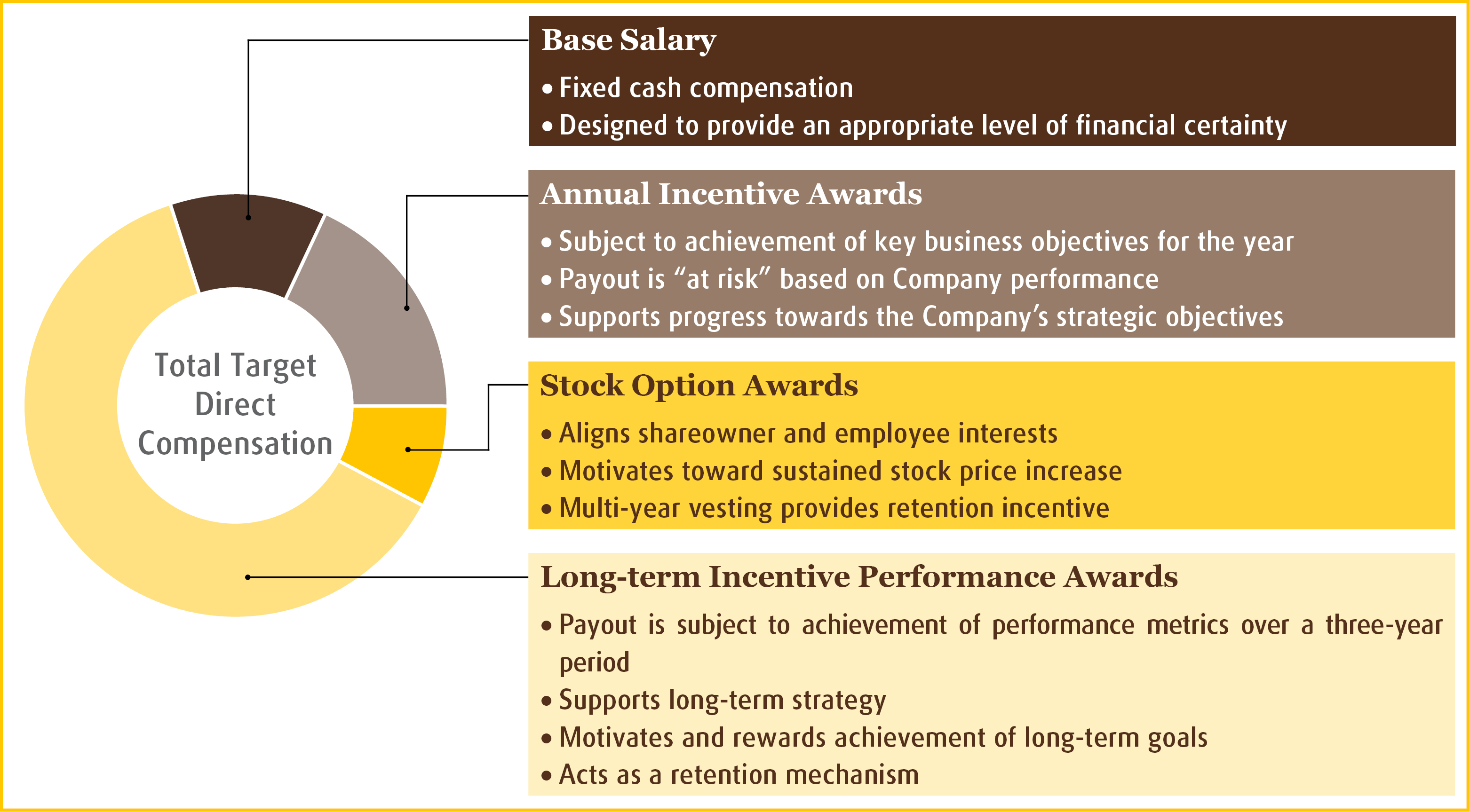
A significant portion of executive compensation is at-risk and tied to Company performance. This helps align executive decision-making with the long-term interests of our shareowners. Compensation practices that support these principles include:
•A balanced mix of cash and equity, providing retention benefits and appropriate incentives over multiple vesting periods;
•Performance based equity awards vesting over multiple years, furthering both retention and incentive goals;
•Periodic reviews of incentive compensation metrics to facilitate alignment with strategic initiatives;
•Multiple distinct goals for annual and long-term performance based awards, avoiding overemphasis on any one metric and mitigating excessive risk-taking;
•Payout structures for the annual Management Incentive Program (the “MIP”) that provide visibility and clarity to participants, and limit payout discretion;
•Long-term Incentive Performance (the “LTIP”) awards that vest over a three-year period;
•Stock option awards that vest over a five-year period and only provide value if our stock price increases;
•Clawback policy that applies to all executive officers;
•Awards that require a double trigger — both a change in control and a termination of employment or a failure to continue, assume or substitute the award — to accelerate vesting; and
•No tax gross-ups on equity awards or golden parachute excise taxes.
2025 Compensation Actions
Key 2025 compensation decisions affecting our executive officers included:
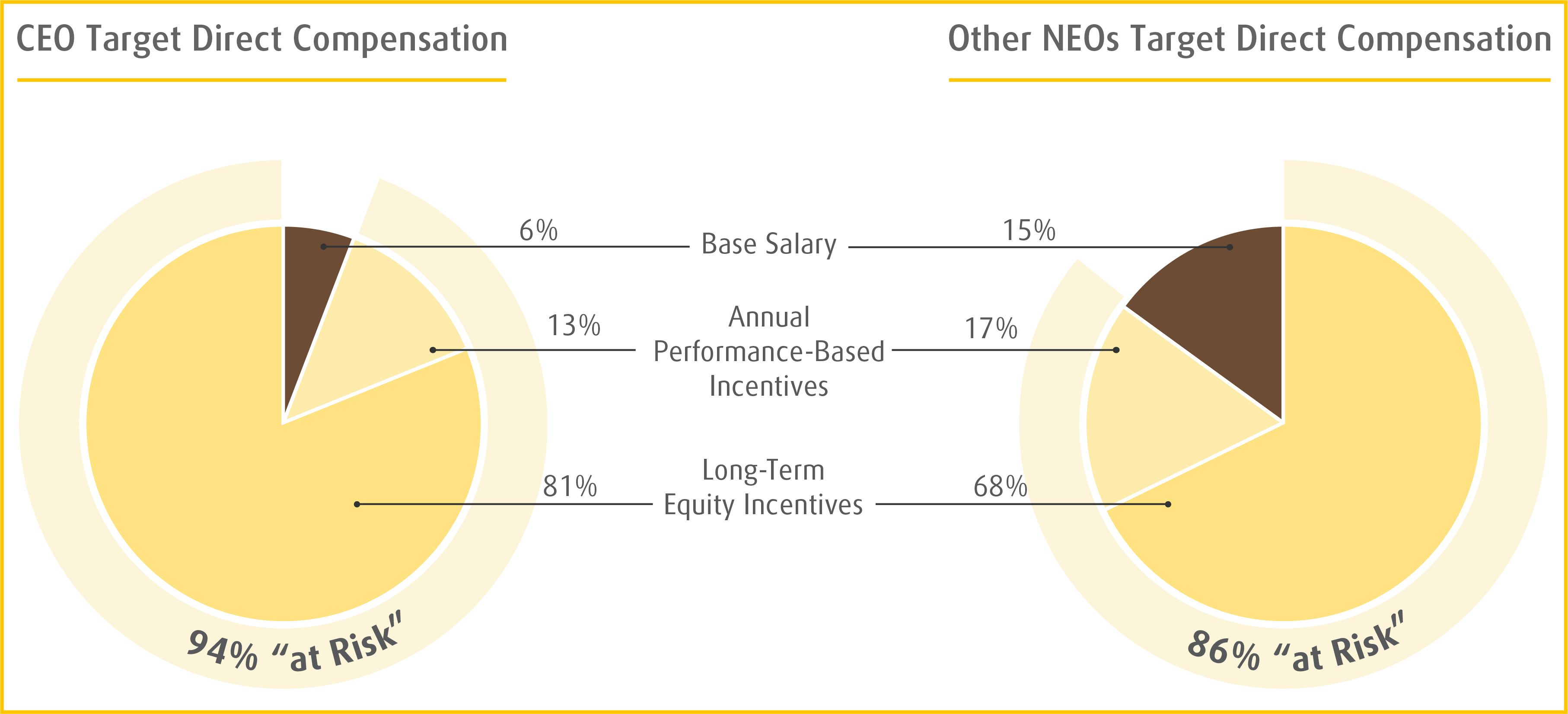
•Most target direct compensation was performance-based or considered “at risk” - 94% for the CEO and 86% for all other named executive officers (“NEOs”) as a group, page 41; •Base salary increases as a result of the annual salary review process, page 43; •Annual MIP awards were earned and paid below target, page 44; •Receipt of a Restricted Stock Unit grant, for executives other than the CEO, to assist in retaining and motivating leadership at a critical transition stage, page 48; and •2023 LTIP awards, which had three-year performance goals ending in 2025, were earned and paid below target, page 47. We maintain executive compensation programs that support the long-term interests of our shareowners. We provide shareowners the opportunity to vote annually, on an advisory basis, to approve the compensation of our Named Executive Officers (the “NEOs”), as described in the Compensation Discussion and Analysis section and in the compensation tables and accompanying narrative disclosure in this Proxy Statement. The board recommends you vote FOR the advisory vote to approve NEO compensation. For more information, see page 68. | | |
| 2026 Omnibus Incentive Compensation Plan |
Annual and long-term incentive compensation and equity compensation awards play an important part in our pay-for-performance philosophy. The ability to grant equity compensation awards also helps us remain competitive in retaining and attracting highly qualified employees upon whom the future growth and success of UPS depend. The 2026 Omnibus Incentive Compensation Plan (the “2026 Plan”) is intended to provide UPS flexibility to motivate, attract, and retain the services of employees and directors who are expected to make contributions to our success, and to allow our employees and directors to share in our success.
If the 2026 Plan is not approved, we do not expect to have sufficient share authorization to meet our anticipated long-term equity compensation needs under our existing equity compensation plan. If the 2026 Plan is not approved, we may be compelled to increase significantly the cash component of our employee and director compensation, which may not necessarily align employee and director compensation interests with the investment interests of our shareowners. Replacing equity awards with cash also would increase cash compensation expense and use cash that might be better utilized otherwise. The board recommends you vote FOR the 2026 Plan. For more information, see page 69. | | |
| Ratify the Appointment of the Independent Registered Public Accounting Firm |
The Audit Committee of the Board of Directors has appointed Deloitte & Touche LLP as our independent registered public accounting firm for the year ending December 31, 2026. The board recommends you vote FOR the ratification of the appointment of Deloitte & Touche LLP. For more information, see page 82. For the reasons described in this Proxy Statement, the board recommends you vote AGAINST the shareowner proposals. Information about these proposals starts on page 85. | | | | | | | | |
10 | | Notice of Annual Meeting of Shareowners and 2026 Proxy Statement |
The Board of Directors operates within a governance structure that promotes accountability and provides appropriate checks and balances to help create long-term value. The board’s responsibilities include:
•Establishing an appropriate corporate governance structure;
•Overseeing management’s development and progress towards long-term strategic goals and applicable measures of value-creation;
•Overseeing management’s identification and mitigation of material risks;
•Establishing an appropriate executive compensation structure; and
•Monitoring business issues that have the potential to significantly impact the Company’s long-term value.
We regularly review and update our corporate governance practices in response to the evolving needs of our business, shareowner feedback, regulatory changes and other corporate developments. Following is an overview of our corporate governance structure and processes, including key aspects of the board’s functions.
Selecting Director Nominees
Maintaining a board of individuals independent of management, with the appropriate skills and experience, and of the highest personal character, integrity and ethical standards, is critical to the proper functioning of the board. The Nominating and Corporate Governance Committee seeks to identify and nominate directors with an appropriate mix of relevant skills, experience, perspectives and backgrounds. Our directors’ biographies beginning on page 22 highlight factors that the board considered when nominating these individuals. | | | | | |
1. | Board Composition Review |
| | The board’s annual self-evaluation process helps the Nominating and Corporate Governance Committee assess areas where additional skills, experience, perspectives or backgrounds may be desired. The Nominating and Corporate Governance Committee also conducts regular board composition reviews. |
| |
| |
2. | Candidate Identification |
| | The Nominating and Corporate Governance Committee uses a variety of sources to identify potential candidates, including board members, members of management, independent consultants and shareowner recommendations. Prospective candidates are evaluated after taking into account feedback from consultants, management and board members, candidate background and qualification reviews, and open discussions between the Nominating and Corporate Governance Committee and the full board. This process allows for active consideration of potential directors with a focus on long-term Company strategy. |
| |
| |
3. | Shortlisted Candidates |
| | The Nominating and Corporate Governance Committee maintains a list of potential director candidates with desired skills, experiences and backgrounds. The list is reviewed at each Nominating and Corporate Governance Committee meeting and updated as appropriate. Each candidate is evaluated to help ensure that existing and planned future commitments would not materially interfere with expected board responsibilities. |
| |
| |
4. | Recommendation, Nomination and Election |
| | Candidates recommended by the Nominating and Corporate Governance Committee and approved by the board are nominated for election. Directors are elected annually. |
| |
| |
| Result: | Since 2020, seven new independent directors have been added, including two in 2025, and as of the Annual Meeting, seven directors will have left. |
| |
| | |
Shareowner Recommendations |
Shareowner recommended director candidates are considered on the same basis as recommendations from other sources. Shareowners can recommend a candidate by writing to the UPS Corporate Secretary, 55 Glenlake Parkway, N.E., Atlanta, Georgia 30328. Submissions must contain the prospective candidate’s name and a detailed description of the experience, qualifications, attributes and skills that make the individual a suitable director candidate.
Board Leadership Structure
Based on the periodic evaluation and recommendation of the Nominating and Corporate Governance Committee, the board determines the most appropriate board leadership structure, including who should serve as Board Chair, and whether the roles of Board Chair and CEO should be separated or combined. In making this determination, the board evaluates a number of factors, including professional experience, operational responsibilities and corporate governance developments.
In October 2020, in connection with Carol Tomé’s election as CEO, the board determined that it was in the best interests of the Company to separate the roles of Board Chair and CEO. Bill Johnson, who had been serving as our independent Lead Director, was appointed Board Chair.
Bill provides experienced leadership and significant value to the board. Bill has served on our board since 2009 and served as independent Lead Director from 2016 until October 2020. He has deep institutional knowledge of the Company and provides strong continuity of leadership. He devotes significant time to understanding our strategy and communicating with the CEO, and other directors, between meetings. He draws on his extensive knowledge of our business, industry, strategic priorities and competitive developments to set the board’s agendas in collaboration with the CEO, and he seeks to ensure that board meetings are productive and interactions with the directors facilitate a useful exchange of viewpoints. In light of the foregoing, the importance of management’s focus on the execution of the Company’s strategic priorities and the need for board leadership continuity during one of our most significant strategic shifts in Company history, in February 2026 as a part of our director nomination process, the board determined it was appropriate to grant Bill a waiver from the board’s mandatory retirement age of 75 so that he can continue to lead the board for an additional year.
Carol is available to all directors between meetings and meets regularly with the Board Chair, and with the directors individually and as a group, to receive feedback. Bill’s collaboration with Carol allows the board to focus attention on the issues of greatest importance to the Company and its shareowners and our CEO to focus primarily on leading the Company.
Furthermore, all the members of each of the Audit Committee, the Compensation and Human Capital Committee, the Nominating and Corporate Governance Committee and the Risk Committee are independent. Each committee is led by a chairperson who sets the meeting agendas and reports to the full board on the committee’s work. Additionally, the independent directors meet in executive session without management present at each regular board meeting, as described below.
Executive Sessions of Independent Directors
Directors hold executive sessions without management present at each regular board meeting. The Board Chair determines the agenda and presides at each session. The Board Chair generally invites the CEO to join a portion of the executive session to receive feedback and when deemed appropriate otherwise. Topics covered during executive sessions include succession planning, management performance, strategic planning, shareowner considerations, board agenda topics and meeting materials, and board performance. In addition, throughout the year the Board Chair meets individually with each director to discuss issues that are important to the board and to solicit and provide further feedback.
| | | | | | | | |
12 | | Notice of Annual Meeting of Shareowners and 2026 Proxy Statement |
Board and Committee Evaluations
The board’s effective performance of its oversight responsibilities is critical to our long-term success and the protection of stakeholders’ interests. The board employs both an ongoing informal and a formal annual process to evaluate its performance and the contributions of individual directors. The Board Chair frequently considers the performance of the board and the board’s committees and has informal discussions about individual director contributions to the board. The Board Chair shares feedback from these discussions with the full board and with individual board members. In addition, during 2025 the Board Chair met individually with each director to discuss overall board effectiveness and performance, individual director time commitments and potential 2026 board meeting agenda items.
| | |
Annual Evaluation Process |
| | | | | |
1. | Formal Annual Evaluation |
| The Board of Directors, Audit Committee, Compensation and Human Capital Committee, Nominating and Corporate Governance Committee, and Risk Committee each conduct an annual, formal self-assessment. The Nominating and Corporate Governance Committee oversees the annual board assessment process and the implementation of the annual committee self-assessments. |
| |
| |
2. | Use of Detailed Questionnaires |
| All board and committee members complete a detailed confidential questionnaire each year. The questionnaire provides for quantitative ratings in key areas, including overall board effectiveness, meeting effectiveness, access to information, information format, board committee structure, access to management, succession planning, meeting dialogue, communication with the CEO, operational reporting, financial oversight, capital structure and financing, capital spending, long-term strategic planning, risk oversight, crisis management and time management. In addition to responding to specific questions, directors are encouraged to provide additional written feedback and make detailed anonymous comments. We engage an independent third party to administer and prepare reports on the evaluations. |
| |
| |
3. | Reviews |
| The results of the committee self-assessments are reviewed by each committee and discussed with the full board. The Nominating and Corporate Governance Committee Chair reviews the results of committee self-assessments and discusses the responses with the chairs of the other board committees as appropriate. The Nominating and Corporate Governance Committee Chair also reviews and discusses the board evaluation results with the full board. |
| |
| |
4. | Follow-up |
| Matters requiring follow-up are addressed by the Nominating and Corporate Governance Committee Chair or the chairs of the other committees as appropriate. In addition, throughout the year the Board Chair meets individually with each director to discuss issues that are important to board members and to solicit further feedback. |
| |
| |
Result: | Feedback from these evaluations has led to several improvements in board functionality, including changes to the format and delivery of board meeting materials, board meeting agendas and recurring topics, strategic planning and oversight, director recruitment practices, orientation and education, engagement with management, board committee memberships, board committee charter changes, allocation of responsibilities among the board’s committees and succession planning. |
| |
Board Refreshment and Succession
| | | | | |
| |
8 years nominee average tenure |
Newer directors (< 5 years) | |
Medium-tenured directors (5-10 years) | |
Longer-tenured directors (> 10 years) | |
| |
The Nominating and Corporate Governance Committee regularly evaluates board composition and necessary skills as our business evolves over time. We seek a balance of knowledge and experience that comes from longer-term board service with new ideas and perspectives that can come from newer directors. Since 2020, we have added seven independent directors and, as of the Annual Meeting will have had seven directors leave the board. The average tenure of the director nominees reflects an appropriate balance between different perspectives brought by newer, medium and long-serving directors.
Board Oversight of Strategic Planning
The board’s responsibilities include oversight of strategic planning. Effective oversight requires a high level of constructive engagement between management and the board. The board leverages its substantial experience and expertise and is fully engaged in the Company’s strategic planning process. Management develops and prioritizes strategic plans on an annual basis. Management then reviews these plans with the board on an annual basis, along with the Company’s challenges, opportunities, industry dynamics, and legal, regulatory and governance developments and other significant strategic matters.
Management provides the board comprehensive updates throughout the year regarding progress on the Company’s strategic plans. Management also provides regular updates regarding the achievement of the Company’s financial and other goals. In addition, the CEO communicates regularly with the board on important business opportunities, financial and operational performance matters, risks and other developments such as sustainability, human capital, labor and customer relations, both during and outside the regular board meeting cycle.
Management Development and Succession Planning
Succession planning and talent development are important at all levels within our organization. The board oversees management’s emergency and long-term succession plans at the executive officer level, most importantly the CEO position. The board annually reviews succession plans for senior management including the CEO, all in the context of the Company’s overall business strategy and with a focus on risk management. More broadly, the board and the Compensation and Human Capital Committee are regularly updated on key talent indicators for the overall workforce, including workforce recruiting, retention and training and development programs.
The board’s succession planning activities are ongoing and strategic and are supported by board committees and independent third-party consultants. In addition, the CEO annually provides an assessment to the board of senior leaders and their potential to succeed at key senior management positions. As a part of this process, potential leaders interact with board members through formal presentations and during informal events.
We also utilize a formal director engagement program in which directors meet with individual executive officers, visit Company operations, participate in employee events and receive in-depth subject matter updates outside of the regular board meeting process. These engagements encourage the ongoing exchange of ideas and information between directors and management, facilitate the board’s oversight responsibilities, and support management development and succession planning efforts.
| | | | | | | | |
14 | | Notice of Annual Meeting of Shareowners and 2026 Proxy Statement |
Risk Oversight
Risk management oversight is an essential board responsibility. The board regularly discusses our most significant risks and how these risks are being managed. The Company’s enterprise risk management process is designed to identify potential events that may affect the achievement of the Company’s strategic objectives or have a material adverse effect on the Company. The board reviews periodic assessments from this process and participates in the Company’s annual enterprise risk evaluation process. The board has delegated to its standing committees specific risk oversight responsibilities as set out below and receives regular reports from the committees on appropriate areas of risk management. As a component thereof, the Company tracks and reports significant enterprise risks by the board and its committees.
| | | | | | | | | | | |
Risk
Committee | Audit
Committee | Compensation and Human Capital Committee | Nominating and Corporate Governance Committee |
| | | |
Oversees management’s identification and evaluation of enterprise risks, including risks associated with intellectual property, operations, privacy, technology, AI, cybersecurity and business continuity. | Oversees policies with respect to financial risk assessment, including guidelines to govern the process by which major financial and accounting risk assessment and management is undertaken. | Considers risks related to compensation policies and practices, with respect to both executive compensation and compensation generally, and considers other human capital risks. | Considers risks related to succession planning, political contributions and lobbying, environmental sustainability and stakeholder engagement matters, among others. |
| | | |
The Company’s Chief Legal and Compliance Officer (“CLO”), Chief Digital and Technology Officer (“CDTO”), Chief Information Security Officer (“CISO”), and Vice President of Compliance and Internal Audit each meet individually with the Risk Committee on a regular basis to discuss and address relevant matters. The Chair of the Risk Committee also meets frequently with the CDTO between meetings.
The Risk Committee updates the board annually on the results of Company’s enterprise risk management identification process and risk assessment results. The board provides feedback to the Company about significant enterprise risks and assesses the Company’s identification of its most significant risk areas. The Risk Committee also coordinates with the Audit Committee, including through regular joint meetings, to enable the Audit Committee to perform its risk-related responsibilities. The Risk Committee oversees the Company’s approach to cyber risk assessment and mitigation by, among other things:
•reviewing the Company’s cybersecurity insurance program;
•reviewing the Company’s cybersecurity budget;
•discussing the results of various internal cybersecurity audits and periodic independent third-party assessments of the Company’s cybersecurity programs;
•being briefed on cybersecurity matters by outside experts; and
•receiving regular updates from the CISO and others on cybersecurity risks, operational metrics, compliance and regulatory developments, training programs, risk mitigation activities, key projects and industry developments.
In 2025, the board delegated AI risk oversight responsibilities to the Risk Committee. The Audit Committee has additional risk assessment and risk oversight responsibilities, specifically with respect to financial risk assessment. The CEO, CFO, CLO and Vice President of Compliance and Internal Audit each meet individually with the Audit Committee on a regular basis.
In addition, the CLO reports directly to our CEO, providing visibility into the Company’s risk profile. The board believes that the work undertaken by its committees, together with the work of the full board and the Company’s senior management, enables effective oversight of the Company’s management of risk.
Stakeholder Engagement
Maintaining open and ongoing dialogs with key stakeholders is an important component of our corporate culture. Our management team participates in numerous investor meetings throughout the year to discuss our business, strategy and financial results. This includes in-person, telephone and webcast conferences, as well as key site visits.
In addition, we undertake an annual stakeholder outreach program to discuss progress on our environmental sustainability, human capital, executive compensation and governance initiatives. Company participants include representatives from Global Total Rewards, Human Resources, Sustainability, Legal and Investor Relations. This year we contacted holders of over 47% of our class B common stock as a part of this program. Engagement provides us with the opportunity to understand issues of significant importance to stakeholders and to receive feedback on our practices and disclosures. Similarly, it provides us with an opportunity to discuss how management believes its actions are aligned with long-term value creation.
We also proactively correspond with other key stakeholders throughout the year. We share feedback from our engagements with the board, the Compensation and Human Capital Committee, and the Nominating and Corporate Governance Committee as appropriate.
| | | | | | | | |
| | |
| | |
| | |
We consider the views of our shareowners and other stakeholders when evaluating our policies and practices; for example, in recent years we have: | | The Compensation and Human Capital Committee considers shareowner feedback, along with the market information and analysis provided by its independent compensation consultant, when making decisions about our executive compensation programs. In recent years we have: |
| | |
| | |
•Accelerated and increased our environmental sustainability reporting; •Increased disclosures around individual director skills, experience and backgrounds; •Separated the Board Chair and CEO roles, and appointed an independent Board Chair; •Increased disclosures around employee mental health and training; •Expanded reporting on lobbying activities; •Revised the Risk Committee charter to include cybersecurity and AI risk oversight responsibilities; •Revised the Nominating and Corporate Governance Committee charter to include oversight of environmental sustainability matters and risks; and •Revised the Compensation and Human Capital Committee charter to include oversight of performance and talent management, culture and development, and workforce retention. | | •Updated the peer group for executive and director compensation market comparisons; •Returned to a single, annual goal setting process for MIP awards; •Began a reevaluation of performance metrics under our incentive compensation plans to align with long-term value creation; •Adopted MIP payout tables, increasing clarity for participants and limiting payout discretion; •Added relative total shareowner return as a component of our LTIP program; •Added an individual payout cap to the MIP; •Provided additional disclosures around the performance measures used for the MIP and LTIP plans; •Adopted a mandatory incentive compensation clawback policy applicable to executive officers; and •Eliminated single-trigger equity vesting following a change in control. |
| | |
| | | | | | | | |
16 | | Notice of Annual Meeting of Shareowners and 2026 Proxy Statement |
Political Engagement
Responsible participation in the political process is important to our success and the protection and creation of shareowner value. We participate in this process in accordance with good corporate governance practices. Our Political Engagement Policy (the “policy”) is summarized below and is available at www.investors.ups.com. As a component of our ongoing governance evaluation process, we recently expanded our reporting around lobbying and trade association memberships.
•The Nominating and Corporate Governance Committee oversees the policy;
•Corporate political contributions are restricted; and
•We publish semi-annual political engagement reports, described below.
Political contributions are made in a legal, ethical and transparent manner that best represents the interests of our stakeholders. Political and lobbying activities require prior approval of the UPS Public Affairs department and are subject to review (and in some cases prior approval) by the Nominating and Corporate Governance Committee.
Senior management works with the Public Affairs department on furthering our business objectives and protecting and enhancing shareowner value. The CLO reviews political and lobbying activities and regularly reports to the board and the Nominating and Corporate Governance Committee on these activities.
The Public Affairs department coordinates the Company’s lobbying activities, including engagements with federal, state, and local governments. UPS is also a member of a variety of trade associations that engage in lobbying. Lobbying activities require prior approval of the Public Affairs department.
The Nominating and Corporate Governance Committee regularly reviews UPS’s participation in trade associations that engage in lobbying to determine if our involvement is consistent with UPS business objectives and whether participation exposes the Company to excessive risk.
Lobbying activities are governed by comprehensive policies and practices designed to facilitate compliance with laws and regulations, including those relating to the lobbying of government officials, the duty to track and report lobbying activities, and the obligation to treat lobbying costs and expenses as nondeductible for tax purposes.
| | |
| Political Activity Transparency |
We publish semi-annual political engagement reports, which are reviewed and approved by the Nominating and Corporate Governance Committee. The reports provide:
•Amounts and recipients of any federal or state Company political contributions in the U.S. (if any such expenditures are made);
•The names of trade associations that received $50,000 or more in membership dues from UPS that use a portion of the payment for political contributions; and
•The names of trade associations, or other organizations that draft model legislation, that received $25,000 or more in membership dues from UPS, and the percentage of dues used for lobbying purposes.
Our most recent report is available on our Investor Relations website at www.investors.ups.com. We also publicly file a federal Lobbying Disclosure Act Report each quarter, providing information on activities associated with influencing legislation through communications with any member or employee of a legislative body, or with any covered executive branch official. This report discloses expenditures for the quarter, describes the specific pieces of legislation that were the topic of communications, and identifies the individuals who lobbied on behalf of UPS. We file similar publicly available periodic reports with state agencies reflecting state lobbying activities.
Sustainability
We are a global package delivery and logistics provider. We offer a broad range of industry-leading products and services through our extensive global presence, serving over 200 countries and territories. In 2025, we delivered an average of 20.8 million packages per day, totaling 5.2 billion packages during the year.
The board considers key sustainability risks and opportunities as part of its involvement in and oversight of UPS’s strategic planning. In executing its responsibilities, the board has delegated consideration of environmental sustainability matters to the Nominating and Corporate Governance Committee. The Nominating and Corporate Governance Committee monitors the development, implementation, and progress of the Company’s environmental sustainability goals and regularly reports on those matters to the board.
Authority for day-to-day management of sustainability matters has been delegated to management. Our Chief Sustainability Officer regularly reports to the Company’s CEO and the Nominating and Corporate Governance Committee regarding sustainability strategies, priorities, goals and performance. In addition, the board is regularly briefed on issues of concern for customers, unions, employees, retirees, investors, governmental entities and other stakeholders. For additional information on board risk oversight, see page 15. UPS provides comprehensive and transparent environmental sustainability reporting. We have published environmental sustainability-related disclosures showcasing our efforts and considerations around our investors, our customers, our employees and the communities in which we operate since our first Corporate Sustainability Report in 2003. These include disclosures under the Global Reporting Initiative (“GRI”) and the CDP (formerly the Carbon Disclosure Project) frameworks, as well as an annual Social Impact Report which highlights our efforts to empower resilient, just and safe communities. These reports, and other environmental sustainability highlights, are available on our Investor Relations website at www.investors.ups.com. The GRI report describes our guiding principles and our strategy to achieve our decarbonization plans. It also includes details on how we intend to achieve our decarbonization goals, recent progress and risks and related mitigation efforts. The Company engages an independent third party that provides assurance on the GRI report. Additional material environmental sustainability related issues, including capital expenditures, are disclosed and described in our periodic filings with the SEC.
Our ability to meet our environmental sustainability goals will depend in part on significant technological advancements, many of which are outside of our control. This includes the development and availability of reliable, affordable and low emission energy solutions, including sustainable aviation fuel and alternative fuel and battery electric vehicles. There can be no assurances that our goals and strategic plans to achieve those goals will be successful, that the related costs will not be higher than expected, that the necessary technological advancements will occur in the timeframe we expect, or at all, that the severity of and or the pace of negative climate-related effects will not accelerate faster than expected, or that proposed regulation or deregulation related to climate change will not have a negative competitive impact, any one of which could have a material adverse effect on our capital expenditures or other expenses, revenue or results of operations.
Moreover, we may determine that it is in our best interests to prioritize other business, social, governance or sustainable investments over the achievement of our goals based on economic, regulatory or social factors, business strategy or other factors. If we do not meet these goals or there is perception that we failed to meet these goals, then, in addition to regulatory and legal risks related to compliance, we could incur adverse publicity and reaction, which could adversely impact our reputation, and in turn adversely impact our results of operations.
Human Capital Management
Our success is dependent upon our people, working together with a shared purpose. As we seek to capture new opportunities and pursue growth, we are focused on maintaining the culture we have cultivated over our nearly 119-year history and incorporating the new perspectives we need to take the business into the future. To assist with employee recruitment and retention, we continuously review the competitiveness of our employee value proposition, including pay, physical- and mental-health benefits, training, talent development and advancement opportunities.
Additional detailed information on human capital management matters is contained in our Annual Report on Form 10-K for the year ended December 31, 2025, filed with the SEC, and is contained in our GRI report, each of which is available on our Investor Relations website at www.investors.ups.com.
| | | | | | | | |
18 | | Notice of Annual Meeting of Shareowners and 2026 Proxy Statement |
Our board, directly and through the Compensation and Human Capital Committee, is responsible for oversight of human capital matters. Effective oversight is accomplished through a variety of methods and processes including regular updates and discussions around human capital, compensation and benefits, technology initiatives impacting the workforce, physical- and mental health and safety matters, employee survey results, hiring and retention, employee demographics, labor relations and contract negotiations, succession planning and employee training initiatives.
In addition, the Compensation and Human Capital Committee charter includes oversight responsibility for performance and talent management, workplace culture and employee development and retention. We believe the board’s oversight of these matters helps identify and mitigate exposure to labor and human capital management risks, and is part of the broader framework that guides how we attract, retain and develop a workforce that aligns with our values and strategies.
We seek to offer competitive compensation and benefits as part of our overall employee value proposition. In addition, our long history of employee stock ownership aligns the interests of our management team with shareowners. In the U.S., benefits available to our non-union employees include: comprehensive health insurance coverage; life insurance; short- and long-term disability coverage; paid caregiver leave; child/elder care spending accounts; work-life balance programs; an employee assistance program; and a discounted employee stock purchase plan. We invest in our people by offering a range of other benefits, such as paid time off, retirement plans, and education assistance. In the U.S., these other benefits are generally provided to non-union employees without regard to full-time or part-time status.
| | |
Employee Health and Safety |
Our Comprehensive Health and Safety Process (“CHSP”) is the foundation of our proactive risk management approach. This approach includes physical safety and mental health considerations, spans job functions from package handling to management roles, and is applied across all environments worldwide, from package sorting facilities to our executive offices. Through the CHSP, we seek to systematically identify, evaluate, and mitigate health and safety risks in a number of ways. For example, we use internal safety committees to identify and mitigate hazards in the workplace, and we routinely audit critical risk areas such as equipment integrity, environmental conditions and emergency preparedness. We support employee health and well-being through various programs, including our “Industrial Athlete” program, which focuses on physical conditioning, nutrition and fatigue management in addition to providing extensive programming and training designed to reduce stress-related risks, strengthen resilience, and support employees’ mental health. Other programs include affinity-based business resource groups, opportunities to provide feedback through confidential employee surveys, and access to confidential counseling. We provide extensive training in safe work methods, risk identification and resource availability, all designed to mitigate risk.
We monitor our health and safety performance against established metrics, including recordable injury frequency, lost-time injury frequency, and the number of reported vehicular incidents alongside a range of predictive indicators. These measures provide visibility into emerging trends and facilitate continuous improvement across the enterprise.
Majority Voting and Director Resignation Policy
Our Bylaws provide for majority voting in uncontested director elections. The number of votes cast for a nominee must exceed the number of votes cast against that person. Any incumbent director who does not receive a majority of the votes cast must offer to resign from the board.
In such an event, the Nominating and Corporate Governance Committee will recommend to the board whether to accept or reject the director’s offer to resign after considering all relevant factors. The board will act on the recommendation within 90 days following certification of the election results after considering all relevant information.
Any director who offers to resign must recuse himself or herself from the board vote, unless the number of independent directors who were successful incumbents is fewer than three. The board will promptly disclose its decision regarding any director’s offer to resign, including its reasoning. If the board determines to accept a director’s offer to resign, the Nominating and Corporate Governance Committee will recommend whether and when to fill such vacancy or reduce the size of the board.
Board Meetings and Attendance
The board held six meetings during 2025. Also during 2025, the Audit Committee met nine times, the Compensation and Human Capital Committee met four times, the Nominating and Corporate Governance Committee met five times and the Risk Committee met four times (including a joint meeting with the Audit Committee). Prior to meetings, the Board Chair and the committee chairs work with management to determine and prepare agendas for the meetings. Board meetings generally occur over two days. Board committees meet on the first day, followed by the beginning of the board meeting. The second day typically consists of reports from each committee chair to the full board, additional presentations by internal business leaders or others with expertise in various subject matters, and an executive session consisting of only independent board members.
All directors attended at least 75% of the total number of board and any committee meetings of which he or she was a member in 2025. Our directors are expected to attend each annual shareowner meeting, and all individuals who were then members of the board attended the 2025 Annual Meeting. The independent directors met in executive session at all regular board meetings held in 2025.
Code of Conduct and Ethics
We are committed to conducting our business in accordance with the highest ethical principles. Our Code of Conduct and Ethics is applicable to anyone who represents UPS, including our directors, executive officers and all other employees and agents of UPS. A copy of our Code of Conduct and Ethics is available on our Investor Relations website at www.investors.ups.com.
Conflicts of Interest and Related Person Transactions
Our Audit Committee is responsible for overseeing our Code of Conduct and Ethics, which includes policies regarding conflicts of interest. The Code requires employees and directors to avoid conflicts of interest, defined as situations where the person’s private interests conflict, or may appear to conflict, with the interests of UPS.
We maintain a written related person transactions policy that applies to any transaction or series of transactions in which: (1) the Company or any of its subsidiaries is a participant; (2) any “related person” (executive officer, director, greater than 5% beneficial owner of the Company’s common stock, or an immediate family member of any of the foregoing) has or will have a material direct or indirect interest; and (3) the aggregate amount involved since the beginning of the Company’s last completed fiscal year will exceed or may reasonably be expected to exceed $100,000. The policy provides that related person transactions that may arise during the year are subject to the Audit Committee’s reasonable prior approval. If advance approval of a related person transaction is not possible, then the transaction will be considered and, if deemed appropriate, ratified no later than the Audit Committee’s next regularly scheduled meeting. In determining whether to approve or ratify a transaction, the Audit Committee will consider, among other factors it deems appropriate, whether the transaction is on terms no less favorable than terms generally available to an unaffiliated third party under the same or similar circumstance, the extent of the related person’s interest in the transaction, whether the transaction would impair independence of a non-employee director and whether there is a business reason for UPS to enter into the transaction. A copy of the policy is available on our Investor Relations website at www.investors.ups.com. There were no related person transactions from January 1, 2025 through the date of this Proxy Statement required to be disclosed pursuant to Item 404(a) of Regulation S-K.
| | | | | | | | |
20 | | Notice of Annual Meeting of Shareowners and 2026 Proxy Statement |
At least annually, each director and executive officer completes a questionnaire in which they are required to disclose any business relationships that may give rise to a conflict of interest, including transactions in which UPS is involved and where an executive officer, a director or a related person has a direct or indirect material interest. We also review the Company’s financial systems and any related person transactions to identify potential conflicts of interest. We have immaterial ordinary course of business transactions and relationships with companies with which our directors are associated. These transactions and relationships were entered into on terms that are both reasonable and competitive. Additional transactions and relationships of this nature may be expected to take place in the ordinary course of business in the future.
Transactions in Company Stock
We prohibit our executive officers and directors from hedging or pledging their ownership in UPS stock. Specifically, they are prohibited from purchasing or selling derivative securities relating to UPS stock and from purchasing financial instruments that are designed to hedge or offset any decrease in the market value of UPS securities. Furthermore, our employees, officers and directors are prohibited from engaging in short sales of UPS stock.
Insider Trading Policy
We have adopted policies and procedures governing the purchase, sale, and other dispositions of the Company’s securities by directors, officers and employees. These procedures are reasonably designed to promote compliance with insider trading laws, rules, and regulations, and New York Stock Exchange listing standards. A copy of our Insider Trading Policy has been filed as Exhibit 19 to our Annual Report on Form 10-K for the year ended December 31, 2025, which has been filed with the SEC and is available on our Investor Relations website at www.investors.ups.com.
Corporate Governance Guidelines and Committee Charters
Our Corporate Governance Guidelines and the charters for each of the board’s committees are available on our Investor Relations website at www.investors.ups.com. Each committee reviews its charter annually. In addition, the Nominating and Corporate Governance Committee reviews our Corporate Governance Guidelines annually and recommends any changes to the board for approval. When amending our committee charters or Corporate Governance Guidelines, we consider current governance trends and best practices, changes in regulatory requirements, advice from outside sources and input from stakeholders.
Communicating with the Board of Directors
Shareowners and other interested parties may communicate directly with the board, with the non-management directors as a group, or with any specific director, by writing to the UPS Corporate Secretary, 55 Glenlake Parkway, N.E., Atlanta, Georgia 30328. Please specify to whom your letter should be directed. After review by the Corporate Secretary, appropriate communications will be forwarded to the addressee. Advertisements, solicitations for business, requests for employment, requests for contributions, matters that may be better addressed by management or other inappropriate materials will not be forwarded.
Proposal 1 — Director Elections
| | |
|
What am I voting on? Election of each of the 12 named director nominees to hold office until the 2027 Annual Meeting and until their respective successors are elected and qualified. Board Recommendation: Vote FOR the election of each nominee. Vote Required: A director will be elected if the number of votes cast for that director exceeds the number of votes cast against that director. |
|
The board has nominated the individuals named below for election as directors at the Annual Meeting. Kate Johnson, who has served as a director since 2020, has not been nominated for re-election at the Annual Meeting. She will depart the Board following the Annual Meeting to focus on her other professional responsibilities. Effective as of the Annual Meeting, the size of the board will be reduced to 12 directors. We thank Kate for her service and her significant contributions to UPS. On January 30, 2026, the President of the United States announced his intent to nominate Kevin Warsh to serve as Chairman of the Board of Governors of the United States Federal Reserve System, subject to confirmation by the United States Senate. Kevin has advised us that if he is confirmed to that position he will resign from the board.
All nominees, other than John Morikis, were elected by shareowners at our last Annual Meeting. John was identified as a director candidate by a third-party search and recruitment consultant. Except as described above, if elected, all nominees are expected to serve until the next Annual Meeting and until their respective successors are elected and qualified. If any nominee is unable to serve as a director, the board may reduce the number of directors that serve on the board or choose a substitute nominee. Any nominee who is currently a director, and for whom more votes are cast against than are cast for, must offer to resign from the board.
As a group, our director nominees, all of whom are currently directors, effectively oversee and constructively challenge management’s performance in the execution of our strategy. Our directors’ broad professional skills and experiences contribute to a wide range of perspectives in the boardroom. The Nominating and Corporate Governance Committee regularly assesses the skills and experience necessary for our board to function effectively and considers where additional expertise may be needed.
Overall board mix with respect to skills, experience, perspectives and backgrounds is a key consideration when identifying and recommending director nominees. While we do not have a formal policy on board diversity, our Corporate Governance Guidelines emphasize an appropriate range of skills, experience, perspectives and backgrounds relevant to the Company’s business. The Nominating and Corporate Governance Committee considers all relevant factors in recruitment and nominations of director candidates.
Our Corporate Governance Guidelines provide that an individual should not be eligible for nomination or election as a director of the Company after he or she reaches the age of 75 (the “retirement age requirement”). For the reasons described under “Board Leadership Structure” above, the board (other than Bill) determined it was in the best interests of the Company and its shareowners to grant Bill a one-year waiver from the retirement age requirement.
Biographical information about the director nominees appears below, including information about the experience, qualifications, attributes, and skills considered by our Nominating and Corporate Governance Committee and board in determining that the nominee should serve as a director. For additional information about how we identify and evaluate nominees for director, see page 11. | | | | | | | | |
22 | | Notice of Annual Meeting of Shareowners and 2026 Proxy Statement |
Director Nominee Skills and Experience
| | | | | | | | | | | | | | | | | | | | | | | | | | | | | | | | | | | | | | |
Skills and Experience / Attributes | | | | | | | | | | | | |
| CEO | | | l | l | l | l | | l | | | l | |
| CFO | | l | l | | | | | | | | l | |
| Consumer / Retail | | l | | | | l | l | l | l | | l | |
| Digital Technology | l | | | | | | | | l | | l | |
| Geopolitical Risk | | | | | | l | l | | | | | l |
| Global / International | | | l | l | l | l | l | l | l | l | | l |
| Healthcare | | l | l | l | l | | | | | | | |
Human Capital Management | | | | l | l | l | | | | l | l | |
| Operational | l | | l | l | l | l | l | l | l | l | | |
Risk / Compliance / Government | l | l | | l | l | | | | | l | l | l |
| Sales / Marketing | | | | | l | l | l | | l | l | | |
Small and Medium- Sized Businesses | | l | | l | l | l | | | | l | | |
Supply Chain Management | l | | l | l | l | l | l | | l | | | |
Technology / Technology Strategy | l | | l | l | | | | l | | l | | |
Other Public Company Board Service | l | | l | l | | l | l | l | l | | l | l |
Director Nominee Biographical Information
| | | | | | | | |
| | |
| Reasons for Nomination Rod brings deep expertise in technologies, business operations and supply chain management to the board. He previously led corporate strategy and systems and technology groups at IBM, where he guided that company through continuous transformation and developed strategies for leadership in evolving computing capabilities, new markets and new client segments, delivering significant shareholder value. Inducted into the National Academy of Engineering, he was recognized by the National Society of Black Engineers for Lifetime Achievement in Industry. Select Skills and Experiences •Operational: Rod led global teams and managed a multi billion-dollar product development and manufacturing business division at IBM, overseeing the highly complex product lifecycle from concept and testing to commercialization. He drove efficient supply chain management, built high-performing teams and delivered high-quality products across global markets. •Risk / Compliance / Government: Throughout his 30-year career at IBM, Rod was responsible for overseeing the integration of regulatory compliance and risk management into new product and service offerings development, facilitating robust intellectual property protection, adherence to export controls, consumer safety and the ethical use of emerging technologies. •Technology / Technology Strategy: Rod oversaw the creation of a wide portfolio of industry-transforming personal computing products, including the launch of mobile computing technologies and other products. He also led IBM’s POWER business and delivered market leadership for UNIX, pioneering what became IBM’s portfolio of IoT solutions. | Professional Highlights 3RAM Group LLC, a capital investment, business consulting and property management services •President (since 2015) International Business Machines (IBM), a global technology products and services company •SVP, Corporate Strategy (2013-2014), Systems and Technology Group (2009-2013), Development & Manufacturing (2007-2009) •VP, Development, IBM Systems and Technology Group (2003-2007) •Several operational and executive roles spanning strategy, technology, systems and supply chain (1981-2003) Education •B.A., Physics, Rollins College •B.S. and M.S., Electrical Engineering, Georgia Institute of Technology |
Rodney Adkins Independent Director Director Since: 2013 Age: 67 Board Committees •Risk (Chair) •Compensation and Human Capital •Executive Public Board Directorships •Avnet, Inc. (since 2015) •PayPal Holdings, Inc. (2017 - 2024) •W.W. Grainger, Inc. (since 2014) |
| | |
| | | | | | | | |
24 | | Notice of Annual Meeting of Shareowners and 2026 Proxy Statement |
| | | | | | | | |
| | |
| Reasons for Nomination Eva brings extensive corporate finance experience to the board, gained throughout her career as CFO at multiple public companies, including in the healthcare and retail sectors, with complex operations and large workforces. She has deep knowledge of financial reporting and accounting standards, organic and inorganic growth strategies and digital transformation. Her strong track record of creating shareholder value and building strong partnerships enhances the board’s oversight of growth initiatives, compliance and financial risk management. Select Skills and Experiences •Financial Expertise: Eva has over three decades of experience in corporate finance roles, overseeing all aspects of corporate financial strategy and operations, including financial reporting, investor relations, capital strategies and procurement. While at CVS, she led the integration of the finance function following the acquisition of Aetna in 2018, unlocking synergies and positioning the company to realize growth. •Consumer / Retail: At Bath & Body Works, Eva plays a key role in shaping the company’s financial strategy. She has led efforts to elevate and reposition the brand as the company optimizes its store footprint and invests in digital capabilities. Eva helped drive the company’s profitable growth, reduce costs and strategically allocate capital as the company executed its omnichannel strategy in a challenging retail environment. •Risk / Compliance / Governance: Throughout her career, Eva has played an instrumental role at leading public companies, overseeing operational and financial risk management, as well as compliance with tax and industry regulations. She has led the implementation of risk mitigation strategies to address both short-and long-term challenges, along with the adoption of robust internal controls and compliance frameworks. | Professional Highlights Bath & Body Works, Inc., a global personal care and home fragrance retailer •CFO (since 2023) Opentrons Labworks, Inc., a life sciences company •CFO (2022-2023) CVS Health Corporation, a diversified health services company •EVP and CFO (2018-2021) •EVP, Controller and Chief Accounting Officer (2013-2018) •SVP and CFO, Pharmacy Services Segment (Caremark) (2010-2013) Merck & Co., a global science and technology company •VP U.S. Market Finance Leader (2009-2010) •VP Investor Relations (2008-2009) •Global Pharmaceuticals VP & Controller (2006-2008) •Additional roles of increasing responsibility (1990-2006) Education •B.S., Accounting and Economics, Rutgers University •MBA, Drexel University |
Eva Boratto Independent Director Director Since: 2020 Age: 59 Board Committees •Audit (Chair) |
| | |
| | | | | | | | |
| | |
| Reasons for Nomination Kevin is a highly accomplished leader of complex, global organizations with a record of driving shareholder value through operating excellence, transformative change, and innovation aligned with dynamic landscapes and customers’ critical needs. Under his guidance, Aptiv evolved from an automotive components supplier into a premier full-systems solutions partner serving automotive, commercial vehicle, aerospace and defense, telecommunications and industrial markets around the world. Select Skills and Experiences •Technology / Technology Strategy: As CEO of Aptiv, Kevin led its transformation into a global technology company focused on advancing the future of mobility and positioned to capitalize on key megatrends, including electrification, digitization, artificial intelligence and automation. In addition, as CFO of Fisher Scientific, he guided the creation of a complete portfolio of products, services and solutions for health science research, discovery and diagnostics organizations worldwide. •CFO / Finance: Kevin is an experienced operationally-focused finance executive with expertise in the industrial and healthcare sectors and a track record of driving profitable growth through disciplined risk management, operating efficiency and cost rationalization initiatives, as well as capital allocation strategies that include organic investments and M&A. His various CFO leadership has included overseeing two IPOs and multiple M&A transactions, including the completion of a $10 billion merger. •Supply Chain Management: In his executive roles, Kevin has developed manufacturing and distribution effectiveness and efficiency plans for global enterprises serving more than 150 countries across six continents. His track record includes navigating supply chain disruptions caused by the COVID-19 pandemic and mitigating other macroeconomic and geopolitical risks. At Delphi and Aptiv, he transformed the manufacturing footprint through modernization and automation, enhancing operational resiliency and unlocking efficiencies. | Professional Highlights Aptiv PLC, a global full-system architecture and software solutions provider •Chairman and CEO (since 2022) •President and CEO (2017-2022) Delphi Automotive, global supplier of technologies for the automotive and commercial vehicle markets (Aptiv predecessor) •President and CEO (2015-2017) •EVP and COO (2014-2015) •EVP and CFO (2010-2014) Liberty Lane Partners, a private equity investment firm •Founding Partner (2007-2010) Fisher Scientific International, Inc., a global manufacturer and distributor of products and solutions for scientific research and healthcare related companies •VP and CFO (2001-2006) Education •B.S., Finance Administration, Michigan State University •MBA, Michigan State University |
Kevin Clark Independent Director Director Since: 2025 Age: 63 Board Committees •Audit Public Board Directorships •Aptiv (since 2015) |
| | |
| | | | | | | | |
26 | | Notice of Annual Meeting of Shareowners and 2026 Proxy Statement |
| | | | | | | | |
| | |
| Reasons for Nomination Wayne brings extensive experience in global operations, finance, capital markets and packaging solutions, acquired through his senior executive leadership roles across the U.S., Europe, Latin America and the Asia-Pacific region. He has a proven track record of executing company-wide initiatives across large organizations, negotiating M&A transactions, developing proprietary products, optimizing supply chains and applying emerging technologies to introduce new products and services. Select Skills and Experiences •Small and Medium-Sized Businesses: Wayne’s corporate leadership experience across a range of small-, mid- and large-cap companies, along with his current work with the Permira executive team to drive growth and long-term value creation across the fund’s portfolio companies, provides him with deep insights into the expectations of a broad range of customers. •Supply Chain Management: Among his various roles at GE, Wayne oversaw supply chain and operations. He launched and led the company-wide Operations Council, which served as GE’s center of excellence for supply chain optimization, delivering enhancements for on-time delivery, quality and environment, and health and safety. •International: Wayne has been CEO of companies headquartered in Japan, Ireland and Germany and has led M&A deals in several emerging markets. He has personally lived in Jamaica, China and Japan. •Technology / Technology Strategy: While at GE, Wayne shifted the products portfolio to better serve differentiated customer needs, increasing profit and driving growth in emerging markets. | Professional Highlights Permira, a global private equity firm •Senior Advisor (since 2018) Klöckner Pentaplast Group, a packaging supplier •CEO and Board Member (2015-2017) Platform Specialty Products Corporation, a global producer of high technology specialty chemical products •President and Board Member (2015) Arysta LifeScience Corporation, a crop protection and life science company •President, CEO and Board Member (2010-2015) General Electric Company (“GE”), a global industrial company •VP, Supply Chain and Operations (2007-2010) •President and CEO, GE Advanced Materials (2005-2006), GE Silicones (2003-2005) •President, GE Plastics Pacific (2001-2003) •President and CEO, GE Toshiba Silicones (2000-2001) •Additional roles of increasing responsibilities (1986-2000) Education •B.S. and M.S., Industrial Engineering, Stanford University |
Wayne Hewett Independent Director Director Since: 2020 Age: 61 Board Committees •Audit Public Board Directorships •Home Depot, Inc. (since 2014) •Wells Fargo & Company (since 2019) •Resolute Holdings (since 2025) Other Notable Affiliations •Hexion Chemicals (Lead Director since 2023) •Cambrex Corporation (Non-Executive Chairman since 2020) •Quotient Sciences (Non-Executive Chairman since 2023) |
| | |
| | | | | | | | |
| | |
| Reasons for Nomination Angela is an experienced senior executive in the healthcare sector, with nearly three decades of experience managing complex businesses with a focus on research and development, commercial sales, supply chain and distribution logistics. She brings deep expertise in navigating M&A, post-acquisition integrations and leading operations in domestic, international and emerging markets. Angela’s experience provides critical contributions to board oversight of our global business operations and deepens the understanding of the evolving expectations of our healthcare clients. Further, her multiple roles in leading business and commercial operations, including oversight of business financials, brings an important lens to the board and the Audit Committee. Select Skills and Experiences •Global / International: As Chief Commercial Officer for a global biopharmaceuticals business at Pfizer, Angela led operations across 185 countries, with oversight responsibilities for the distribution of over 600 medicines that reached more than 1.3 billion people globally. In this role, she built and expanded collaborations with health insurers, governments, policymakers, and global health stakeholders to advance medicines accessibility. •Healthcare: Angela played a critical role in the launch of the first COVID-19 vaccine and the first oral antiviral treatment a year later, securing rapid expansion of temperature-sensitive and time-critical distribution logistics. Through her extensive experience working across different segments of the healthcare industry, including biotechnology, she developed deep insights into fast-paced pharmaceutical innovation, enhancing the board’s oversight of our complex healthcare logistics services globally. •Sales / Marketing: In her role as Chief Commercial Officer at Pfizer, she led global sales and marketing teams, overseeing marketing strategies and building multiple partnerships to grow and expand product portfolio. | Professional Highlights Flagship Pioneering, a bioplatform innovation company •CEO-Partner (since 2025) •CEO, Metaphore Biotechnologies (Flagship-founded biotechnology company) (since 2025) Pfizer, Inc., a multinational pharmaceutical and biotechnology company •Chief Commercial Officer, President, Global Biopharmaceuticals Business (2019-2023) •Group President, Essential Health (2018) •Global President, Inflammation and Immunology (2015-2017) •Regional President, Vaccines US (2014-2015) •VP, Primary Care, Emerging Markets (2011-2013) •VP, Established Products US (2008-2011) •Additional roles of increasing responsibility (1997-2008) Education •B.S., Microbiology, University of Cape Town •MBA, Cornell University, Johnson School of Management |
Angela Hwang Independent Director Director Since: 2020 Age: 60 Board Committees •Audit Other Notable Affiliations •Connecticut Innovations (Board Member) •Cornell University Johnson School of Management (Advisory Council) |
| | |
| | | | | | | | |
28 | | Notice of Annual Meeting of Shareowners and 2026 Proxy Statement |
| | | | | | | | |
| | |
| Reasons for Nomination Bill brings over 30 years of executive leadership experience, along with expertise in complex global business operations and logistics, investment and risk management strategies and labor relations. His track record of successfully leading brand development and deep insights into the retail and consumer industries provide invaluable contributions to the board’s oversight of our strategy and risk management. Building on his extensive public company board experience, Bill has held several leadership roles on our board, developing a deep understanding of our strategy, culture, and operations to support informed decision-making and organizational resilience. His experience in leading boards has been invaluable. Select Skills and Experiences •Consumer / Retail: Through his career-long experience at Heinz, including 15 years as President and CEO, Bill played a pivotal role in that company’s growth and transformation, strengthening its market position through strategic acquisitions and restructuring its global brand portfolio. Under his leadership, the company achieved significant sales growth across six continents. •Global / International: Bill led multiple international divisions of Heinz, including operations in the Asia-Pacific, spanning Australia, New Zealand, China, Thailand and South Korea. He oversaw several international strategic acquisitions, significantly expanding that company’s global presence and driving international revenue growth. •Human Capital Management: While overseeing global operations at Heinz, Bill executed talent strategies that supported that company’s international expansion, fostered a high-performance culture, built a diverse global talent pipeline, enhanced retention strategies and effectively managed labor relations. He was also instrumental in establishing and building Sovos Brands into a high growth consumer packaged goods company. | Professional Highlights Advent International Corporation, a global private equity firm •Operating Partner, Global Retail and Consumer (since 2014) Trian Fund Management, L.P., an investment management firm •Advisory Partner (2015-2017) H.J. Heinz Company, a global foods manufacturer •President and CEO (1998-2013) and Chairman (2000-2013) •President and COO (1996-1998) •SVP, Asia-Pacific Operations (1993–1996) •Additional roles of increasing responsibility (1982-1993) Additional management roles with progressive scope of responsibilities: Drackett (a specialty consumer household products company), Ralston Purina (an animal and pet food, consumer products holding company) and Anderson-Clayton (a commodities trading company) Education •B.S., University of California, Los Angeles •MBA, University of Texas at Austin |
William Johnson Independent Board Chair Director Since: 2009 Age: 77 Board Committees •Nominating and Corporate Governance (Chair) •Executive Public Board Directorships •Sovos Brands, Inc. (2017-2024) •PepsiCo, Inc. (2015-2020) |
| | |
| | | | | | | | |
| | |
| Reasons for Nomination Franck is a highly accomplished executive with a successful track record of managing complex supply chains and enabling efficient operations that supported the growth and profitability of multinational business operations. He has extensive experience navigating global markets and developing strategic initiatives that enhance market positioning and customer engagement. Franck contributes a deep understanding of the evolving global landscape and shifting consumer preferences to support our board’s discussions related to international operations and risk management. Select Skills and Experiences •Consumer / Retail: Through his career-long tenure at Colgate, Franck successfully led operations and marketing, product innovation, talent, M&A and global brand management. He addressed customers’ needs through the acquisitions of several premium brands that are among Colgate’s most successful today. •Global / International: Franck led Colgate’s operations in Asia, the South Pacific and Latin America. As COO of Emerging Markets, he led fast-growing international businesses, oversaw strategic acquisitions in Europe and other emerging markets and expanded that company’s geographic footprint. •Supply Chain Management: During his time as President, Global Marketing, R&D and Supply Chain at Colgate, Franck was responsible for that company’s global supply chain and production capabilities, overseeing a large workforce of employees across a significant number of international factories, optimizing efficiency and creating flexibility to serve local market requirements. | Professional Highlights Colgate-Palmolive Company, a global consumer products company •Vice Chairman (2016-2018) •COO, Emerging Markets (2010-2016) •President, Global Marketing, R&D and Supply Chain (2007-2010) •President, Western Europe, Central Europe and South Pacific (2005-2007) •Additional management roles of increasing responsibility (1978-2005) Education •Master’s Degree, Marketing, EDHEC Business School •MBA, Stephen M. Ross School of Business, University of Michigan |
Franck Moison Independent Director Director Since: 2017 Age: 72 Board Committees •Nominating and Corporate Governance •Risk Public Board Directorships •VusionGroup SA (since 2020) •Hanesbrands Inc. (2015 - 2025) Other Notable Affiliations •SomaLogic, Board Member (2019 - 2021) •EDHEC Business School (Paris, London, Singapore), Chairman of the International Advisory Board •McDonough School of Business, Georgetown University, International Board Member |
| | |
| | | | | | | | |
30 | | Notice of Annual Meeting of Shareowners and 2026 Proxy Statement |
| | | | | | | | |
| | |
| Reasons for Nomination John brings over 20 years of executive leadership in global operations, supply chain optimization and customer-focused business transformation to the board. His proven track record of strengthening market positions and spearheading innovative, consumer-focused strategies that have driven record earnings and sales, significantly enhances the board’s oversight of UPS’s shareholder value creation strategy. Select Skills and Experiences •Consumer / Retail: Over his 40-year career at Sherwin-Williams, John demonstrated an extensive understanding of retail and business customer needs, along with broad market insights, enabling him to successfully guide the company through variable macroeconomic headwinds while sustaining growth. Under his leadership, the company delivered record profitability and 13 consecutive years of increased sales. •Global / International: John led Sherwin-Williams through a considerable strategic transformation, which focused on industry commoditization, innovation and customer solutions. Under his leadership, the company expanded its geographic footprint, resilient supply chain and portfolio to 123 countries, successfully completed a $11.3 billion acquisition of an international coatings business and launched a global R&D innovation center. •Technology / Technology Strategy: John has led the development of customer-focused innovative technologies to maximize the consumer experience and efficiency, including the launch of a color capture mobile app and a first of its kind microbicidal paint. | Professional Highlights The Sherwin-Williams Company, a global paints and coatings manufacturer and distributor •Executive Chairman (2023-2024) •CEO (2016-2023), Board Chair (2017-2023) •President and COO (2006-2016) •President, Paint Stores (1999-2006) •Sales and Marketing leadership roles of increasing responsibility (1984-2006) Education •B.A., Business Administration and Psychology, Saint Joseph’s College •MBA, National Louis University |
John Morikis Independent Director Director Since: 2025 Age: 62 Board Committees •Audit Public Board Directorships •Whirlpool Corporation (since 2025) •General Mills, Inc. (since 2024) •Johnson & Johnson (since 2025) •The Sherwin-Williams Company (2015 - 2025) •Fortune Brands Innovations, Inc. (2011 - 2024) |
| | |
| | | | | | | | |
| | |
| Reasons for Nomination A recognized leader in the retail sector, Christiana brings deep experience in consumer marketing and distribution strategy, digital transformation and e-commerce, as well as a track record of successfully driving large-scale operational change in global labor-intensive organizations. Building on her extensive public company board experience, Christiana utilizes her over 35 years of retail and consumer industry experience to inform her vital contributions to the board’s oversight of our technology, marketing and distribution strategy and operations. Select Skills and Experiences •Consumer / Retail: During her time at Nike, Christiana played an instrumental role overseeing the expansion of the company’s direct-to-consumer business. Under her leadership, Nike direct-to-consumer global revenues increased significantly. Christiana also brings extensive retail experience from her time at McKinsey, where she helped to create and extend the firm’s proprietary knowledge in merchandising, omnichannel and e-commerce, global strategy and lean store operations. •Digital Technology: In her various leadership roles at Nike, Christiana oversaw integrated global e-commerce strategy and led the accelerated growth of Nike’s digital commerce and customer engagement capabilities. Now, as the Founder and Principal of Lovejoy Advisors, LLC, she focuses on advising consumer and retail businesses on digital transformations. •Operational: Christiana is an experienced operator of large multichannel retail organizations, providing strong supply chain and cost management expertise in the global consumer industry. During her nearly 25 years at McKinsey, she worked across developed and emerging markets providing global leadership, expertise and strategic vision to senior executives of consumer companies, including designing and leading transformation programs, developing cross-channel marketing and merchandising programs and driving successful market entry and expansion strategies. | Professional Highlights Lovejoy Advisors, LLC, an advisory services firm that assists clients with digitally transforming consumer and retail businesses •Founder and Principal (since 2016) Nike, Inc., a global designer, marketer and distributor of athletic apparel •President, Direct-to-Consumer (2013-2016) •Vice President and General Manager, Global Digital Commerce (2012-2013) •VP and COO, Global Direct-to-Consumer (2010-2012) McKinsey & Company, a global management consulting firm •Director and Senior Partner (2000-2010) •Additional management roles of increasing responsibility (1986-2000) Additional management roles of progressive scope of responsibilities: Merrill Lynch & Company (an investment and wealth management company) Education •B.A., International Relations and Economics, Stanford University •MBA, Harvard Business School |
Christiana Smith Shi Independent Director Director Since: 2018 Age: 66 Board Committees •Compensation and Human Capital (Chair) •Risk Public Board Directorships •Columbia Sportswear Company (since 2022) •Williams Sonoma, Inc. (2017-2019) •Mondelez International, Inc. (2016-2023) |
| | |
| | | | | | | | |
32 | | Notice of Annual Meeting of Shareowners and 2026 Proxy Statement |
| | | | | | | | |
| | |
| Reasons for Nomination Russell is a proven executive leader in operations, logistics, global supply chain management and labor relations. Through his long career in aerospace engineering and integrated systems manufacturing, he has established a successful track record of executing mission-critical strategies that deliver increased value to shareholders and enhance competitiveness. He brings extensive experience that contributes to the board oversight of effective transportation fleet management, sustainable operations and business transformation by moving complex business issues into focused, targeted actions for improvement. Select Skills and Experiences •Technology / Technology Strategy: In his role as President and CEO of the Commercial Engines and Services division at GE Aerospace, Russell leads that company's strategy on technology, solutions and services across the energy value chain, from the point of generation to consumption. Throughout his time at GE, Russell has gained valuable experience working on engineering and integration of innovative sustainable energy solutions, which contributes valuable insights to the board oversight of our fleet electrification and energy transition strategy. •Operational: During his tenure at GE, Russell has overseen operations as President and CEO of five GE businesses, including Aviation Services, Power, Energy Connections and Transportation. Across his over 28-year career at GE, he has experience leading through market cycles and navigating multiple industries and business segments. •Sales / Marketing: Russell gained valuable experience in sales and marketing through various roles at GE. He has been responsible for the development and deployment of strategic and operational actions to drive commercial growth and business performance while working to exceed customer expectations. | Professional Highlights GE Aerospace, a global aerospace propulsion, services, and systems leader •President and CEO, Commercial Engines and Services (Since 2022; retiring in July 2026) General Electric Company, a multinational conglomerate with aerospace, energy, healthcare, and finance divisions •President and CEO, GE Aviation Services (2020-2022) •President and CEO, GE Power Portfolio (2019-2020), GE Power (2017-2019), GE Energy Connections (2015-2017), GE Transportation (2013-2015) •Additional management roles of increasing responsibility at GE Transportation and GE Aviation (1997-2013) Education •B.B.A., Finance, Cleveland State University |
Russell Stokes Independent Director Director Since: 2020 Age: 54 Board Committees •Compensation and Human Capital •Nominating and Corporate Governance Other Notable Affiliations •The Smithsonian’s National Air and Space Museum (Board Member since 2025) |
| | |
| | | | | | | | |
| | |
| Reasons for Nomination Carol is a recognized consumer and retail industry executive with a successful track record of managing labor-intensive, complex organizations, driving growth, developing talent and successfully executing strategic priorities. Building on her extensive public company board experience, Carol applies her deep institutional knowledge, financial expertise and broader industry insights, enhancing board discussions on critical priorities and evolving market risks. Select Skills and Experiences •Financial Expertise: Gained through her nearly two decades of senior leadership at Home Depot, where she served as that company’s CFO, Carol has in-depth knowledge of logistics, corporate finance, risk and compliance. She oversaw financial reporting, planning and analysis, internal audit, investor relations and tax, as well as strategy and business development, IT and cybersecurity. Under her leadership as CFO, Home Depot delivered a significant increase in shareholder value and sales grew substantially. •Human Capital Management: While overseeing global operations at UPS, Carol has spearheaded initiatives to improve employee experience and maintain a strong talent pipeline, including successfully managing complex labor union negotiations. •Consumer / Retail: During her career at Home Depot, Carol drove that company’s transformation into one of the world’s largest retailers, reinvigorating the consumer business, and growing B2B sector, despite a challenging macroeconomic environment during the financial recession and housing crisis. At UPS, she enhanced B2B segment profitability through automated technologies and enhanced distribution networks to improve delivery volumes. | Professional Highlights United Parcel Service •CEO (since 2020) The Home Depot, Inc., one of the world’s largest retailers •EVP and CFO (2001-2019) •SVP, Finance and Treasurer (1999-2001) •VP and Treasurer (1995-1999) Johns-Manville, Inc., a manufacturer of insulation and building products •Director of Banking (1992-1995) United Bank of Denver, now Wells Fargo & Company •Commercial Lender (1981-1992) Education •B.A., Communication, University of Wyoming •MBA, University of Denver |
Carol Tomé Chief Executive Officer and Director Director Since: 2003 Age: 69 Board Committees •Executive Public Board Directorships •Verizon Communications, Inc. (since 2021) Other Notable Affiliations •Atlanta Committee for Progress (Executive Committee Member) •Former Grady Memorial Hospital Corporation Board Member •Former Federal Reserve Bank of Atlanta Board Member (2008 -2013), and Board Chair (2010 - 2012) |
| | |
| | | | | | | | |
34 | | Notice of Annual Meeting of Shareowners and 2026 Proxy Statement |
| | | | | | | | |
| | |
| Reasons for Nomination Kevin is a distinguished political advisor and economist, bringing a deep expertise in the global financial and business environment, as well as significant experience working in the private sector for a leading global investment bank. As a former central banker, presidential advisor and financial markets expert, he contributes to the board his extensive understanding of economic policies, public affairs and geopolitical dynamics. On March 4, 2026, the President of the United States nominated Kevin to serve as Chairman of the Board of Governors of the United States Federal Reserve System, subject to confirmation by the United States Senate. Kevin has advised us that if he is confirmed to that position, he will resign from the board. Select Skills and Experiences •Financial Expertise: As a member of the Federal Reserve’s board, Kevin focused on financial and economic developments and monetary policies. In this position, he played a significant role in navigating the global financial crisis in 2008. In his earlier career, he was a member of the Mergers & Acquisitions team at Morgan Stanley, developing strong expertise in financial analysis and strategic growth initiatives. •Risk / Compliance / Government: Kevin served as a special assistant to President George W. Bush for economic policy and as executive secretary at the National Economic Council. During his time at the White House, he advised the President and senior administration officials on issues related to the U.S. economy, capital markets, securities, banking, and insurance issues. •Geopolitical Risk: During Kevin’s time as a member of the Federal Reserve board, he served as the Fed’s representative to the Group of Twenty (G-20), consisting of the world’s largest 20 economies, and as the Fed’s emissary to the emerging and advanced economies in Asia. Additionally, Kevin is broadly recognized as an expert in global monetary policy and international financial markets, including in his current role as a Distinguished Visiting Fellow in Economics at the Hoover Institution. | Professional Highlights Stanford University •Shepard Family Distinguished Visiting Fellow in Economics at the Hoover Institution, a public policy think tank (since 2012) •Dean’s Visiting Scholar and lecturer at the Graduate School of Business (since 2011) Duquesne Family Office LLC, the investment firm of Stanley F. Druckenmiller •Partner (since 2011) Federal Reserve Board of Governors •Member (2006-2011) The White House Administration of President George W. Bush •Special Assistant for Economic Policy and Executive Secretary of the National Economic Council (2002-2006) Morgan Stanley & Co., a leading global financial services firm •VP and Executive Director of Mergers and Acquisitions (1995-2002) Education •A.B., Public Policy, Stanford University •J.D., Harvard Law School |
Kevin Warsh Independent Director Director Since: 2012 Age: 55 Board Committees •Compensation and Human Capital •Nominating and Corporate Governance Public Board Directorships •Coupang, Inc. (since 2019) Other Notable Affiliations •Group of Thirty (G30) •Congressional Budget Office, Panel of Economic Advisers |
| | |
Director Independence
We believe independent directors encourage robust debate and constructively challenged opinions in the boardroom. Our Corporate Governance Guidelines include director independence standards consistent with the New York Stock Exchange (“NYSE”) listing standards. Our Corporate Governance Guidelines are available on the governance section of our Investor Relations website at www.investors.ups.com.
The board has evaluated each director’s independence and considered whether there were any relevant relationships between UPS and each director, or any member of his or her immediate family. The board also examined whether there were any relationships between UPS and organizations where a director is or was a partner, principal shareowner or executive officer.
Specifically, the board evaluated certain ordinary course business transactions and relationships between UPS and the organizations that currently or in the prior year employed Eva Boratto, Michael Burns, Kevin Clark, Wayne Hewett, Kate Johnson, Russell Stokes or Kevin Warsh, or their immediate family members, as an executive officer. The board also evaluated the ordinary course business transactions and relationships between UPS and any organizations where Rodney Adkins, Wayne Hewett, Angela Hwang, Christiana Smith Shi or Kevin Warsh, or their immediate family members, were a partner or principal shareowner. In each case, no such transactions exceeded the thresholds in UPS’s Corporate Governance Guidelines. The board determined that none of these transactions or relationships were material to the Company, the individuals or the organizations with which they were associated.
The board has determined that each current director, including all director nominees, other than our CEO, Carol Tomé, is independent. The independent directors are Rodney Adkins, Eva Boratto, Kevin Clark, Wayne Hewett, Angela Hwang, Kate Johnson, William Johnson, Franck Moison, John Morikis, Christiana Smith Shi, Russell Stokes and Kevin Warsh. The board has also determined that all members of the Audit Committee, Compensation and Human Capital Committee, Nominating and Corporate Governance Committee and Risk Committee are independent, and all members of the Audit Committee and the Compensation and Human Capital Committee meet the additional independence criteria applicable to directors serving on these committees under NYSE listing standards.
| | | | | | | | |
36 | | Notice of Annual Meeting of Shareowners and 2026 Proxy Statement |
Committees of the Board of Directors
The board has four committees composed entirely of independent directors as defined by the NYSE and by our director independence standards. The board also has an Executive Committee that may exercise all powers of the Board of Directors in the management of our business and affairs, except for those powers expressly reserved to the board under Delaware law or otherwise limited by the board. Carol Tomé is the Chair, and Rod Adkins and Bill Johnson also serve on the Executive Committee.
| | | | | | | | | | | |
Audit Committee(1) | Compensation and Human Capital Committee(2) | Nominating and Corporate Governance Committee | Risk Committee |
| | | |
Eva Boratto, Chair
Kevin Clark
Wayne Hewett
Angela Hwang
John Morikis | Christiana Smith Shi, Chair
Rodney Adkins
Russell Stokes
Kevin Warsh | William Johnson, Chair Kate Johnson(3) Franck Moison Russell Stokes Kevin Warsh | Rodney Adkins, Chair Kate Johnson(3) Franck Moison Christiana Smith Shi |
| | | |
Meetings in 2025: 9 | Meetings in 2025: 4 | Meetings in 2025: 5 | Meetings in 2025: 4 |
| | | |
| Primary Responsibilities | Primary Responsibilities | Primary Responsibilities | Primary Responsibilities |
| | | |
•Assisting the board in discharging its responsibilities relating to accounting, reporting and financial practices •Overseeing accounting and financial reporting processes •Overseeing the integrity of financial statements, systems of disclosure controls and internal controls •Overseeing the performance of the internal audit function •Appointing and overseeing the performance of independent accountants •Overseeing compliance with legal and regulatory requirements as well as the Code •Discussing with management policies with respect to financial risk assessment | •Assisting the board in discharging its responsibilities with respect to executive officer compensation •Reviewing and approving corporate goals and objectives relevant to CEO compensation •Evaluating the CEO’s performance •Overseeing the evaluation of risks associated with compensation strategy, policies and programs •Overseeing any outside consultants retained to advise the committee •Recommending to the board the compensation for non-management directors •Overseeing performance and talent management, culture and employee development and retention | •Addressing succession planning •Assisting the board in identifying and screening qualified director candidates, including shareowner submitted candidates •Recommending board candidates for election or reelection, or to fill vacancies •Aiding in attracting qualified board candidates •Recommending corporate governance guidelines, including the structure, composition and functioning of the board and all board committees, the delegation of authority to subcommittees, board oversight of management actions and reporting duties of management •Overseeing relevant environmental sustainability matters and related risks | •Overseeing management’s identification and evaluation of enterprise risks •Overseeing and reviewing with management the Company’s risk governance framework •Overseeing risk identification, tolerance, assessment and management practices for strategic enterprise risks, including AI risks, cybersecurity risks and cyber incident response •Reviewing approaches to risk assessment and mitigation strategies, in coordination with the board and other board committees •Communicating with the Audit Committee to enable it to perform its responsibilities with respect to oversight of risk assessment and management |
| | | |
(1)All members of the Audit Committee have been designated by the board as audit committee financial experts. Each member of the Audit Committee meets the independence requirements of the NYSE and SEC rules applicable to audit committee members, and each is financially literate.
(2)Each member of the Compensation and Human Capital Committee meets the NYSE’s independence requirements. In addition, each member is a non-employee director as defined in Rule 16b-3 under the Securities Exchange Act of 1934. None of the members is or was during 2025 an employee or former employee of UPS, and none had any direct or indirect material interest in or relationship with UPS outside of his or her position as a non-employee director. The Compensation and Human Capital Committee may delegate its responsibilities to subcommittees of one or more directors as it may deem appropriate. For information regarding the roles of our executive officers and the independent compensation consultant regarding the amount or form of executive and director compensation (as applicable), see the Compensation Discussion and Analysis section and the Director Compensation section below in this Proxy Statement. Compensation Committee Interlocks and Insider Participation: None of our executive officers serves or served during 2025 as a member of a board of directors or compensation committee of any entity that has one or more executive officers who serve on our board or Compensation and Human Capital Committee.
(3)Kate Johnson has not been nominated for reelection at the Annual Meeting as she will depart the board in May to focus on her other professional responsibilities.
Director Compensation
The Compensation and Human Capital Committee of the Board of Directors evaluates director compensation with the assistance of its independent compensation consultant, Frederic W. Cook & Co., Inc. (“FW Cook”). Following a review of Company peer group and broader industry practices, in November 2024, the board increased non-employee director annual cash retainers to $125,000 and increased the annual restricted stock unit (“RSU”) award value to $195,000, placing total director pay (inclusive of the increases for board leadership positions described below) in-line with the peer group median. Directors are also reimbursed for board related expenses. Our CEO does not receive any compensation for board service. To reflect the additional responsibilities and time commitment associated with various board leadership positions, our independent Board Chair receives an additional annual cash retainer of $160,000 and an additional annual RSU award valued at $70,000. The chairs of the Nominating and Corporate Governance and Risk Committees each receive an additional annual cash retainer of $20,000, the Chair of the Compensation and Human Capital Committee receives an additional annual cash retainer of $25,000 (an increase of $5,000 as compared to 2024), and the Chair of the Audit Committee receives an additional annual cash retainer of $30,000 (an increase of $5,000 as compared to 2024). Cash retainers are paid on a quarterly basis. Non-employee directors may defer retainers by participating in the UPS Deferred Compensation Plan. The Company does not make any contributions to this plan and there are no preferential or above-market earnings on amounts invested in the plan.
Equity compensation links director pay to the value of Company stock and aligns the interests of directors with long-term shareowners. RSUs are fully vested on the date of grant and are required to be held by the director until he or she separates from the board, at which time the RSUs convert to shares of class A common stock. Dividends earned on shares underlying RSUs are deemed reinvested in additional units at each dividend payable date and are subject to the same terms as the original grant. This holding period requirement increases the strength of alignment of directors’ interests with those of our long-term shareowners.
| | |
2025 Director Compensation and Outstanding Stock Awards |
The following tables set forth the cash compensation and the aggregate value of stock awards paid to individuals who served as directors in 2025 (other than our CEO), as well as outstanding director equity awards held as of December 31, 2025, except as described below.
| | | | | | | | | | | | | | | | | | | | | | | |
2025 Director Compensation | | Outstanding Director Stock Awards
(as of December 31, 2025) |
| Name | Fees Earned or Paid in Cash
($) | Stock
Awards
($)(1) | Total
($) | | | Stock Awards |
| Name | Restricted
Stock Units
(#) | Phantom
Stock Units
(#) |
Rodney Adkins(2) | 145,000 | 195,000 | 340,000 | | Rodney Adkins | 25,742 | — |
Eva Boratto(2) | 155,000 | 195,000 | 350,000 | | Eva Boratto | 7,884 | — |
Michael Burns(3) | 62,500 | — | 62,500 | | Michael Burns | — | — |
Kevin Clark(3) | 93,750 | 243,750 | 337,500 | | Kevin Clark | 2,548 | — |
| Wayne Hewett | 125,000 | 195,000 | 320,000 | | Wayne Hewett | 7,884 | — |
| Angela Hwang | 125,000 | 195,000 | 320,000 | | Angela Hwang | 8,292 | — |
| Kate Johnson | 125,000 | 195,000 | 320,000 | | Kate Johnson | 7,518 | — |
William Johnson(2)(4) | 305,000 | 265,000 | 570,000 | | William Johnson | 43,835 | — |
| Franck Moison | 125,000 | 195,000 | 320,000 | | Franck Moison | 16,277 | — |
John Morikis(3) | 62,500 | 195,000 | 257,500 | | John Morikis | 2,075 | — |
Christiana Smith Shi(2) | 150,000 | 195,000 | 345,000 | | Christiana Smith Shi | 14,043 | — |
| Russell Stokes | 125,000 | 195,000 | 320,000 | | Russell Stokes | 7,518 | — |
| Kevin Warsh | 125,000 | 195,000 | 320,000 | | Kevin Warsh | 28,184 | — |
| | | | | Carol Tomé(5) | 30,326 | 1,558 |
(1)The values of stock awards in this column represent the grant date fair value of RSUs granted in 2025, computed in accordance with Financial Accounting Standards Board Accounting Standards Codification (“FASB ASC”) Topic 718. Kevin Clark’s stock awards include the annual RSU award and an initial prorated grant of RSUs made upon joining the board in March 2025.
(2)Includes cash compensation for committee chair service.
(3)Cash compensation prorated based on length of board service during 2025.
(4)Includes stock awards for independent board chair service.
(5)Only includes outstanding stock awards that were granted while serving as a non-employee director. Phantom stock units were granted to non-employee directors pursuant to a deferred compensation program previously provided to non-employee directors. Upon separation from service, amounts represented by phantom stock units will be distributed in cash over an elected time period.
| | | | | | | | |
38 | | Notice of Annual Meeting of Shareowners and 2026 Proxy Statement |
Compensation Committee Report
The Compensation and Human Capital Committee (as used in this Executive Compensation section, the “Committee”) is responsible for setting the principles that guide compensation decision-making, establishing the performance goals under our executive compensation plans and programs, and approving compensation for the executive officers. The Committee is also responsible for overseeing performance and talent management, workforce representation, workplace culture and employee development and retention.
The Committee is focused on maintaining executive compensation programs that support the long-term interests of the Company’s shareowners. We align the interests of our executive officers with those of all shareowners by linking a significant portion of executive compensation to Company performance and shareowner returns. The Company’s programs are also designed to attract, retain, and motivate executives who make substantial contributions to the Company’s performance by allowing them to share in the Company’s success.
Significant Committee activities in 2025 included: updating metrics used within the Company’s Long-term Incentive Performance (“LTIP”) program to better align with progress towards achievement of the Company’s strategic objectives; considering LTIP program structural changes to better align performance- and time-based incentives with practices of peer companies, helping increase stability in compensation, and improving attraction and retention of key talent; approving a limited personal security benefit for executives to help mitigate ongoing physical and digital threats against business leaders; increasing the Discounted Employee Stock Purchase Plan discount for all employees from 5% to 10% to encourage stock ownership, increase interest in the Company’s success and provide an additional retention incentive; and approving a special one-time RSU award to our approximately 450 senior management employees, including the NEOs (other than the CEO), to retain and motivate these employees during one of the most important strategic shifts in Company history.
Also during 2025, the Committee continued to execute on its human capital oversight responsibilities, including supporting succession planning efforts at the senior management level, reviewing talent and culture matters and overseeing employee development, recruitment and retention efforts.
We have reviewed the Compensation Discussion and Analysis and discussed it with management. Based on our review and discussions, we recommended to the Board of Directors that the Compensation Discussion and Analysis be included in the 2026 Proxy Statement and incorporated by reference in the Company’s Annual Report on Form 10-K for the year ended December 31, 2025 filed with the Securities and Exchange Commission (“SEC”).
The following Compensation Discussion and Analysis describes the Committee’s principles, strategy and programs regarding 2025 executive compensation.
The Compensation and Human Capital Committee
Christiana Smith Shi, Chair
Rodney Adkins
Russell Stokes
Kevin Warsh
Compensation Discussion and Analysis
UPS’s executive compensation principles, strategy and programs for 2025 are described below. This section explains how and why the Committee made its 2025 compensation decisions for our executive officers, with additional details regarding the following NEOs:
| | | | | |
| |
Named Executive Officer | Title |
| |
| |
Carol Tomé | Chief Executive Officer |
| Brian Dykes | Chief Financial Officer |
| Nando Cesarone | President U.S. Operations and Airline |
| Kate Gutmann | President International, Healthcare and Supply Chain Solutions |
| Bala Subramanian | Chief Digital and Technology Officer |
| |
| | |
| Executive Compensation Strategy |
UPS’s executive compensation programs are designed to drive organizational performance by linking a significant portion of executive pay to Company operational and financial performance; attract, retain and motivate our executive officer with competitive and fair compensation; encourage long-term stock ownership and careers with UPS; and align the interests of our executives to long-term value creation. We seek to develop performance metrics aligned with the Company’s strategy and business model. Long-term incentive awards vest over timeframes aligned with the delivery of long-term shareowner value.
| | |
Key Elements of Executive Compensation |
Target direct compensation (generally, base salary and target annual and long-term incentives, but excluding any special awards) for our NEOs in 2025 consisted of the following key elements.
| | | | | | | | |
40 | | Notice of Annual Meeting of Shareowners and 2026 Proxy Statement |
| | |
| Target Direct Compensation |
A substantial majority of NEO target direct compensation is “at risk” and subject to the achievement of annual or long-term performance goals and/or meeting service-based vesting requirements. The charts below highlight the elements of our CEO’s and an average of our other NEOs’ target direct compensation for 2025.
| | | | | | | | | | | | | | |
Other Elements of Annual Compensation |
| | | | | | | | | | | | | | |
| Benefits | | Perquisites | | Retirement Programs |
•NEOs generally participate in the same plans as other employees. •Includes medical, dental and disability plans. •See further details on page 49. | | •Limited in nature; we believe benefits to the Company outweigh the costs. •Includes financial planning, personal security services and executive health services that facilitate the NEOs’ ability to carry out responsibilities, maximize working time and minimize distractions. •Considered necessary or appropriate to attract and retain executive talent. •See further details on page 49. | | •NEOs and most non-union U.S. employees participate in the same qualified plans with the same formulas. •Includes non-qualified and qualified pension, retirement savings and deferred compensation plans. •See further details on page 49. |
| | |
| Roles and Responsibilities |
The Committee is responsible for setting the principles that guide compensation decision-making, establishing performance goals under our executive compensation programs and approving compensation for the executive officers. In 2025, the Committee again retained FW Cook to act as its independent compensation advisor. FW Cook reported directly to the Committee and provided no additional services to UPS. The following table summarizes key roles and responsibilities in the executive compensation decision-making process.
| | |
|
| Participant and Roles |
|
|
The Committee •develops executive compensation principles and strategy •sets incentive compensation performance goals •evaluates the CEO’s performance •reviews the CEO’s performance assessment of other executive officers •reviews and approves incentive and other compensation of the executive officers •oversees the risk evaluation associated with compensation strategy and programs •considers whether to engage any compensation consultants, and evaluates their independence •reviews and discusses the Compensation Discussion and Analysis with management •recommends to the board the inclusion of the Compensation Discussion and Analysis in the Proxy Statement •approves the inclusion of the Committee’s report on executive compensation in the Proxy Statement |
|
|
Independent Members of the Board of Directors •review the Committee’s assessment of the CEO’s performance •complete a separate evaluation of the CEO’s performance •approve the Compensation Discussion and Analysis for inclusion in the Proxy Statement |
|
|
Independent Compensation Consultant •serves as a resource for market data on pay practices and trends •provides independent advice to the Committee •provides competitive analysis and advice related to independent director and executive officer compensation •reviews the Compensation Discussion and Analysis •conducts an annual risk assessment of the Company’s compensation programs |
|
|
Executive Officers •CEO makes compensation recommendations to the Committee for the other executive officers •CEO and CFO recommend performance goals under incentive compensation plans and provide an assessment as to whether performance goals were achieved |
|
| | |
| Compensation Consultant Independence |
In November 2025, the Committee reviewed FW Cook’s independence and evaluated any potential conflicts of interest. The Committee evaluated all relevant factors, including: (1) other services provided to UPS by FW Cook (if any); (2) fees paid by UPS as a percentage of FW Cook’s total revenue; (3) policies or procedures maintained by FW Cook that are designed to prevent a conflict of interest; (4) any business or personal relationships between the individual consultants involved in the engagement and any member of the Committee; (5) any Company stock owned by the individual consultants involved in the engagement; and (6) any business or personal relationships between UPS executive officers and FW Cook or the individual consultants involved in the engagement. After evaluating these factors, the Committee concluded that FW Cook was independent, and that the engagement of FW Cook did not raise any conflicts of interest.
| | | | | | | | |
42 | | Notice of Annual Meeting of Shareowners and 2026 Proxy Statement |
| | |
| Peer Group and Market Data Utilization |
In determining compensation targets and payouts, the Committee evaluates, among other things, pay practices and compensation levels at a peer group of companies. In addition to peer group analyses, the Committee considers other market data, including general compensation survey data from comparably sized companies. Compensation is not targeted to a particular percentile within that peer group or otherwise.
With assistance from its independent compensation consultant, the Committee evaluates the peer group annually to determine if the companies included in the group are the most appropriate comparators for measuring the success of our executives in delivering shareowner value.
The Committee seeks to select a compensation peer group that is aligned with the Company’s business strategy and focus. Quantitative considerations consist of historical revenue, operating income and free cash flow, as well as total shareowner return. Other more general considerations include market capitalization, percentage of foreign sales, capital intensity, operating margins and size of employee population. After review, the Committee determined not to make any changes to the peer group in 2025.
The compensation peer group consists of the following:
| | | | | | | | |
| | |
AT&T, Inc. | FedEx Corporation | McDonald’s Corp. |
| The Boeing Company | The Home Depot, Inc. | PepsiCo, Inc. |
| Caterpillar Inc. | Intel Corporation | The Procter & Gamble Company |
| Cisco Systems, Inc. | Johnson & Johnson | Target Corp. |
| Comcast Corporation | Lockheed Martin Corporation | Walmart, Inc. |
| Deere & Company | Lowe’s Companies, Inc. | |
| | |
| | |
| Internal Compensation Comparisons and Annual Performance Reviews |
The Committee also generally considers the compensation differentials between executive officers and other UPS positions, and the additional responsibilities of the CEO compared to other executive officers. Internal comparisons help ensure that executive officer compensation is reasonable when compared to that of direct reports.
The CEO assesses the performance of all other executive officers each year and provides feedback to the Committee. In addition, the Committee evaluates the CEO’s performance on an annual basis. The Committee Chair discusses the results of this evaluation with the full board (other than the CEO) in an executive session. As part of this evaluation, the board considers the CEO’s strategic vision and leadership, execution of UPS’s business strategy and achievement of business goals. Other factors considered include the CEO’s ability to make long-term decisions that create a competitive advantage and overall effectiveness as a leader.
Base salaries provide our executive officers, including the NEOs, with a fixed level of cash compensation and are designed to provide an appropriate level of financial certainty. The Committee considers several factors in determining executive officers’ annual base salaries, including Company and individual performance, scope of responsibility, leadership, market data and internal compensation comparisons. In February 2025, the Committee approved the following: a base salary increase of 15% for our CFO to bring his base salary closer to the median for the CFOs in the compensation peer group; base salary increases of between 3.0% and 8.0% for our other NEOs (other than the CEO) for the reasons set forth above; and no increase to the CEO’s base salary. In addition, our CFO was appointed to the position in July 2024, therefore his 2024 salary listed in the 2025 Summary Compensation Table below only reflects six months of service as CFO.
| | |
Management Incentive Program (MIP) Overview |
The MIP is designed to motivate management by aligning pay with annual Company performance. This is accomplished by linking payouts to the achievement of pre-established metrics approved by the Committee (as described below). MIP awards are paid in cash, unless a participant elects to receive the award in shares. Annual MIP award opportunities are provided as a percentage of base salary. MIP awards are fully at risk and are based on Company performance. MIP awards are subject to a maximum payout of 200% of target for each NEO.
2025 MIP Awards
The Committee sets MIP performance metrics and targets on a full-year basis. With input from its independent compensation consultant, the Committee in recent years has revised the performance metrics and weightings for MIP awards to more closely align them with progress towards strategic objectives. The Committee approved the 2025 MIP performance targets and weightings shown below:
| | | | | | |
| 2025 MIP Performance Metrics | 2025 MIP Performance Targets | |
| | |
Consolidated revenue was considered important to generating profits and maintaining our long-term competitive positioning and viability. | $89B(1) | |
| | |
| | |
| | |
Consolidated non-GAAP adjusted operating profit reflects our effectiveness in achieving our targets in other key performance elements, including volume growth and operating leverage. | $9.6B(1) | |
| | |
| | |
| | |
Total committed service reflects our dependability in delivering packages on or before the time we promised. | 96.5% | |
| | |
(1)The 2025 revenue and non-GAAP adjusted operating profit targets were set at levels taking into account the timing of the Company’s planned execution of its strategic initiatives, including the accelerated glide down of volume from our largest customer, our Network Reconfiguration and Efficiency Reimagined initiatives, and the impact of insourcing the Company’s Ground Saver product. The 2025 MIP performance targets remained challenging and were aligned with our January 30, 2025 full-year 2025 guidance.
To provide additional clarity and visibility, and remove subjectivity around potential MIP payouts, including in response to stakeholder feedback, the Committee approved threshold and maximum payout opportunities, which are shown below. For actual results between threshold, target and maximum, payouts were structured as shown below.
| | | | | | | | |
44 | | Notice of Annual Meeting of Shareowners and 2026 Proxy Statement |
Actual performance results and MIP award payouts were as follows:
| | | | | | | | | | | |
2025 MIP Performance Metric | 2025 MIP Performance
Target | Actual Performance | Weighted Payout Score
(% of Target) |
| Consolidated Revenue | $89.0B | $88.7B | 38.3% |
| Consolidated non-GAAP Adjusted Operating Profit | $9.6B | $8.7B(1) | 24.8% |
| Enterprise Total Committed Service | 96.5% | 96.8% | 11.5% |
| 2025 MIP Payout Factor | 75% |
(1) Determined by reference to our publicly reported non-GAAP adjusted operating profit, further adjusted to remove (a) gains related to sale-leaseback transactions, (b) certain charges related to the grounding of our MD-11 fleet and (c) certain international tariff impacts.
| | | | | | | | | | | | | | |
| Name | Incentive
Target
(% Base Salary) | Incentive
Target Value
($) | 2025 MIP Payout Factor (%) | Total 2025 MIP Award Payout ($) |
| Carol Tomé | 200 | 3,019,425 | 75% | 2,264,569 |
| Brian Dykes | 115 | 958,819 | 75% | 719,115 |
| Nando Cesarone | 115 | 1,085,339 | 75% | 814,004 |
| Kate Gutmann | 115 | 1,085,339 | 75% | 814,004 |
Bala Subramanian | 115 | 943,284 | 75% | 707,463 |
| | |
| Long-Term Incentive Awards |
Our key long-term incentive programs, the LTIP program and the Stock Option program, provide participants with equity-based incentives that reward performance over a multi-year period and provide a retention mechanism. Overlapping LTIP performance cycles incentivize sustained financial performance. The Stock Option program rewards stock price appreciation, which is directly linked to shareowner returns. In 2025, to help retain and motivate our approximately 450 senior leaders, including NEOs (other than the CEO), during one of the most important strategic shifts in Company history, the Committee approved a special one-time long-term RSU award. A summary of these programs follows:
| | | | | | | | | | | |
| Program | Performance Measures and/ or Value Proposition | Payment Form and
Program Type | Program Objectives |
| | | |
| LTIP | Revenue Growth Non-GAAP Adjusted Operating ROIC Relative Total Shareowner Return as a modifier Value increases or decreases with stock price | If earned, restricted performance units (RPUs) are settled in stock If earned, RPUs generally vest at the end of the three-year performance period | Supports long-term operating plan and business strategy Significant link to long-term shareowner interests |
| | | |
| | | |
| Stock Option | Value recognized only if stock price appreciates | Stock options generally vest 20% per year over five years and have a ten-year term | Significant link to long-term shareowner interests Enhance stock ownership and shareowner alignment |
| | | |
Total Long-Term Equity Incentive Award Target Values
Long-term equity incentive award target values are based on internal pay comparison considerations, levels of responsibility and market data regarding total compensation for comparable positions at similarly situated companies. The LTIP target opportunity and Stock Option award value granted to NEOs in 2025, expressed as a percentage of base salary, is shown below.
| | | | | | | | | | | |
| Name | LTIP Target RPU Value (% Base Salary) | Stock Option Value (% Base Salary) | Total Value (% Base Salary) |
| Carol Tomé | 1,185 | 90 | 1,275 |
| Brian Dykes | 450 | 50 | 500 |
| Nando Cesarone | 450 | 50 | 500 |
| Kate Gutmann | 450 | 50 | 500 |
| Bala Subramanian | 450 | 50 | 500 |
LTIP Program Overview
The LTIP program strengthens the performance-based component of executive compensation, promotes longer-term focus, enhances retention of key talent, and aligns the incentive compensation opportunity for executives with the long-term interests of shareowners. Approximately 450 members of our senior management team, including the NEOs, participate in this program. The program combines internal and external relative business performance measures with the goal of motivating and rewarding management for operational and financial success, while helping to align with long-term shareowner returns.
Participants receive a target award of restricted performance units (“RPUs”) at the beginning of a three-year performance period. The number of RPUs that NEOs can earn under the 2025 grants is shown in the “Grants of Plan-Based Awards” table. The actual number of RPUs earned is determined following the completion of the three-year performance period and is based on achievement of the performance measures described below. Dividends payable on shares underlying participants’ RPUs are allocated in dividend equivalent units (“DEUs”). DEUs are subject to the same conditions as the underlying award. Vested awards are settled in shares of class A common stock. Separate vesting rules apply to terminations subject to the UPS Key Employee Severance Plan or by reason of death, disability or retirement during the performance period, as discussed under “Potential Payments Upon Termination or Change in Control” below.
| | | | | | | | |
46 | | Notice of Annual Meeting of Shareowners and 2026 Proxy Statement |
During the second quarter of 2025, the Committee, with input from its independent compensation consultant, approved the following performance measures for the 2025 LTIP awards: non-GAAP adjusted revenue growth (“revenue growth”) and non-GAAP adjusted return on invested capital (“ROIC”). Each performance measure will be evaluated independently and weighted equally (50%) in determining the final payout percentage. The payout percentage will be subject to modification based on the Company’s relative total shareowner return (“RTSR”) as a percentile rank relative to the total shareholder return of the companies listed on the Standard & Poor’s 500 Composite Index (the “Index”) during that same period. The maximum LTIP award that can be earned is 220% of target. A description of each performance measure and the operation of the RTSR modifier follows.
Revenue Growth(1). Revenue growth measures our success in growing our business. Revenue growth is determined by reference to year-over-year growth in the Company’s consolidated revenue over prior year actual revenue, subject to adjustment to exclude the effect of unusual or infrequently occurring items, charges for restructurings, extraordinary items and the cumulative effect of changes in accounting treatment. Revenue will be calculated on a constant currency basis. Following the completion of the performance period, the Committee will certify (i) the three-year average revenue growth for the performance period; (ii) the three-year average revenue growth for the performance period as compared to the target; and (iii) the final payout percentage for this metric.
ROIC(1). ROIC is determined by dividing the Company’s adjusted operating profit by the Company’s average invested capital during the performance period. The Company’s “adjusted operating profit” is operating income determined in accordance with GAAP, adjusted for unusual or infrequently occurring items, charges for restructuring, discontinued operations, extraordinary items, and changes in accounting treatment. The Company’s “average invested capital” is the 12-month average equity and pension and postretirement benefit maturities along with long-term and short-term debt and finance leases. Following the completion of the performance period, the Committee will certify (i) the three-year average ROIC during the performance period; (ii) the three-year average ROIC during the performance period as compared to target; and (iii) the final payout percentage for this metric.
Relative Total Shareowner Return. RTSR is the total return on an investment in UPS stock (stock price appreciation plus dividends) as compared with the total return on an investment in the companies in the Index at the beginning of the performance period. Following the completion of the performance period, the Committee will certify the Company’s RTSR and the payout modifier for the performance period, if any.
| | | | | |
RTSR Percentile Rank | Payout Modifier |
Above 75th percentile | +20% |
Between 25th and 75th percentile | None |
Below 25th percentile | -20% |
2023 LTIP Award Payout
The 2023 LTIP award payout was determined following the completion of the Company’s 2025 fiscal year. The performance metrics for the 2023 LTIP award were non-GAAP adjusted earnings per share(1) and non-GAAP adjusted free cash flow(1), each evaluated independently and equally weighted. The adjusted earnings per share target for 2023 was the projected adjusted earnings per share for that year, with one-third of the non-GAAP adjusted earnings per share award allocated to this result. The adjusted earnings per share growth target for the remainder of the performance period was the projected average annual adjusted earnings per share growth during each of the remaining years in the performance period, with two-thirds of the non-GAAP adjusted earnings per share award allocated to this result. The final payout was subject to modification based on RTSR compared to the Index. Actual results and performance targets for the 2023 LTIP award are set out below. RPUs earned under the 2023 LTIP are considered vested and are settled in shares of class A common stock.
(1)Non-GAAP adjusted financial measures. We believe that these non-GAAP adjusted financial measures are appropriate for the determination of our incentive compensation award results because they exclude items that may not be indicative of, or are unrelated to, how management evaluates our underlying operations and provide a useful baseline for analyzing trends in our underlying business. Non-GAAP adjusted financial measures should be considered in addition to, and not as an alternative for, our reported results prepared in accordance with GAAP. Our non-GAAP adjusted financial information does not represent a comprehensive basis of accounting. Therefore, our non-GAAP adjusted financial information may not be comparable to similarly titled measures reported by other companies.
| | | | | | | | | | | | | | | | | |
2023 LTIP Results
(Payout as a Percent of Target) |
2023
Non-GAAP
Adjusted EPS
Payout | 2024 - 2025
Non-GAAP
Adjusted EPS
Growth Payout | 2023 - 2025
Non-GAAP
Adjusted FCF
Payout | Total Performance
Payout (Avg) | RTSR Modifier
Impact | Final Payout |
| —% | —% | 56% | 28% | (20)% | 8% |
| | | | | | | | | | | | | | | | | |
2023 LTIP Performance Metrics |
| | | | | | | | | | | | | | | | | | | | | | | | | | | | | |
2023 Non-GAAP Adjusted Earnings
Per Share (17% of Payout) | 2024 - 2025 Non-GAAP Adjusted Earnings
Per Share Growth (33% of Payout) |
| Threshold | Target | Maximum | Actual | Payout % | Threshold | Target | Maximum | Actual | Payout % |
| $10.23 | $11.32 | $11.85 | $8.78 | —% | 2.2% | 6.7% | 8.8% | (9.7)% | —% |
| | | | | | | | | | | | | | | | | | | | | | | | | | | | | |
2023 - 2025 Non-GAAP Adjusted Free Cash Flow
(50% of Payout) | RTSR Modifier |
| Threshold | Target | Maximum | Actual | Payout % | Below 25th | Between 25th and 75th | Above 75th | Actual | Modifier |
| $16,135 | $23,050 | $29,965 | $17,026 | 56.0% | -20% | None | +20% | 10th | (20.0)% |
Stock Option Program and 2025 Stock Option Awards
Stock option awards are granted as a percent of each NEO’s base salary. These long-term awards create a direct link between Company performance and shareowner value, as well as provide retention value. Stock option awards generally vest 20% per year over five years and expire ten years from the date of grant. Beyond vesting periods, we do not impose additional holding period requirements. Stock option awards generally require continued employment during the vesting period. Unvested stock options vest automatically upon termination of employment due to death, disability or retirement. Stock option awards are also subject to the terms of the UPS Key Employee Severance Plan as discussed under “Potential Payments Upon Termination or Change in Control” below. Grants do not include DEUs or reload features. The number of stock options granted to the NEOs in 2025 is shown in the “Grants of Plan-Based Awards” table.
Special One-Time Restricted Stock Unit Award
In 2025, the Committee approved a special one-time long-term RSU award to the approximately 450 members of our senior management team, including the NEOs (other than the CEO). The award was not representative of the Company’s standard executive compensation practices, but was made in recognition of the effort and focus required to lead one of the most important ongoing strategic shifts in Company history. This strategic shift includes the accelerated glide down of volume from our largest customer and our Network Reconfiguration and Efficiency Reimagined initiatives.
The award value was set at 30% of each recipient’s LTIP target award value and vests over three years, with 25% of the award vesting on each of the first two anniversary dates of the award and the remaining 50% vesting on the third anniversary of the award. Dividends payable on shares underlying participants’ RSUs are allocated in DEUs and are subject to the same conditions as the underlying award. Vested awards are settled in shares of class A common stock. Separate vesting rules apply to terminations subject to the UPS Key Employee Severance Plan or by reason of death, disability or retirement during the performance period, as discussed under “Potential Payments Upon Termination or Change in Control” below. Additional information about the award values for our NEOs is shown below.
| | | | | | | | |
| Name | RSU Value (% of LTIP Target Award Value) | RSU Value ($) |
| Carol Tomé | 0 | 0 |
| Brian Dykes | 30 | 1,125,653 |
| Nando Cesarone | 30 | 1,274,186 |
| Kate Gutmann | 30 | 1,274,186 |
| Bala Subramanian | 30 | 1,107,338 |
| | | | | | | | |
48 | | Notice of Annual Meeting of Shareowners and 2026 Proxy Statement |
| | |
| Employment Transition Awards, Retention Arrangements and Recognition Awards |
Generally, we do not pay discretionary bonuses in cash or stock, or make other discretionary payments, to our executives. In certain recent prior periods, however, to attract and retain senior executive talent, the Committee has approved limited payments to certain members of the Company’s Executive Leadership Team. No such payments were approved in 2025. Prior year payments that included components vesting in 2025 are described below.
In 2021, the Committee granted Kate Gutmann a special award in recognition of her extraordinary contributions and performance during 2020. The award consisted of RSUs which vested in 2022 through 2024; and a stock option award with a grant date fair value of $175,000 which vests 20% per year over five years beginning on March 25, 2022, provided generally that she remains an employee through the applicable vesting dates.
The benefits and perquisites provided to our NEOs are not a material part of executive compensation and are largely limited to those offered to our employees generally, or that we otherwise believe are necessary or appropriate to attract and retain executive talent. We believe certain perquisites help facilitate our NEOs’ ability to carry out their responsibilities, maximize working time and minimize distractions. Additional information on these benefits and perquisites follows.
UPS 401(k) Savings Plan
The UPS 401(k) Savings Plan is open to all U.S.-based employees who are not subject to a collective bargaining agreement and who are not eligible to participate in another savings plan sponsored by UPS or one of its subsidiaries. We generally match 50% of up to 6% of eligible pay contributed to the UPS 401(k) Savings Plan for eligible employees. The match is contributed quarterly according to the participant's pre-tax investment elections on file with the record keeper. We also generally provide an annual contribution based on years of service and expressed as a percentage of eligible compensation (5% for 0-4 years, 6% for 5-9 years, 7% for 10-14 years and 8% for 15 or more years). Effective for employees hired or rehired on or after January 1, 2025, we generally provide an annual contribution of 3% of eligible compensation. For employees who were hired prior to 2008 and are participants in the Final Average Compensation formula of the UPS Retirement Plan, we generally make an annual transition contribution of 5% of eligible compensation for plan years 2023 to 2027, which will increase to 7% beginning in 2028. Effective January 1, 2025, participants in the UPS 401(k) Savings Plan must be employed on the last day of the applicable period to receive the employer contributions.
Qualified and Non-Qualified Pension Plans
Certain executive officers are eligible to participate in our qualified retirement program, the UPS Retirement Plan, which was closed to new entrants as of July 1, 2016. Benefits payable under the plan are subject to the maximum compensation limits and the annual benefit limits for a tax-qualified defined benefit plan as established by the Internal Revenue Service. Amounts exceeding these limits are paid pursuant to the UPS Excess Coordinating Benefit Plan, which is a non-qualified restoration plan designed to replace the benefits limited under the tax-qualified plan. Without the Excess Coordinating Benefit Plan, the executive officers would receive a lower benefit as a percent of final average earnings than the benefit received by certain other participants in the UPS Retirement Plan. In accordance with the terms of the Excess Coordinating Benefit Plan, following a participant’s retirement, the Company pays an amount equal to the Social Security and Medicare taxes due on the present value of the benefits provided under the plan.
Financial Planning Services
Our executive officers are eligible for a financial services benefit. The Company reimburses fees from financial and tax service providers up to $15,000 per year, including the cost of personal excess liability insurance coverage.
Executive Health Services
Our executive officers are eligible for certain executive health services benefits, including comprehensive physical examinations. UPS’s business continuity is best facilitated by avoiding any prolonged or unexpected health-related absences by members of its senior management team.
Personal Security Services
Our executive officers are eligible for limited personal security benefits, including provision of professional security for personal and residential protection during non-work hours, security assessments and enhancements at personal residences, and secure transportation for non-business-related trips. These benefits are provided to promote the security of our executive officers in accordance with the recommendations of a third-party security consultant. The total annual value of this benefit for all executive officers collectively is limited to $100,000.
| | |
| Other Compensation and Governance Policies |
Stock Ownership Guidelines
Our stock ownership guidelines apply to executive officers and members of the board. The current stock ownership guidelines are: eight times the CEO’s annual salary; five times the annual salaries of the other executive officers; and five times a non-employee director’s annual retainer. Shares of class A common stock (excluding any pledged shares, if applicable), deferred units and vested and unvested RSUs and RPUs awarded under our equity incentive plans are considered owned for purposes of calculating ownership. Executive officers and directors are expected to reach target ownership within five years of the date that the executive officer or director became subject to the guideline. As of December 31, 2025, all of the NEOs who have been subject to the guidelines for at least five years exceeded their stock ownership guidelines. In addition, all non-employee directors who have been subject to the guidelines for at least five years exceeded their stock ownership guidelines. RSUs are required to be held by non-employee directors until separation from the board.
Incentive-Based Compensation Clawback Policy
We have adopted an incentive-based compensation clawback policy that complies with NYSE requirements. This policy provides for the recovery of the amount of erroneously awarded incentive-based compensation received by executive officers when the Company is required to prepare an accounting restatement, subject to limited exceptions.
Hedging and Pledging Policies
We prohibit our executive officers and directors from hedging their ownership in UPS stock. Specifically, they are prohibited from purchasing or selling derivative securities relating to UPS stock and from purchasing financial instruments that are designed to hedge or offset any decrease in the market value of UPS securities. Additionally, we prohibit our directors and executive officers from pledging UPS securities, including using UPS securities as collateral for a loan and holding UPS securities in margin accounts. Furthermore, our employees, officers and directors are prohibited from engaging in short sales of UPS stock.
Employment and Severance Arrangements; Change in Control Payments
We do not enter into agreements providing for the continuation of employment, or individual change in control agreements with any of our executive officers, including our NEOs, or other U.S.-based non-union employees. However, in certain recent periods, to attract and retain senior executive talent and in furtherance of the board’s succession planning efforts, we have entered into various employment offer letters, retention arrangements and non-compete agreements in favor of UPS. These arrangements may provide for compensation to an executive, but do not guarantee an employment term; employment is on an at-will basis. Some of the agreements were designed to compensate the individuals for compensation forfeited at their prior employers, to transition them into our incentive programs or to provide consideration for their agreement not to compete with UPS following their potential separation. In addition, retention arrangements are intended to incentivize those individuals to maintain their employment with UPS. No such agreements were entered into or provided for any payments that were made in 2025.
Protective Covenant Agreements
Each of our NEOs have entered into protective covenant agreements with the Company which protect UPS’s confidential information and include non-competition and non-solicitation covenants in favor of UPS.
| | | | | | | | |
50 | | Notice of Annual Meeting of Shareowners and 2026 Proxy Statement |
Key Employee Severance Plan
The UPS Key Employee Severance Plan (the “Severance Plan”) provides for severance compensation and benefits upon certain terminations of employment of key employees, including the NEOs. The severance protections under the Severance Plan replace cash severance benefits (if any) to which a participating employee would have otherwise been entitled under their protective covenant agreements.
The Severance Plan generally provides that if the Company terminates a participant’s employment other than due to “Cause,” “Disability Termination” or death (a “Qualifying Termination”), the Company will pay: (i) an amount in cash equal to a pro-rata portion of the individual’s annual performance incentive award under the MIP that would have been earned for the year of termination, based on actual performance for the full performance period, with the pro-rata portion calculated based on the number of months during which the individual was employed by the Company during the applicable year; (ii) an amount in cash equal to one time (two times for the CEO) the sum of the participant’s annual base salary plus the participant’s target MIP performance award in effect as of the termination date; (iii) an amount in cash equal to the portion of the participant’s monthly Consolidated Omnibus Budget Reconciliation Act of 1985 (“COBRA”) premium for the participant and the participant’s dependents to the extent it exceeds the premiums paid by the participant for such coverage immediately prior to termination times the number of months in the participant’s applicable COBRA period; and (iv) career counseling services up to $20,000 ($30,000 for the CEO).
In addition, with respect to stock options held by retirement-eligible employees, and RPUs granted LTIP, in each case granted on or after the effective date of the Severance Plan, a participant who experiences a Qualifying Termination will generally be entitled to the same treatment that would apply in the event of “retirement” under the terms of such awards. With respect to stock options granted to a participant on or after the effective date of the Severance Plan, such stock options (to the extent the participant is not retirement eligible and that are vested as of the date of the Qualifying Termination) will remain exercisable until the earlier of the first anniversary of the termination date and the original expiration date of the stock options.
Change in Control
All outstanding equity awards that are continued or assumed by a successor entity in connection with a change in control require a “double trigger” for vesting to accelerate; that is, they also require a qualifying termination of employment prior to any acceleration of vesting.
Equity Grant Practices
Grants of awards to executive officers under our equity incentive programs are approved by the Committee. Grants are typically made at preestablished Committee meeting dates or in connection with a new hire or promotion, and irrespective of the timing of release of any material nonpublic information. Stock options have an exercise price equal to the NYSE closing market price on the date of grant. Stock option awards are granted to executive officers annually, typically at a regularly scheduled meeting of the Committee. Meeting dates are set in advance, and the timing of the meetings, and the grant of stock options, including terms and value of the awards, is made without regard to any material nonpublic information. The Company has not timed the disclosure of material nonpublic information for the purpose of affecting the value of executive compensation.
Option Awards Granted in Close Proximity to Disclosure of Material Nonpublic Information
In accordance with Item 402(x)(2) of Regulation S‑K, the following table provides information regarding stock option awards granted to our NEOs during the last completed fiscal year within a period beginning four business days before and ending one business day after the filing or furnishing of a Form 10‑Q, Form 10‑K, or Form 8‑K that discloses material nonpublic information (“MNPI”). The Company does not time stock option grants or other equity-based awards to take advantage of the release of MNPI and does not release MNPI for the purpose of affecting the value of executive compensation.
On May 9, 2025, as a part of a regularly scheduled meeting, the Compensation and Human Capital Committee approved the annual stock option grant to our NEOs. On May 14, 2025, we filed a Current Report on Form 8‑K (Item 8.01) disclosing that on May 12, 2025 we entered into an underwriting agreement relating to the issuance of multiple series of senior notes (the “Senior Notes Transaction”). Stock options were granted to our NEOs on May 9, 2025, which was within the period described above. The percentage change presented in the table below reflects the change in the closing market price of our class B common stock from the trading day immediately prior to the disclosure of the Senior Notes Transaction to the trading day immediately following such disclosure, as required by Item 402(x)(2).
Such grants were not made in contemplation of, nor influenced by, neither the Senior Notes Transaction nor the anticipated disclosure thereof. Each stock option award reflected below was granted with an effective grant date of May 9, 2025 and an exercise price equal to the fair market value of the Company’s class B common stock on the grant date. The options vest at a rate of 20% annually beginning May 9, 2026 and have a 10‑year term.
RSUs were also granted to the NEOs (other than the CEO) on May 9, 2025. In accordance with Item 402(x)(2) of Regulation S‑K, the table below reflects only stock options, stock appreciation rights, and similar option‑like instruments.
| | | | | | | | | | | | | | | | | |
| Name | Grant Date | Number of Securities Underlying the Award (#) | Exercise Price of the Award ($) | Grant Date Fair Value of the Award ($) | Percentage Change in the Closing Market Price of the Securities Underlying the Award Between the Trading Day Ending Immediately Prior to the Disclosure of Material Nonpublic Information and the Trading Day Beginning Immediately Following the Disclosure of Material Nonpublic Information (%)(1) |
| Carol Tomé | 5/9/2025 | 72,583 | 95.89 | 1,358,754 | 0.54 |
| Brian Dykes | 5/9/2025 | 22,270 | 95.89 | 416,894 | 0.54 |
| Nando Cesarone | 5/9/2025 | 25,208 | 95.89 | 471,894 | 0.54 |
| Kate Gutmann | 5/9/2025 | 25,208 | 95.89 | 471,894 | 0.54 |
| Bala Subramanian | 5/9/2025 | 21,909 | 95.89 | 410,136 | 0.54 |
(1)Reflects the change in the closing market price of the Company’s class B common stock from $99.81 on May 13, 2025 (the trading day immediately prior to the disclosure of MNPI) to $100.35 on May 15, 2025 (the trading day immediately following such disclosure), representing an increase of 0.54%. The MNPI was disclosed in the Company’s Current Report on Form 8‑K filed on May 14, 2025, which reported the Company’s entry into an underwriting agreement relating to the issuance of multiple series of senior notes.
| | |
| Consideration of Previous “Say on Pay” Voting Results |
Our shareowners vote annually, on an advisory basis, to approve the compensation of our NEOs as set out in the Compensation Discussion and Analysis section and in the compensation tables and accompanying narrative disclosure in the Proxy Statement. See “Proposal 2 – Advisory Vote to Approve Named Executive Officer Compensation.” In the most recent advisory vote to approve NEO compensation, taken at the 2025 Annual Meeting of Shareowners, over 84% of votes cast approved our NEO compensation.
The Committee carefully considered the results of this vote as well as many other factors in determining the structure and operation of our executive compensation programs. In addition, we regularly engage with our stakeholders, including on executive compensation matters. We use the results of these engagements to inform board and Committee discussions on our executive compensation policies and programs.
| | | | | | | | |
52 | | Notice of Annual Meeting of Shareowners and 2026 Proxy Statement |
2025 Summary Compensation Table
The following table sets forth the compensation of our NEOs.
| | | | | | | | | | | | | | | | | | | | | | | | | | | | | |
Name and Principal Position | Year | Salary ($)(1) | Bonus ($)(2) | Stock Awards ($)(3) | Option Awards ($)(4) | Non-Equity Incentive Plan Compensation ($)(5) | Change in Pension Value and Nonqualified Deferred Compensation Earnings ($)(6) | All Other Compensation ($)(7) | Total ($) |
Carol Tomé Chief Executive Officer | 2025 | 1,509,713 | — | 17,550,546 | 1,358,754 | 2,264,569 | — | 195,206 | 22,878,788 |
2024 | 1,509,713 | — | 18,283,138 | 1,358,768 | 2,747,677 | — | 164,681 | 24,063,977 |
| 2023 | 1,509,713 | — | 18,916,192 | 1,358,762 | 1,509,713 | — | 95,671 | 23,390,051 |
Brian Dykes Chief Financial Officer | 2025 | 806,567 | — | 4,806,424 | 416,894 | 719,115 | 123,026 | 143,624 | 7,015,650 |
| 2024 | 619,553 | — | 2,500,130 | 103,515 | 758,713 | — | 117,856 | 4,099,767 |
Nando Cesarone President U.S. and UPS Airline | 2025 | 926,296 | — | 5,440,640 | 471,894 | 814,004 | — | 125,444 | 7,778,278 |
2024 | 867,501 | — | 3,901,807 | 424,211 | 914,499 | — | 119,314 | 6,227,332 |
| 2023 | 840,254 | — | 4,686,065 | 407,924 | 487,837 | — | 99,161 | 6,521,241 |
Kate Gutmann President International, Healthcare and Supply Chain Solutions | 2025 | 926,296 | — | 5,440,640 | 471,894 | 814,004 | 534,793 | 163,009 | 8,350,636 |
2024 | 867,501 | — | 3,901,807 | 424,211 | 914,499 | — | 148,472 | 6,256,490 |
| 2023 | 840,254 | — | 4,686,065 | 407,924 | 487,837 | 3,786,483 | 152,958 | 10,361,521 |
| | | | | | | | |
Bala Subramanian Chief Digital and Technology Officer | 2025 | 814,274 | — | 4,728,469 | 410,136 | 707,463 | — | 90,134 | 6,750,476 |
2024 | 790,556 | 250,000 | 3,555,753 | 386,601 | 833,385 | — | 79,671 | 5,895,966 |
| 2023 | 766,622 | 500,000 | 4,139,164 | 373,540 | 444,566 | — | 76,370 | 6,300,262 |
(1)Salary earned during the portion of the year that the executive was employed. Brian Dykes became CFO in July 2024, therefore his 2024 salary only reflects six months of service as CFO.
(2)Cash transition payments made in connection with Bala Subramanian’s hiring.
(3)Aggregate grant date fair value for stock awards computed in accordance with FASB ASC Topic 718, excluding the effect of estimated forfeitures. Stock awards include LTIP RPUs and the special one-time long-term RSU award made to the NEOs (other than the CEO) in 2025. Information about the assumptions used to value these awards can be found in Note 13 “Stock-Based Compensation” in our 2025 Annual Report on Form 10-K. The amounts reported for these awards may not represent the amounts that the individuals will actually receive. The amounts received, if any, for LTIP RPU awards will ultimately depend on Company performance and the change in our stock price over time. An overview of the features of these awards can be found in the “Compensation Discussion and Analysis” section. Assuming maximum performance, the maximum value of the 2025 LTIP RPU awards at the grant date is as follows: Tomé — $39,358,242; Dykes — $8,254,403; Cesarone — $9,343,522; Gutmann — $9,343,522; and Subramanian — $8,120,636.
(4)Aggregate grant date fair value for option awards granted in the applicable year, computed in accordance with FASB ASC Topic 718. The assumptions used to value these awards can be found in Note 13 “Stock-Based Compensation” in our 2025 Annual Report on Form 10-K. The amounts reported for these awards may not represent the amounts that the individuals will actually receive. The amounts received, if any, ultimately will depend on the change in our stock price over time. An overview of the features of these awards can be found in the “Compensation Discussion and Analysis” section.
(5)Consists of the 2025 MIP Award, which is payable in cash.
(6)Represents an estimate of the annual increase in the actuarial present value of the NEO’s accrued benefit under our retirement plans for the applicable year, assuming retirement at age 60 (or current age, if later). The actuarial present value of Brian Dykes’ and Kate Gutmann’s respective accrued benefits under our retirement plans increased by $123,026 and $534,793 respectively between the measurement date used for 2024 and the measurement date used for 2025. See “Executive Compensation — 2025 Pension Benefits” for additional information, including assumptions used in this calculation. The change in pension value can be impacted by a number of factors, including additional credited service, changes in amounts of compensation covered by the benefit formula, plan amendments and assumption changes.
(7)All other compensation consisted of the following:
| | | | | | | | | | | | | | | | | | | | | | | | | | |
| Name | 401(k) Plan Retirement Contributions(a) ($) | Restoration Savings Plan Contributions(b) ($) | 401(k) Plan Match ($) | Life Insurance Premiums ($) | Financial Planning Services ($) | Healthcare Benefits ($) | Personal Security Services
($) | Total ($) |
| Carol Tomé | 21,000 | 104,374 | 10,500 | 22,246 | 15,000 | 7,080 | 15,006 | 195,206 |
| Brian Dykes | 28,000 | 88,069 | 10,500 | 1,362 | 4,053 | 7,080 | 4,560 | 143,624 |
| Nando Cesarone | 28,000 | 63,393 | 10,500 | 2,419 | 14,053 | 7,080 | — | 125,445 |
| Kate Gutmann | 28,000 | 105,937 | 10,500 | 4,522 | 6,970 | 7,080 | — | 163,009 |
| Bala Subramanian | 17,500 | 37,142 | 10,500 | 2,109 | 8,303 | 7,080 | 7,500 | 90,134 |
(a)Retirement contributions are based on years of service, as described on page 49. (b)Benefits payable under the UPS 401(k) Savings Plan are subject to the maximum compensation limits and the annual benefit limits for a tax-qualified defined contribution plan as established by the Internal Revenue Service. Amounts exceeding these limits are paid pursuant to the UPS Restoration Savings Plan. For Brian Dykes and Kate Gutmann, this also includes a transition contribution into the UPS Restoration Savings Plan, as described on page 49. 2025 Grants of Plan-Based Awards
The following table provides information about plan-based awards granted during 2025 to each of the NEOs.
| | | | | | | | | | | | | | | | | | | | | | | | | | | | | | | | | | | | | | |
| | Grant Date | Estimated Possible Payouts Under Non-Equity Incentive Plan Awards(1) | | Estimated Future Payouts Under Equity Incentive Plan Awards(2) | All Other Stock Awards: Number of Shares of Stock or Units (#)(3) | All Other Option Awards: Number of Securities Underlying Options (#)(4) | Exercise or Base Price of Option Awards ($/Sh) | Grant Date Fair Value of Stock and Option Awards ($)(5) |
| Name | Threshold ($) | Target ($) | Maximum ($) | | Threshold (#) | Target (#) | Maximum (#) |
| Carol Tomé | — | 150,971 | 3,019,425 | 6,038,851 | | — | — | — | — | — | — | — |
5/9/2025 | — | — | — | | 9,328 | 186,569 | 410,452 | — | — | — | 17,550,546 |
| 5/9/2025 | — | — | — | | — | — | — | — | 72,583 | 95.89 | 1,358,754 |
| Brian Dykes | — | 47,941 | 958,819 | 1,917,639 | | — | — | — | — | — | — | — |
5/9/2025 | — | — | — | | 1,956 | 39,128 | 86,082 | — | — | — | 3,680,771 |
5/9/2025 | — | — | — | | — | — | — | — | 22,270 | 95.89 | 416,894 |
| 5/9/2025 | — | — | — | | — | — | — | 11,739 | — | — | 1,125,653 |
Nando Cesarone | — | 54,267 | 1,085,339 | 2,170,678 | | — | — | — | — | — | — | — |
5/9/2025 | — | — | — | | 2,215 | 44,291 | 97,440 | — | — | — | 4,166,454 |
5/9/2025 | — | — | — | | — | — | — | — | 25,208 | 95.89 | 471,894 |
| 5/9/2025 | — | — | — | | — | — | — | 13,288 | — | — | 1,274,186 |
Kate Gutmann | — | 54,267 | 1,085,339 | 2,170,678 | | — | — | — | — | — | — | — |
5/9/2025 | — | — | — | | 2,215 | 44,291 | 97,440 | — | — | — | 4,166,454 |
5/9/2025 | — | — | — | | — | — | — | — | 25,208 | 95.89 | 471,894 |
| 5/9/2025 | — | — | — | | — | — | — | 13,288 | — | — | 1,274,186 |
Bala Subramanian | — | 47,164 | 943,284 | 1,886,568 | | — | — | — | — | — | — | — |
5/9/2025 | — | — | — | | 1,925 | 38,494 | 84,687 | — | — | — | 3,621,131 |
5/9/2025 | — | — | — | | — | — | — | — | 21,909 | 95.89 | 410,136 |
| 5/9/2025 | — | — | — | | — | — | — | 11,548 | — | — | 1,107,338 |
(1)Reflects, as applicable, the threshold, target and maximum payouts of the 2025 MIP award for each NEO. These potential payments are performance-based and therefore at risk.
(2)Reflects, as applicable, the potential number of RPUs that could be earned under the 2025 LTIP if the threshold, target or maximum performance goals are attained.
(3)Reflects the number of RSUs granted under the special one-time long-term RSU award.
(4)Reflects the stock options granted under the Stock Option program in 2025.
(5)Grant date fair value under FASB ASC Topic 718, excluding the effect of estimated forfeitures, of the LTIP RPUs, special one-time long-term RSU award and stock options, as applicable, granted to each NEO in 2025. Fair values are calculated using the NYSE closing price of UPS class B common stock on the date of grant for RPUs and RSUs, and the Black-Scholes option pricing model for stock options. The grant date fair value of the RPUs granted under the 2025 LTIP, which have performance conditions, are computed based on the probable outcome of the performance conditions. There can be no assurance that any value will ever be realized.
| | | | | | | | |
54 | | Notice of Annual Meeting of Shareowners and 2026 Proxy Statement |
2025 Outstanding Equity Awards at Fiscal Year-End
The following table shows the number of shares underlying exercisable options, unexercisable options and unvested RSUs and RPUs held by the NEOs on December 31, 2025.
| | | | | | | | | | | | | | | | | | | | | | | | | | | | | | | | |
| | Option Awards | | Stock Awards |
| Name | Number of Securities Underlying Unexercised Options Exercisable (#) | Number of Securities Underlying Unexercised Options Unexercisable (#)(1) | Option Exercise Price ($) | Option Grant Date | Option Expiration Date | | Number of Shares or Units of Stock That Have Not Vested (#)(2) | Market Value of Shares or Units of Stock That Have Not Vested ($)(3) | Equity Incentive Plan Awards: Number of Unearned Shares, Units or Other Rights That Have Not Vested (#)(4) | Equity Incentive Plan Awards: Market or Payout Value of Unearned Shares, Units or Other Rights That Have Not Vested ($)(3) |
| Carol Tomé | 101,261 | — | 99.28 | 6/1/2020 | 6/1/2030 | | — | — | — | — |
| | 38,095 | 9,524 | 165.66 | 2/10/2021 | 2/10/2031 | | — | — | — | — |
| 15,214 | 10,143 | 214.58 | 3/23/2022 | 3/23/2032 | | — | — | — | — |
| | 13,230 | 19,846 | 185.54 | 3/22/2023 | 3/22/2033 | | — | — | — | — |
| 7,818 | 31,272 | 154.76 | 3/20/2024 | 3/20/2034 | | — | — | — | — |
| — | 72,583 | 95.89 | 5/9/2025 | 5/9/2035 | | — | — | 325,145 | 32,251,133 |
| Brian Dykes | 1,953 | 489 | 165.66 | 2/10/2021 | 2/10/2031 | | — | — | — | — |
| 924 | 617 | 214.58 | 3/23/2022 | 3/23/2032 | | — | — | — | — |
| 974 | 1,461 | 185.54 | 3/22/2023 | 3/22/2033 | | — | — | — | — |
| 595 | 2,383 | 154.76 | 3/20/2024 | 3/20/2034 | | — | — | — | — |
| — | 22,270 | 95.89 | 5/9/2025 | 5/9/2035 | | 12,367 | 1,226,678 | 60,706 | 6,021,428 |
| Nando Cesarone | 757 | — | 106.43 | 3/1/2018 | 3/1/2028 | | — | — | — | — |
| | 633 | — | 104.45 | 3/22/2018 | 3/22/2028 | | — | — | — | — |
| | 3,383 | — | 111.80 | 2/14/2019 | 2/14/2029 | | — | — | — | — |
| | 8,226 | — | 105.54 | 2/12/2020 | 2/12/2030 | | — | — | — | — |
| | 7,962 | 2,654 | 165.66 | 2/10/2021 | 2/10/2031 | | — | — | — | — |
| | 4,348 | 2,899 | 214.58 | 3/23/2022 | 3/23/2032 | | — | — | — | — |
| | 3,972 | 5,958 | 185.54 | 3/22/2023 | 3/22/2033 | | — | — | — | — |
| | 2,440 | 9,764 | 154.76 | 3/20/2024 | 3/20/2034 | | — | — | — | — |
| — | 25,208 | 95.89 | 5/9/2025 | 5/9/2035 | | 13,999 | 1,388,543 | 74,111 | 7,351,070 |
| Kate Gutmann | 10,083 | — | 106.43 | 3/1/2018 | 3/1/2028 | | — | — | — | — |
| | 9,704 | — | 111.80 | 2/14/2019 | 2/14/2029 | | — | — | — | — |
| | 15,064 | — | 105.54 | 2/12/2020 | 2/12/2030 | | — | — | — | — |
| | 7,303 | 1,826 | 165.66 | 2/10/2021 | 2/10/2031 | | — | — | — | — |
| | 5,325 | 1,332 | 163.25 | 3/25/2021 | 3/25/2031 | | — | — | — | — |
| 4,674 | 3,116 | 214.58 | 3/23/2022 | 3/23/2032 | | — | — | — | — |
| 3,972 | 5,958 | 185.54 | 3/22/2023 | 3/22/2033 | | — | — | — | — |
| | 2,440 | 9,764 | 154.76 | 3/20/2024 | 3/20/2034 | | — | — | — | — |
| — | 25,208 | 95.89 | 5/9/2025 | 5/9/2035 | | 13,999 | 1,388,543 | 74,111 | 7,351,070 |
| Bala Subramanian | 3,637 | 5,456 | 185.54 | 3/22/2023 | 3/22/2033 | | — | — | — | — |
| 2,224 | 8,898 | 154.76 | 3/20/2024 | 3/20/2034 | | — | — | — | — |
| — | 21,909 | 95.89 | 5/9/2025 | 5/9/2035 | | 12,166 | 1,206,720 | 65,566 | 6,503,492 |
(1)Stock options generally vest ratably over a five-year period beginning on the first anniversary of the date of grant and expire ten years from the date of grant. Unvested stock options fully vest on the NEO’s retirement date if certain service requirements are met.
(2)Special one-time long-term RSU award, and DEUs allocated since the date of such grant, which vests as follows: 25% on each of May 9, 2026 and 2027, and 50% on May 9, 2028; values are rounded to the closest unit.
(3)Market value based on NYSE closing price of the class B common stock on the last trading day of the year of $99.19.
(4)Potential units to be earned under the 2024 and 2025 LTIP awards, and any DEUs allocated since the grants were made, at target performance level. For the 2025 LTIP award, which has a performance period ending December 31, 2027, the maximum number of RPUs that could have been earned (with DEUs allocated through December 31, 2025) is as follows: Tomé — 433,015; Dykes — 90,814; Cesarone — 102,797; Gutmann — 102,797; and Subramanian — 89,342. For the 2024 LTIP award, which has a performance period ending December 31, 2026, the maximum number of RPUs that could be earned is as follows: Tomé — 282,304; Dykes — 42,739; Cesarone — 60,247; Gutmann — 60,247; and Subramanian — 54,903.
2025 Option Exercises and Stock Vested
The following table sets forth the RSUs and RPUs that vested, for each NEO in 2025. No NEOs exercised any stock options in 2025.
| | | | | | | | | | | | | | | | | |
| | Option Awards | | Stock Awards |
| Name | Number of Shares Acquired on Exercise (#) | Value Realized on Exercise ($) | | Number of Shares Acquired on Vesting (#)(1) | Value Realized on Vesting ($)(2) |
| Carol Tomé | — | — | | 7,790 | 772,690 |
| Brian Dykes | — | — | | 3,138 | 353,235 |
| Nando Cesarone | — | — | | 1,831 | 181,617 |
| Kate Gutmann | — | — | | 1,831 | 181,617 |
| Bala Subramanian | — | — | | 1,676 | 166,242 |
(1)Consists of: the 2023 LTIP RPUs that vested on December 31, 2025; and the portion of a prior year RSU award to Brian Dykes that vested in 2025. Vested awards are settled in an equivalent number of shares of class A common stock.
(2)Based on the NYSE closing price of the class B common stock on the applicable vesting date.
2025 Pension Benefits
The following table quantifies the pension benefits expected to be paid to each NEO from the UPS Retirement Plan and the UPS Excess Coordinating Benefit Plan as of December 31, 2025. The terms of each are described below.
| | | | | | | | | | | | | | |
| Name | Plan Name | Years of Credited Service (#)(2) | Present Value of Accumulated Benefit ($)(3) | Payments During Last Fiscal Year ($) |
Carol Tomé(1) | UPS Retirement Plan | — | — | — |
| | UPS Excess Coordinating Benefit Plan | — | — | — |
| | Total | — | — | — |
| Brian Dykes | UPS Retirement Plan | 22.58 | 595,457 | — |
| UPS Excess Coordinating Benefit Plan | — | — | — |
| Total | — | — | — |
Nando Cesarone(1) | UPS Retirement Plan | — | — | — |
| | UPS Excess Coordinating Benefit Plan | — | — | — |
| | Total | — | — | — |
| Kate Gutmann | UPS Retirement Plan | 33.0 | 1,489,528 | — |
| | UPS Excess Coordinating Benefit Plan | 33.0 | 4,055,965 | — |
| | Total | — | 5,545,493 | — |
Bala Subramanian(1) | UPS Retirement Plan | — | — | — |
| UPS Excess Coordinating Benefit Plan | — | — | — |
| Total | — | — | — |
(1)Not eligible to participate in the UPS Retirement Plan or the UPS Excess Coordinating Benefit Plan.
(2)Represents years of service as of December 31, 2025 for all plans.
(3)Total discounted value of the monthly lifetime benefit earned at December 31, 2025, assuming the individual continues in service and retires at age 60 or at the executive’s actual age, if later. The present value is not the monthly or annual lifetime benefit that would be paid to the individual. The present values are based on discount rates of 5.74% and 5.81% for the UPS Retirement Plan and UPS Excess Coordinating Benefit Plan, respectively, at December 31, 2025. The present values assume no pre-retirement mortality and utilize the Pri-2012 healthy mortality table with adjusted mortality improvement after 2012 (no collar for the UPS Retirement Plan and white collar for the UPS Excess Coordinating Benefit Plan), with mortality improvements after 2012 using the MP-2021 projection scale adjusted to converge to 0.5% in 2030 on the SOA Retirement Plan’s Experience Committee model.
| | | | | | | | |
56 | | Notice of Annual Meeting of Shareowners and 2026 Proxy Statement |
The UPS Retirement Plan is non-contributory and includes substantially all eligible employees of participating domestic subsidiaries who are not members of a collective bargaining unit, as well as certain employees covered by a collective bargaining agreement. The UPS Retirement Plan was closed to new entrants as of July 1, 2016.
UPS also sponsors a non-qualified defined benefit plan, the UPS Excess Coordinating Benefit Plan, for non-union employees whose pay and benefits in the qualified plan are limited by the Internal Revenue Service. An employee must be at least age 55 with ten years of service to be eligible to participate in this plan. In the year that an individual first becomes eligible to participate in the UPS Excess Coordinating Benefit Plan, there is an increase for the participant for that year equal to the full present value of the participant’s accrued benefit in the plan. In accordance with the terms of the Excess Coordinating Benefit Plan, following a participant’s retirement, the Company pays an amount equal to the Social Security and Medicare taxes due on the present value of the benefits provided under the plan.
The UPS Retirement Plan and UPS Excess Coordinating Benefit Plan provide monthly lifetime benefits to participants and their eligible beneficiaries based on final average compensation at retirement, years of service with UPS and age at retirement. Participants may choose to receive a reduced benefit payable in the form of an annuity that is equivalent to the single lifetime benefit.
The plans provide monthly benefits based on the results from up to four benefit formulas. Participants receive the largest benefit from among the applicable benefit formulas. For Kate Gutmann and Brian Dykes, the formula that results in the largest benefit is called the “grandfathered integrated formula.” This formula provides retirement income equal to 58.33% of final average compensation, offset by a portion of the Social Security benefit. A participant with less than 35 years of benefit service receives a proportionately lesser amount.
Participants earn benefit service for the time they work as an eligible UPS employee. For purposes of the formulas, compensation includes salary and an eligible portion of the MIP award. The average final compensation for each participant in the plans is the average covered compensation of the participant during the five highest consecutive years out of the last ten full calendar years of service.
Benefits payable under the UPS Retirement Plan are subject to the maximum compensation limits and the annual benefit limits for a tax-qualified defined benefit plan as prescribed and adjusted from time to time by the Internal Revenue Service. Eligible amounts exceeding these limits will be paid from the UPS Excess Coordinating Benefit Plan. Under this plan, participants receive the benefit in the form of a life annuity.
The UPS Retirement Plan and UPS Excess Coordinating Benefit Plan permit participants with 25 or more years of benefit service to retire as early as age 55 with only a limited reduction in the amount of their monthly benefits. NEOs eligible to retire at age 60 receive unreduced benefits from these plans. In addition, these plans allow participants with ten years or more of service to retire at age 55 with a larger reduction in the amount of their benefit. These plans froze accruals after December 31, 2022.
2025 Non-Qualified Deferred Compensation
The following table shows NEO and Company contributions or credits, earnings and account balances for the NEOs in the UPS Deferred Compensation Plan and UPS Restoration Savings Plan for 2025.
| | | | | | | | | | | | | | | | | | | | |
| Name | Plan Name | Executive Contributions in Last FY ($)(1) | Registrant Contributions in Last FY ($)(2) | Aggregate Earnings in Last FY ($)(3) | Aggregate Withdrawals/ Distributions ($) | Aggregate Balance at Last FYE ($)(4) |
| Carol Tomé | UPS Deferred Compensation Plan | 3,163,995 | — | 1,559,053 | — | 15,401,535 |
| | UPS Restoration Savings Plan | — | 93,027 | 31,223 | — | 421,330 |
| Outstanding Non-employee Director RSU Awards | — | — | (572,560) | — | 3,008,041 |
| Brian Dykes | UPS Deferred Compensation Plan | 40,328 | — | 31,682 | — | 234,449 |
| UPS Restoration Savings Plan | — | 57,341 | 19,631 | — | 129,057 |
| Nando Cesarone | UPS Restoration Savings Plan | — | 58,572 | 30,588 | — | 296,372 |
| Kate Gutmann | UPS Deferred Compensation Plan | — | — | (42,175) | — | 360,629 |
| UPS Restoration Savings Plan | — | 92,387 | 26,429 | — | 224,309 |
| Bala Subramanian | UPS Restoration Savings Plan | — | 36,027 | 12,527 | — | 94,569 |
(1)Amounts are also included in the “Salary” column of the 2025 Summary Compensation Table, other than amounts attributed to the deferral of the 2024 MIP, paid in 2025 as follows: Tomé — $2,635,595. The 2024 MIP deferral was included in the “Non-Equity Incentive Plan Compensation” column of the 2024 Summary Compensation Table.
(2)Reflects Company contributions credited to the NEO’s Restoration Savings Plan account during fiscal 2025, whereas the Summary Compensation Table reflects Company contributions in respect of fiscal 2025 compensation. As a result, a portion of this amount is disclosed as “All Other Compensation” in the 2024 Summary Compensation Table and a portion is disclosed as “All Other Compensation” in the 2025 Summary Compensation Table.
(3)No amounts in this column are reported in the 2025 Summary Compensation Table.
(4)Certain amounts in this column represent salary, bonus or stock options contributed by the NEO to the plans in prior years as follows: Tomé — $7,743,949; Dykes — $107,385; and Gutmann — $118,149.
The deferred compensation features in the UPS Deferred Compensation Plan and the UPS Restoration Savings Plan are described below. Not all of the NEOs participate in each feature of the UPS Deferred Compensation Plan.
Prior to December 31, 2004, contributions could be deferred from executive officers’ monthly salary and from certain bonuses. Also prior to December 31, 2004, non-employee directors could defer retainer and meeting fees quarterly. Assets from the discontinued UPS Retirement Plan for Outside Directors were transferred to the 2004 and Before Salary Deferral Feature in 2003. No contributions were permitted after December 31, 2004, except as described below. Since January 1, 2005, executive officers have been able to defer 1% to 35% of their monthly salary and 1% to 80% of the cash portion of the MIP award. They may also defer excess pre-tax contributions if the UPS 401(k) Savings Plan fails the annual average deferral percentage test. Non-employee directors may defer retainer fees quarterly. Elections are made annually for the following calendar year.
| | |
| Stock Option Deferral Feature |
Assets are invested solely in shares of UPS stock. Non-qualified or incentive stock options which vested prior to December 31, 2004, were deferrable during the annual enrollment period for the following calendar year. Participants deferred receipt of UPS stock that would otherwise be taxable upon the exercise of the stock option. The shares received upon exercise of these options are deferred into a rabbi trust. The shares held in this trust are classified as treasury stock, and the liability to participating employees is classified as “deferred compensation obligations” in the shareowners’ equity section of the balance sheet. No deferrals of stock options were permitted after December 31, 2004. As a result of the requirements applicable to non-qualified deferred compensation arrangements under Section 409A of the Internal Revenue Code and related guidance, deferral of stock options is no longer offered under the UPS Deferred Compensation Plan for options that vested after December 31, 2004.
| | | | | | | | |
58 | | Notice of Annual Meeting of Shareowners and 2026 Proxy Statement |
| | |
Withdrawals and Distributions Under the UPS Deferred Compensation Plan |
For the 2004 and Before Salary Deferral Feature, participants may elect to receive the funds in a lump sum or up to a ten-year installment (of 120 monthly payments), subject to restrictions if the balance is less than $20,000. For the 2005 and Beyond Salary Deferral Feature, participants may elect to receive funds in a lump sum or up to a ten-year installment (120 monthly payments), subject to certain restrictions.
For the Stock Option Deferral Feature, participants may elect to receive shares in a lump sum or up to ten annual installments, subject to restrictions if the balance is less than $20,000. The distribution of shares occurs pro-rata based on the type of stock options (non-qualified or incentive) that were originally deferred.
The distribution election under the 2005 and Beyond Salary Deferral Feature may only be changed one time, but may be changed more frequently under the 2004 and Before Salary Deferral Feature and the Stock Option Deferral Feature. Hardship distributions are permitted under all three features of the UPS Deferred Compensation Plan. Withdrawals are not permitted under the 2005 and Beyond Salary Deferral Feature, but withdrawals are permitted for 100% of the account under the 2004 and Before Salary Deferral Feature and Stock Option Deferral Feature. However, withdrawals will result in a forfeiture of 10% of the participant’s total account balances.
No Company contributions are made to any of the three features of the UPS Deferred Compensation Plan. The aggregate balances shown in the table above represent amounts that the NEOs have earned but elected to defer, plus earnings (or less losses). There are no above-market or preferential earnings in the UPS Deferred Compensation Plan. The investment options mirror those in the UPS 401(k) Savings Plan. Dividends earned on shares of UPS stock in the UPS Deferred Compensation Plan are earned at the same rate as all other class A and class B shares of common stock. Dividends are added to the participant’s deferred compensation balance. Deferral elections made under the UPS Deferred Compensation Plan are irrevocable once made.
| | |
| UPS Restoration Savings Plan |
Benefits payable under the UPS 401(k) Savings Plan are subject to the maximum compensation limits and the annual benefit limits for a tax-qualified defined contribution plan as established by the Internal Revenue Service. Amounts exceeding these limits are paid pursuant to the UPS Restoration Savings Plan, which is a non-qualified restoration plan designed to replace the benefits limited under the tax-qualified plan. Without the UPS Restoration Savings Plan, executive officers would receive a lower benefit as a percent of eligible compensation than the benefit received by other participants in the UPS Savings Plan.
Potential Payments on Termination or Change in Control
Executive officers serve without employment contracts, as do most of our other U.S.-based non-union employees. In connection with each of Carol Tomé’s and Bala Subramanian’s hiring, we entered into protective covenant agreements with them which protect UPS’s confidential information and include non-competition and non-solicitation covenants in favor of UPS. The Severance Plan provides for severance compensation and benefits upon certain terminations of employment of key employees, including the NEOs. The protections under the Severance Plan replace cash severance benefits (if any) to which a participating employee would have otherwise been entitled under their protective covenant agreement (as described above).
The Severance Plan in general provides that if the Company terminates the employment of a participant other than due to “Cause,” “Disability Termination” or death (a “Qualifying Termination”), the Company will pay: (i) an amount in cash equal to a pro-rata portion of the individual’s annual performance incentive award under the MIP that would have been earned for the year of termination, based on actual performance for the full performance period, with the pro-rata portion calculated based on the number of months during which the individual was employed by the Company during the applicable year; (ii) an amount in cash equal to one time ( two times for the CEO) the sum of the participant’s annual base salary plus the participant’s target MIP performance award in effect as of the termination date; (iii) an amount in cash equal to the portion of the participant’s monthly Consolidated Omnibus Budget Reconciliation Act of 1985 (“COBRA”) premium for the participant and the participant’s dependents to the extent it exceeds the premiums paid by the participant for such coverage immediately prior to termination times the number of months in the participant’s applicable COBRA period; and (iv) career counseling services up to $20,000 ( $30,000 for the CEO).
In addition, with respect to options held by retirement-eligible employees and RPUs granted under the LTIP, in each case granted on or after the effective date of the Severance Plan, a participant who experiences a Qualifying Termination will generally be entitled to the same treatment that would apply in the event of “retirement” under the terms of such awards. With respect to stock options granted to a participant on or after the effective date of the Severance Plan, such stock options (to the extent the participant is not retirement eligible and that are vested as of the date of the Qualifying Termination) will remain exercisable until the earlier of the first anniversary of the termination date or the original expiration date of the stock options.
For terminations of employment not governed by retention arrangements or awards made prior to the effective date of the Severance Plan, our equity incentive plans and related documents contain provisions that affect outstanding awards to all plan participants, including the NEOs, in the event of a participant’s death, disability, retirement or a change in control (as defined below) of the Company.
Upon a participant’s death, disability or retirement, stock options immediately vest and remain exercisable until the tenth anniversary of the date of grant, and shares of restricted stock, or RPUs that are no longer subject to performance conditions, will immediately vest. In the case of a participant’s death, shares (or cash, as applicable) attributable to the number of restricted shares or RPUs will be transferred to the participant’s estate within 90 days. In the case of a participant’s disability or retirement, shares (or cash, as applicable) attributable to the number of restricted shares or RPUs will be transferred to the participant on the same schedule as if they had remained employed. Shares of restricted stock and RPUs that are still subject to performance conditions will be deemed earned on a prorated basis for the number of months worked during the performance period. In the case of a participant’s death, shares (or cash, as applicable) attributable to the prorated number of restricted shares or RPUs calculated at target performance level will be transferred to the participant’s estate within 90 days. In the case of a participant’s disability or retirement, shares (or cash, as applicable) attributable to the prorated number of restricted shares or RPUs calculated based on actual performance results for the full performance period will be transferred to the participant following the end of the performance period.
With respect to the special one-time long-term RSU awards made in 2025, upon a participant’s death, such unvested RSUs and related DEUs will become fully vested and shares attributable to such RSUs and related DEUs will be transferred to the participant’s estate. Upon a participant’s disability, the unvested RSUs and related DEUs will continue to vest as if the participant remained an employee through each remaining vesting date.
Upon a change in control, if the successor company does not continue, assume or substitute other grants for outstanding awards, or upon a change in control followed by a termination of the grantee’s employment by UPS without cause or by the grantee for good reason, stock options will immediately vest and become exercisable. In each such event, shares of restricted stock, RSUs or RPUs that are no longer subject to performance conditions will immediately vest. Awards that are still subject to performance conditions will be deemed earned to the extent that actual achievement of the applicable performance conditions can be determined, or on a prorated basis for the portion of the performance period completed prior to the change in control or qualifying termination, based on target or actual performance.
| | |
| Other Outstanding Awards; No Tax Gross-Ups |
Any other awards which may be outstanding would vest and be paid generally as described above (except, where applicable, timing of payment generally will be tied to such change in control, rather than termination or resignation). We do not provide for the payment of tax gross-ups on outstanding awards.
The following table shows the potential payments upon a termination of employment under various circumstances, assuming the event occurred on December 31, 2025. The closing price per share of our class B common stock on the NYSE on the last trading day of 2025 was $99.19. The actual amounts to be paid under any of the scenarios can only be determined at the time of such NEO’s separation from the Company.
| | | | | | | | |
60 | | Notice of Annual Meeting of Shareowners and 2026 Proxy Statement |
| | | | | | | | | | | | | | |
| Name | Separation Pay(1) ($) | Accelerated/ Continued Vesting of Equity Awards(2) ($) | Benefits(3) | Total ($) |
| Carol Tomé | | | | |
| Termination (voluntary or involuntary for cause) | — | — | — | — |
| Termination (involuntary without cause) | 9,082,166 | 14,993,064 | — | 24,075,230 |
| Change in Control (with qualifying termination) | 9,082,166 | 15,232,588 | — | 24,314,754 |
| Retirement | — | 15,232,588 | — | 15,232,588 |
| Death | — | 15,232,588 | — | 15,232,588 |
| Disability | — | 15,232,558 | — | 15,232,558 |
| Brian Dykes | | | | |
| Termination (voluntary or involuntary for cause) | — | — | — | — |
| Termination (involuntary without cause) | 1,827,585 | 2,649,464 | — | 4,477,049 |
| Change in Control (with qualifying termination) | 1,827,585 | 3,949,633 | — | 5,777,218 |
| Retirement | — | — | — | — |
| Death | — | 3,949,633 | — | 3,949,633 |
| Disability | — | 3,949,633 | — | 3,949,633 |
| Nando Cesarone | | | | |
| Termination (voluntary or involuntary for cause) | — | — | — | — |
| Termination (involuntary without cause) | 2,062,983 | 3,355,796 | — | 5,418,779 |
| Change in Control (with qualifying termination) | 2,062,983 | 4,827,525 | — | 6,890,508 |
| Retirement | — | — | — | — |
| Death | — | 4,827,525 | — | 4,827,525 |
| Disability | — | 4,827,525 | — | 4,827,525 |
| Kate Gutmann | | | | |
| Termination (voluntary or involuntary for cause) | — | — | — | — |
| Termination (involuntary without cause) | 2,064,155 | 3,355,796 | — | 5,419,951 |
| Change in Control (with qualifying termination) | 2,064,155 | 4,827,525 | — | 6,891,680 |
| Retirement | — | 4,827,525 | 608,487 | 5,436,012 |
| Death | — | 4,827,525 | — | 4,827,525 |
| Disability | — | 4,827,525 | — | 4,827,525 |
| Bala Subramanian | | | | |
| Termination (voluntary or involuntary for cause) | — | — | — | — |
| Termination (involuntary without cause) | 1,798,367 | 2,992,959 | — | 4,791,326 |
| Change in Control (with qualifying termination) | 1,798,367 | 4,271,978 | — | 6,070,345 |
| Retirement | — | — | — | — |
| Death | — | 4,271,978 | — | 4,271,978 |
| Disability | — | 4,271,978 | — | 4,271,978 |
(1)Represents the benefits under the UPS Key Employee Severance Plan. For Carol Tomé, represents two times her annual base salary, two times her target MIP award (200% of base salary) and COBRA premium. For the other NEOs, represents the sum of their annual base salary, target MIP award (115% of base salary) and COBRA premium.
(2)Represents the value of accelerated or continued vesting of stock options, RSUs and RPUs in accordance with the terms of our equity incentive plans and the applicable award certificates. Also includes the 2024 and 2025 LTIP awards calculated at target. The performance measurement period for the 2024 LTIP award ends December 31, 2026, and the performance measurement period for the 2025 LTIP award ends December 31, 2027.
(3)Represents the actuarial present value of the incremental non-qualified amounts payable upon change in control, early retirement, death and disability from the UPS Excess Coordinating Benefit Plan. For information about the UPS Excess Coordinating Benefit Plan, see the Pension Benefits table and related narrative. The same assumptions were used to calculate the present value of the amounts in the table that were used for the Pension Benefits table except that benefits are assumed to be payable immediately as of December 31, 2025, (or age 55 if later), instead of age 60. Only individuals eligible for early retirement (age 55 with ten years of service) who are not yet age 60 have an early retirement value in the table.
The previous table does not include payments and benefits to the extent they are generally provided on a non-discriminatory basis to salaried employees not subject to a collective bargaining agreement upon termination of employment. These include: life insurance upon death in the amount of 12 times the employee’s monthly salary, with a December 31, 2025 maximum benefit payable of $1 million; a death benefit in the amount of three times the employee’s monthly salary; disability benefits; and accrued vacation amounts.
The previous table also does not include amounts to which the executives would be entitled to receive that are already described in the compensation tables that appear earlier in this Proxy Statement, including: the value of vested equity awards; amounts payable under defined benefit pension plans (except as described above with respect to Kate Gutmann); and amounts previously deferred into the deferred compensation plan.
| | |
| Definition of a Change in Control |
A change in control as defined in our equity incentive compensation plans is generally deemed to have occurred as of the first day that any one or more of the following conditions shall have been satisfied:
•The consummation of a reorganization, merger, share exchange or consolidation, in each case, where persons who were shareowners of UPS immediately prior to such reorganization, merger, share exchange or consolidation do not, immediately thereafter, own more than fifty percent (50%) of the combined voting power of the reorganized, merged, surviving or consolidated company’s then-outstanding securities entitled to vote generally in the election of directors in substantially the same proportions as immediately prior to the transaction; or a liquidation or dissolution of UPS or the sale of substantially all of UPS’s assets; or
•Individuals who, as of any date (the “Beginning Date”), constitute the board (the “Incumbent Board”) and who, as of the end of the two-year period beginning on such Beginning Date, cease for any reason to constitute at least a majority of the board, provided that any person becoming a director subsequent to the Beginning Date whose election, or nomination for election by UPS’s shareowners, was approved by a vote of at least a majority of the directors then comprising the Incumbent Board (other than an election or nomination of an individual whose initial assumption of office is in connection with an actual or threatened election contest relating to the election of the directors of UPS, as such terms are used under applicable SEC rules and requirements) shall be considered as though such person were a member of the Incumbent Board.
Equity Compensation Plans
The following table sets forth information as of December 31, 2025, concerning shares of our common stock authorized for issuance under our equity compensation plans.
| | | | | | | | | | | |
| Plan category | Number of Securities to be Issued Upon Exercise of Outstanding Options, Warrants and Rights (a) | Weighted-Average Exercise Price of Outstanding Options, Warrants and Rights ($)(b) | Number of Securities Remaining Available for Future Issuance Under Equity Compensation Plans (Excluding Securities Reflected in Column (a)) (c) |
Equity compensation plans approved by security holders(1) | 5,945,149 | 125.08 | 13,820,100(2) |
| Equity compensation plans not approved by security holders | — | N/A | — |
| Total | 5,945,149 | 125.08 | 13,820,100 |
(1)Includes all equity incentive compensation plans and the Discounted Employee Stock Purchase Plan, each of which has been approved by our shareowners. Effective with the approval of the 2021 Omnibus Incentive Compensation Plan (the “2021 Plan”) in May 2021, no additional securities may be issued under prior equity incentive compensation plans. Awards that do not entitle the holder to receive or purchase shares and awards that are settled in cash are not counted against the aggregate number of shares available for awards under the 2021 Plan. Awards that are subject to performance conditions are reported at the maximum performance level, which may overstate the dilution associated with such awards.
(2)In addition to grants of options, warrants or rights, this number includes up to 5,945,149 shares of common stock or other stock-based awards that may be issued under the 2021 Plan, and up to 7,874,951 shares of common stock that may be issued under the Discounted Employee Stock Purchase Plan. This number does not include shares under prior equity incentive compensation plans because no new awards may be made under those plans.
| | | | | | | | |
62 | | Notice of Annual Meeting of Shareowners and 2026 Proxy Statement |
Median Employee to CEO Pay Ratio
As required by Item 402(u) of Regulation S-K, pursuant to the Dodd-Frank Wall Street Reform and Consumer Protection Act, we are providing the following ratio of the annual total compensation of our CEO to the annual total compensation of our median employee. For purposes of this disclosure, the 2025 annual total compensation of the median compensated employee was $66,268; our CEO’s 2025 annual total compensation was $22,892,052, and the ratio of these amounts was 345-to-one.
Our CEO’s 2025 annual total compensation was different from the amount included in the 2025 Summary Compensation Table “Total” column. Amounts related to healthcare benefits, which are available generally to all salaried employees of the Company, are included in the annual total compensation amounts above. The CEO’s and median employee’s Company-paid healthcare benefit amounts were $13,264 and $6,817, respectively. For the CEO, this amount is not included in the 2025 Summary Compensation Table, as permitted by SEC regulations.
The SEC’s rules for identifying the median compensated employee and calculating the pay ratio based on that employee’s annual total compensation allow companies to adopt a variety of methodologies, to apply certain exclusions, and to make reasonable estimates and assumptions that reflect their employee populations and compensation practices. As a result, the pay ratio reported by other companies may not be comparable to the pay ratio reported above, as other companies have different employee populations and compensation practices and may utilize different methodologies, exclusions, estimates and assumptions in calculating their own pay ratios.
The pay ratio reported above is a reasonable estimate calculated in a manner consistent with SEC rules based on our payroll and employment records and the methodology described below. As permitted by SEC rules, for our 2025 pay ratio reported above, we used a median employee whose compensation substantially similar to the prior year median compensated employee, who is no longer employed by the Company. We believe there has been no change in our employee population or employee compensation arrangements that would significantly impact our pay ratio disclosure. For these purposes, we identified the median compensated employee from our employee population as of October 1, 2023, using total taxable wages (Form W-2 Box 1 or equivalent) paid to our employees in fiscal year 2023. We determined our total workforce as of October 1, 2023, which consisted of 485,504 employees. During 2023, UPS acquired Happy Returns and MNX Global Logistics. These entities employed 326 and 791 employees, respectively. As permitted by SEC rules, under the 5% “De Minimis Exemption,” we excluded 22,994 non-U.S. employees, or 4.7% of our total workforce. As a result of these exclusions, our median compensated employee was identified from an employee population of 462,510 employees.
The excluded countries and their employee populations were as follows: Argentina (202), Australia (500), Austria (214), Bahrain (30), Belgium (1,157), Brazil (1,502), Chile (357), Costa Rica (379), Czechia (566), Denmark (565), Dominican Republic (87), Ecuador (269), Egypt (20), El Salvador (4), Finland (184), Greece (160), Guam (1), Guatemala (54), Honduras (6), Hong Kong (803), Hungary (498), Indonesia (114), Ireland (883), Italy (1,748), Jamaica (3), Japan (622), Jersey (1), Kazakhstan (38), Luxembourg (13), Macau (2), Malaysia (251), Morocco (65), New Zealand (43), Nicaragua (18), Nigeria (222), Norway (100), Pakistan (50), Panama (32), Peru (167), Philippines (1,305), Portugal (280), Puerto Rico (442), Romania (122), Russia (5), South Korea (522), Singapore (1,055), Slovakia (29), Slovenia (58), South Africa (260), Spain (1,548), Sweden (935), Switzerland (759), Taiwan (872), Thailand (436), Turkey (1,548), U.S. Virgin Islands (10), Ukraine (106), United Arab Emirates (442) and Vietnam (330).
Pay Versus Performance
As required by Item 402(v) of Regulation S-K, we are providing the following table and related disclosures.
| | | | | | | | | | | | | | | | | | | | | | | | | | |
Year(1) | Summary Comp Table Total for PEO ($) | Comp Actually Paid to PEO ($) | Average Summary Comp Table Total for Non-PEO Named Executive Officers ($) | Average Comp Actually Paid to Non-PEO Named Executive Officers ($) | Value of Initial Fixed $100 Investment Based on: | Net Income (GAAP) (millions) ($) | Non-GAAP Adjusted Operating Profit(3) (millions) ($) |
Total
Shareholder
Return
($) | Peer Group(2) Total Shareholder Return ($) |
| 2025 | 22,878,788 | 10,260,804 | 7,473,760 | 5,057,563 | 74.69 | 136.89 | 5,572 | 8,661 |
| 2024 | 24,063,977 | 9,185,261 | 6,059,067 | 1,713,257 | 87.89 | 120.71 | 5,782 | 8,894 |
| 2023 | 23,390,051 | 15,171,604 | 7,631,274 | 4,457,788 | 105.29 | 121.34 | 6,708 | 9,873 |
| 2022 | 18,965,201 | 13,072,062 | 6,714,395 | 5,141,166 | 111.96 | 108.02 | 11,548 | 13,853 |
| 2021 | 27,620,893 | 43,250,361 | 10,489,120 | 19,573,719 | 133.61 | 129.04 | 12,890 | 13,144 |
(1)For all periods presented, Carol Tomé has been the principal executive officer (“PEO”). In 2025, the Non-PEO NEOs were Brian Dykes, Nando Cesarone, Kate Gutmann and Bala Subramanian. In 2024, the Non-PEO NEOs were Brian Dykes, Brian Newman, Nando Cesarone, Kate Gutmann and Bala Subramanian. In 2023 and 2022, the Non-PEO NEOs were Brian Newman, Nando Cesarone, Kate Gutmann and Bala Subramanian. In 2021, the Non-PEO NEOs were Brian Newman, Scott Price, Nando Cesarone and Kate Gutmann.
(2)Our peer group is represented by the Dow Jones Transportation Average.
(3)In accordance with SEC rules, we are required to include in the above table the most important financial performance measure (not otherwise required to be disclosed in the table) used to link compensation actually paid to our named executive officers for 2025 to Company performance. We consider this measure to be non-GAAP Adjusted Operating Profit, which is calculated by excluding the following items from Operating Profit determined in accordance with GAAP: for 2025, transformation strategy costs, goodwill and asset impairment charges, and a net loss on divestiture; for 2024, transformation strategy costs, gain on divestiture, a one-time payment for an international regulatory matter, goodwill and asset impairment charges, expense for a separate regulatory matter, and a charge related to a multiemployer pension plan withdrawal; for 2023, a one-time compensation representing a payment to certain U.S.-based non-union part-time supervisors, goodwill and asset impairment charges, and transformation strategy costs; for 2022, a one-time non-cash expense related to stock-based awards that were accelerated to fully vest in 2022 in connection with a change in incentive compensation program design, a one-time non-cash charge reflecting a reduction in the estimated residual value of fully-depreciated MD-11 aircraft, and transformation strategy costs; and for 2021, transformation strategy costs, goodwill and asset impairment charges, and divestitures.
| | | | | | | | | | | | | | | |
PEO SCT Total to CAP Reconciliation | |
| Year | Summary Compensation Table Total for PEO ($) | Deductions from SCT Total(1) ($) | Additions and other adjustments to SCT Total(2) ($) | Compensation
Actually Paid
($) | |
| 2025 | 22,878,788 | 18,909,300 | 6,291,316 | 10,260,804 | |
| 2024 | 24,063,977 | 19,641,906 | 4,763,190 | 9,185,261 | |
| 2023 | 23,390,051 | 20,274,954 | 12,056,507 | 15,171,604 | |
| 2022 | 18,965,201 | 16,275,515 | 10,382,376 | 13,072,062 | |
| 2021 | 27,620,893 | 24,795,449 | 40,424,917 | 43,250,361 | |
(1)Grant-date fair value of stock awards granted during the year (2025: $17,550,546, 2024: $18,283,138, 2023: $18,916,192, 2022: $15,046,968, 2021: $23,670,426), the grant-date fair value of option awards granted during the year (2025: $1,358,754, 2024: $1,358,768, 2023: $1,358,762, 2022: $1,228,547, 2021: $1,125,023) and the aggregate change in the actuarial present value of accumulated benefits under pension plans (2025: $—, 2024: $—, 2023: $—, 2022: $—, 2021: $—).
(2)Service cost for defined benefit pension plans (2025: $—, 2024: $—, 2023: $—, 2022: $—, 2021: $—), and the value of equity awards calculated using the required methodology for determining CAP, as further detailed in the table below.
| | | | | | | | |
64 | | Notice of Annual Meeting of Shareowners and 2026 Proxy Statement |
| | | | | | | | | | | | | | | | | | | | | |
PEO Equity Component of CAP | | | |
| Year | Year End Fair Value of Equity Awards Granted in the Year
($) | Change in Fair Value from Prior Year End to Year End of Outstanding Unvested Equity Awards Granted in Prior Years
($) | Fair Value as of Vesting Date of Equity Awards Granted and Vested in the Year
($) | Change in Fair Value from Prior Year End to Vesting Date of Equity Awards Granted in Prior Years that Vested in the Year
($) | Fair Value as of Prior Year End of Equity Awards Forfeited in the Year
($) | Total Equity Award Adjustments
($) | |
| 2025 | 20,077,430 | (4,196,558) | — | (9,589,556) | — | 6,291,316 | |
| 2024 | 14,961,235 | (4,644,851) | — | (5,553,194) | — | 4,763,190 | |
| 2023 | 14,112,488 | (3,170,240) | 2,071,950 | (957,691) | — | 12,056,507 | |
| 2022 | 12,805,107 | (5,289,424) | — | 2,866,693 | — | 10,382,376 | |
| 2021 | 33,072,440 | 6,256,043 | — | 1,096,434 | — | 40,424,917 | |
•Stock awards issued under the MIP are valued at the NYSE closing price of UPS class B stock at each applicable date.
•Outstanding stock awards issued under the LTIP are valued using a Monte Carlo model at each reporting date with performance outcomes assumed to be at target. LTIP awards that vest during the period are valued using actual performance outcomes and the NYSE closing price of UPS class B stock on the vesting date.
•Option awards are valued using a Black-Scholes option pricing model that reflects the award’s exercise price relative to the NYSE closing price of UPS class B common stock at each valuation date.
•Stock award valuations include reinvested dividends where applicable.
| | | | | | | | | | | | | | | |
Average Non-PEO NEOs SCT Total to CAP Reconciliation | |
| Year | Summary Compensation Table Total for Other NEOs ($) | Deductions from SCT Total(1) ($) | Additions and other adjustments to SCT Total(2) ($) | Compensation
Actually Paid
($) | |
| 2025 | 7,473,760 | 5,711,203 | 3,295,006 | 5,057,563 | |
| 2024 | 6,059,067 | 4,065,134 | (280,676) | 1,713,257 | |
| 2023 | 7,631,274 | 6,111,238 | 2,937,752 | 4,457,788 | |
| 2022 | 6,714,395 | 5,656,642 | 4,083,413 | 5,141,166 | |
| 2021 | 10,489,120 | 8,564,070 | 17,648,669 | 19,573,719 | |
(1)Average grant date fair value of stock awards granted during the year (2025: $5,104,043, 2024: $3,713,647, 2023: $4,765,597, 2022: $5,378,818, 2021: $8,200,584), the average grant date fair value of option awards granted during the year (2025: $442,705, 2024: $351,486, 2023: $399,020, 2022: $277,825, 2021: $351,349) and the average aggregate change in the actuarial present value of accumulated benefits under pension plans (2025: $164,455, 2024: $—, 2023: $946,621, 2022: $—, 2021: $12,137).
(2)Average service cost for defined benefit pension plans (2025: $—, 2024: $—, 2023: $—, 2022: $44,219, 2021: $40,127), and the value of equity awards calculated using the required methodology for determining CAP, as further detailed in the table below.
| | | | | | | | | | | | | | | | | | | | | |
Average Non-PEO NEOs Equity Component of CAP | | | |
| Year | Year End Fair Value of Equity Awards Granted in the Year
($) | Change in Fair Value from Prior Year End to Year End of Outstanding Unvested Equity Awards Granted in Prior Years
($) | Fair Value as of Vesting Date of Equity Awards Granted and Vested in the Year
($) | Change in Fair Value from Prior Year End to Vesting Date of Equity Awards Granted in Prior Years that Vested in the Year
($) | Fair Value as of Prior Year End of Equity Awards Forfeited in the Year
($) | Total Equity Award Adjustments
($) | |
| 2025 | 4,594,997 | 449,560 | — | (1,749,551) | — | 3,295,006 | |
| 2024 | 2,466,569 | (771,043) | — | (1,361,426) | (614,776) | (280,676) | |
| 2023 | 3,467,543 | (884,732) | 546,548 | (191,607) | — | 2,937,752 | |
| 2022 | 4,841,330 | (1,551,105) | — | 748,969 | — | 4,039,194 | |
| 2021 | 12,120,687 | 2,762,650 | — | 2,725,205 | — | 17,608,542 | |
•Stock awards issued under the MIP are valued at the NYSE closing price of UPS class B stock at each applicable date.
•Outstanding stock awards issued under the LTIP are valued using a Monte Carlo model at each reporting date with performance outcomes assumed to be at target. LTIP awards that vest during the period are valued using actual performance outcomes and the NYSE closing price of UPS class B stock on the vesting date.
•Option awards are valued using a Black-Scholes option pricing model that reflects the award’s exercise price relative to the NYSE closing price of UPS class B common stock at each valuation date.
•Stock award valuations include reinvested dividends where applicable.
The following table lists what we believe represents the most important financial performance measures we used to link compensation actually paid to our NEOs for fiscal 2025 to our performance.
| | | |
Tabular List | |
Non-GAAP adjusted operating profit | |
Revenue | |
Non-GAAP adjusted earnings per share | |
Non-GAAP adjusted free cash flow | |
Non-GAAP adjusted operating return on invested capital | |
| | | | | | | | |
66 | | Notice of Annual Meeting of Shareowners and 2026 Proxy Statement |
Proposal 2 — Advisory Vote to Approve Named Executive Officer Compensation
| | |
|
What am I voting on? Whether you approve, on an advisory basis, the compensation of the NEOs as disclosed in this Proxy Statement. Board Recommendation: Vote FOR this proposal. Vote Required: Approval by a majority of the voting power of the shares present in person or by proxy. |
|
In accordance with the Dodd-Frank Wall Street Reform and Consumer Protection Act (the “Dodd-Frank Act”) and Section 14A of the Exchange Act, shareowners may vote, on an advisory basis, to approve the 2025 compensation paid to our NEOs as disclosed in this Proxy Statement (“say on pay”). We conduct say on pay votes annually. We expect that the next say on pay vote will occur at our 2027 Annual Meeting of Shareowners.
Pay for performance and alignment with the long-term interests of our shareowners are key principles of our compensation programs. NEO compensation reflects the following:
•encouraging executive decision-making that is aligned with the long-term interests of our shareowners;
•tying a significant portion of executive pay to Company performance over a multi-year period; and
•balancing shorter and longer-term performance metrics to encourage the efficient management of our business and minimize excessive risk-taking.
Although this vote is non-binding, the Compensation and Human Capital Committee and the board value shareowner views and will consider the voting results. If there is a significant negative vote, we expect that we will consult directly with significant shareowners to better understand their concerns. The Compensation and Human Capital Committee and the board would consider feedback obtained through this process in making future compensation decisions.
In accordance with the Dodd-Frank Act, this vote will not overrule any decisions by the board, will not create or imply any change to or any additional fiduciary duties of the board and will not restrict or limit the ability of shareowners generally to make proposals for inclusion in proxy materials related to executive compensation.
Shareowners are being asked to approve the following resolution:
“RESOLVED, that the shareowners approve, on an advisory basis, the compensation of the NEOs, as described in the Compensation Discussion and Analysis section and in the compensation tables and accompanying narrative disclosures in the Company’s Proxy Statement for the 2026 Annual Meeting of Shareowners.”
| | | | | | | | |
68 | | Notice of Annual Meeting of Shareowners and 2026 Proxy Statement |
Proposal 3 — Approve 2026 Omnibus Incentive Compensation Plan
| | |
|
What am I voting on? Whether you approve the United Parcel Service, Inc. 2026 Omnibus Incentive Compensation Plan as described in this Proxy Statement. Board Recommendation: Vote FOR this proposal. Vote Required: Approval by a majority of the votes cast. |
|
The Board of Directors has adopted, and recommends that the shareowners approve, the United Parcel Service, Inc. 2026 Omnibus Incentive Compensation Plan (the “2026 Plan”), which will succeed the United Parcel Service, Inc. 2021 Omnibus Incentive Compensation Plan (the “2021 Plan”). The 2026 Plan permits the grant of options, stock appreciation rights, restricted stock, restricted stock units, restricted performance shares, restricted performance units, shares or cash awards (collectively, “awards”).
Shareowner approval of the 2026 Plan is required by NYSE rules. If we receive shareowner approval of the 2026 Plan, it will become effective as of the day of the 2026 Annual Meeting of Shareowners (May 7, 2026). If shareowners approve the 2026 Plan, no further grants will be made under the 2021 Plan after such date, but awards outstanding under the 2021 Plan will continue in effect in accordance with their terms. If we do not receive shareowner approval of the 2026 Plan, it will not go into effect and the 2021 Plan will remain in effect.
A summary of the material terms of the 2026 Plan is provided below, which summary is qualified in its entirety by reference to the text of the 2026 Plan that is included as Annex A to this proxy statement.
In evaluating this proposal, shareowners should consider all of the information in this proposal.
| | |
Purposes of the 2026 Plan |
As discussed in the Compensation Discussion and Analysis, annual and long-term incentive compensation and equity compensation awards play an important part in our pay-for-performance philosophy. The ability to grant equity compensation awards also helps us remain competitive in retaining and attracting highly qualified employees and directors upon whom, in large measure, the future growth and success of UPS depend. In 2025, we granted equity compensation awards to our directors and to approximately 450 of our employees as a component of their compensation.
In general, the purposes of the 2026 Plan are to: (1) advance the interests of the Company and its shareowners by providing grants of short-term and long-term incentives and rewards to UPS employees, directors, and certain consultants, agents and other service providers (collectively, “Participants”) for service and/or performance; and (2) promote teamwork among such Participants. The 2026 Plan is further intended to provide flexibility to UPS in our ability to motivate, attract, and retain the services of Participants who make contributions to our success and to allow them to share in our success.
If the 2026 Plan is not approved, we do not expect to have sufficient shares under our existing 2021 Plan to meet our anticipated equity compensation needs after 2026. If the 2026 Plan is not approved, we may be compelled to increase significantly the cash component of employee and director compensation, which may not necessarily align employee and director interests with the interests of our shareowners. Replacing equity awards with cash also would increase cash compensation expense and require the use of cash that might be better utilized for other corporate purposes.
| | |
Key Corporate Governance Practices and Provisions under the 2026 Plan |
We believe that the 2026 Plan will promote the interests of our shareowners and is consistent with principles of good corporate governance. The 2026 Plan includes the following key practices and provisions.
Administered by an independent committee. Awards to executive officers will generally be administered by the Compensation and Human Capital Committee (the “Committee”) of our Board of Directors or, under limited circumstances, the full Board of Directors. The Committee is composed entirely of independent directors who meet the SEC and NYSE standards for independence.
No current dividends on unearned awards. The 2026 Plan prohibits the payment of dividends or dividend equivalents on unvested or unearned awards.
No “liberal” change in control definition. The change in control definition in the 2026 Plan is not “liberal” and, for example, would not occur merely upon shareowner approval of a transaction. A change in control must actually occur in order for the change in control provisions in the 2026 Plan to be triggered.
Best practice change in control treatment of awards. In connection with a change in control, time-based awards will generally only be accelerated if the awards are not assumed or converted following the change in control. “Double trigger” treatment (in other words, a qualifying termination of service following a Change in Control) will apply to time-based awards in other circumstances. Performance-based awards will generally only be accelerated (1) to the extent of actual achievement of the performance conditions or (2) on a prorated basis for time elapsed in ongoing performance period(s) based on target or actual achievement. Double-trigger treatment will apply to performance based awards in other circumstances (1) to the extent of actual achievement of the performance conditions or (2) on a prorated basis for time elapsed in ongoing performance period(s) based on target or actual achievement.
Awards are subject to clawback. All awards under the 2026 Plan are subject to recoupment or clawback under the Company’s Incentive-Based Compensation Clawback Policy and in certain other circumstances.
No liberal share counting with respect to all awards. The 2026 Plan prohibits the reuse of shares withheld or delivered to satisfy the exercise price of an option or stock appreciation right or to satisfy tax withholding requirements of any award.
Cap on Compensation Paid to Non-Employee Directors. With respect to any single fiscal year, the aggregate compensation that may be granted or awarded to a single non-employee director may not exceed $750,000, with a limited exception for a non-executive chair of the Board.
No discounted stock options or SARs. Except as otherwise described below, all stock option and SAR awards under the 2026 Plan must have an exercise or base price that is not less than the fair market value of the underlying common stock on the date of grant.
No repricing of stock options or SARs. The 2026 Plan generally prohibits any repricing or cash buyout of stock options or SARs without shareowner approval.
No tax gross ups. The 2026 Plan does not include any tax gross-up provisions.
No reloads. The 2026 Plan does not permit the grant of stock option reloads.
| | |
Shares Available for Issuance under the 2026 Plan |
The shares issuable pursuant to awards granted under the 2026 Plan will be shares of class A common stock of UPS (the “Shares”). The maximum number of Shares available for awards granted under the 2026 Plan (the “Share Reserve”) is (1) 25,000,000 Shares, less (2) one Share for each Share issued under an award granted under the 2021 Plan after December 31, 2025, plus (3) the Shares that are subject to awards under the 2026 Plan or any Prior Plans (as defined below) that are added (or added back, as applicable) under the share counting rules of the 2026 Plan, subject to adjustment as described below. Such Shares may be Shares of original issuance or treasury Shares, or a combination of both. To the extent provided in an award, any award denominated in Shares may be settled in cash or any award denominated in cash may be settled in Shares, subject to certain limitations in the 2026 Plan. The maximum number of Shares that can be issued upon the exercise of options under the 2026 Plan that are designated as incentive stock options and intended to meet the requirements of Section 422 of the Code (“Incentive Stock Options”) is 25,000,000. Each Share subject to an award under the 2026 Plan will reduce the Share Reserve by one Share.
If any Shares subject to an award under the 2026 Plan are forfeited before vesting or any award under the 2026 Plan (in whole or in part) otherwise expires, terminates, is cancelled, is settled in cash or is unearned, without the issuance of such Shares in full to a participant, such Shares, to the extent of any such forfeiture, expiration, termination, cancellation, cash payment or unearned amount, will again be available for grant under the 2026 Plan and be added back to the Share Reserve. If, after December 31, 2025, any Shares subject to an award under the 2021 Plan, the United Parcel Service, Inc. 2018 Omnibus Incentive Compensation Plan, the United Parcel Service, Inc. 2015 Omnibus Incentive Compensation Plan, the United Parcel Service, Inc. 2012 Omnibus Incentive Compensation Plan the United Parcel Service, Inc., 2009 Omnibus Incentive Compensation Plan or the United Parcel Service, Inc. Incentive Compensation Plan (each a “Prior Plan”, collectively the “Prior Plans”) are forfeited or such award (in whole or in part) otherwise expires, terminates, is cancelled, is settled in cash or is
| | | | | | | | |
70 | | Notice of Annual Meeting of Shareowners and 2026 Proxy Statement |
unearned, without the issuance of Shares in full, then to the extent of such forfeiture, expiration, termination cancellation, cash payment or unearned amount, any Shares not issued under such Prior Plan award will be available for grant under the 2026 Plan and be added to the Share Reserve.
For the avoidance of doubt: (1) Shares withheld or otherwise used from an award to satisfy tax withholding requirements will count against the number of Shares remaining available for awards granted under the 2026 Plan, and Shares delivered or otherwise used by a participant to satisfy tax withholding requirements will not be added to the Share Reserve; (2) the full number of Shares subject to a stock option will count against the number of Shares remaining available for awards granted under the 2026 Plan, even if the exercise price of the option is satisfied through net- settlement or by delivering Shares to us (by either actual delivery or attestation); (3) the full number of Shares subject to a SAR will count against the number of Shares remaining available for awards made under the 2026 Plan (rather than the net number of Shares actually delivered upon exercise); and (4) Shares repurchased with proceeds from the payment of the exercise price of a stock option shall not be added to the Share Reserve. The Share Reserve will not be reduced for awards that may be settled solely in cash or for Shares subject to awards issued in substitution for assumption of awards under an acquired plan (see the “Corporate Transaction” section below for additional details).
| | |
Determination of Number of Shares for the 2026 Plan |
The board and the Committee considered various factors, including potential burn rate, potential dilution or overhang and the Company’s historical grant practices, in determining the size of the Share Reserve. Information regarding our view of the burn rate, dilution and overhang associated with the Prior Plans and the potential dilution associated with the 2026 Plan is set forth below.
We actively manage our long-term dilution by limiting the number of Shares subject to equity awards that we grant annually, commonly expressed as a percentage of weighted average class A and class B common shares outstanding and referred to as burn rate. Burn rate is a key measure of dilution that shows how rapidly a company is depleting its shares reserved for issuance under equity compensation plans, and differs from annual dilution because it does not take into account cancellations and other shares returned to the reserve. In order to calculate burn rate, we include the number of stock options granted in any given period, plus the number of Shares subject to full value awards granted (or for performance-based awards, earned) during the period and divide the total by the weighted average class A and class B common Shares outstanding.
We have calculated the burn rate this way under the Prior Plans for the past three years, as set forth in the following table:
| | | | | | | | | | | | | | | | | | | | |
| Year | Options Granted | LTIP Awards Earned | RSUs Granted | Total | Weighted
Average
Common
Shares
Outstanding | Burn
Rate |
| 2025 | 290,000 | 87,000 | 474,000 | 851,000 | 848,000,000 | 0.10% |
| 2024 | 153,000 | 296,000 | 14,000 | 463,000 | 854,000,000 | 0.05% |
| 2023 | 127,000 | 661,000 | 2,816,000 | 3,604,000 | 855,000,000 | 0.42% |
| Three-year average | | | | | | 0.19% |
* With respect to performance-based shares/units in the table above, we calculate the share usage rate based on the applicable number of shares earned each year. For reference, the performance-based shares/units granted during the prior 3-year period were as follows: 1,436,000 shares in 2025, 918,000 shares in 2024 and 760,000 shares in 2023.
An additional metric that we use to measure the cumulative impact of our equity program is potential fully diluted overhang. We calculate this as (A) the number of Shares subject to equity awards outstanding but not exercised or settled, plus (B) the number of Shares available for new awards, divided by (C) the total Shares outstanding at the end of the year plus A and B. Our potential fully diluted overhang as of December 31, 2025 was 1.2% and our average potential fully diluted overhang for the three most recently completed calendar years was 1.35%. Based on the total number of class A and class B shares outstanding as of December 31, 2025 (848,900,000), the number of Shares requested under the 2026 Plan (25,000,000) represents potential additional dilution, or overhang, of 2.14%.
Following are the factors that were material to the evaluation by the board and Committee in determining acceptable and targeted levels of dilution: competitive data from relevant peer companies, the current and future accounting expense associated with our equity award practices, shareowner feedback and the influence of certain proxy advisory firms. Our equity programs are revisited at least annually and assessed against these and other measures.
As noted below, the Committee retains full discretion under the 2026 Plan to determine the number and amount of awards to be granted under the 2026 Plan, subject to the terms of the 2026 Plan, and future benefits that may be received by participants under the 2026 Plan are not determinable at this time.
The following table summarizes the class A and class B common shares outstanding and Shares remaining available for future awards under the Prior Plans as of December 31, 2025. The table includes information regarding all of our outstanding equity awards and Shares available for future awards under our Prior Plans as of December 31, 2025 (and without giving effect to this Proposal 3). Our equity compensation program grants are generally awarded in the first or second quarter of each year.
| | | | | | | | | | | | | | |
| Shares | Weighted
Average
Remaining Term
(in years) | Weighted
Average
Exercise Price | Percentage of
Common Shares
Outstanding as of
December 31, 2025 |
Outstanding stock options as of December 31, 2025 | 1,676,000 | 5.06 | $124.55 | 0.20% |
Outstanding full-value awards as of December 31, 2025 | 2,715,000 | | | 0.32% |
| Proposed new Shares available for awards under 2026 Plan | 25,000,000 | | | 2.94% |
| Proposed new Shares available for awards under the 2026 Plan plus outstanding options and awards as of December 31, 2025* | 29,391,000 | | | 3.46% |
| Number of common shares outstanding as of December 31, 2025 | 848,900,000 | | | |
* The proposed share reserve is subject to reduction for any awards granted under the 2021 Plan after December 31, 2025; as of such date there were 5,945,149 shares available for future awards under the 2021 Plan.
If we receive shareowner approval of the 2026 Plan, it will become effective as of the day of the 2026 Annual Meeting of Shareowners (May 7, 2026) and no further grants will be made under the 2021 Plan after such date. If we do not receive shareowner approval of the 2026 Plan, it will not go into effect and the Shares available for awards under the 2021 Plan will remain available for future issuance.
The Shares are not listed on a national securities exchange or traded in an organized over-the-counter market, but each Share is convertible into one share of UPS’s class B common stock. The closing price of our class B common stock on the NYSE on March 2, 2026 was $114.42 per share. Therefore, the aggregate market value as of March 2, 2026 of the 25,000,000 Shares requested under the 2026 Plan is $2,860,500,000.
| | |
Limits on Compensation Paid to Non-Employee Directors |
With respect to any single fiscal year, the aggregate compensation that may be granted or awarded to any single non-employee director, including all cash fees and retainers paid during the fiscal year to the non-employee director, in respect of his or her service as a member of the board during such fiscal year, including service as a member or chair of any committee of the board, may not exceed $750,000. For purposes of such limit,(a) the value of awards will be determined based on the aggregate grant date fair value of all awards granted to non-employee director in such fiscal year (computed in accordance with applicable financial reporting rules) and (b) cash compensation will be counted towards this limit in the year earned (regardless of whether deferred), and any interest or other earnings on such compensation will not be counted towards the limit. The board may make exceptions of this limit for a non-executive chair of the board, as the board may determine in its discretion, provided that any such non-executive chair of the board receiving such additional compensation may not participate in the decision to award such compensation.
| | |
Dividends and Dividend Equivalent Rights |
Neither dividends nor dividend equivalents may be paid with respect to options or SARs. Notwithstanding any other provision of the 2026 Plan to the contrary, with respect to any award that provides for or includes a right to dividends or dividend equivalents, if dividends are declared during the period that such award is outstanding, then such dividends (or dividend equivalents) will either (1) not be paid or credited with respect to such award or (2) be accumulated but remain subject to vesting requirement(s) to the same extent as the applicable award and will only be paid at the time or times such vesting requirement(s) are satisfied.
| | | | | | | | |
72 | | Notice of Annual Meeting of Shareowners and 2026 Proxy Statement |
| | |
Administration and Eligibility |
The 2026 Plan will be administered by the Committee, except that the Board of Directors will administer the 2026 Plan with respect to non-employee directors. The Board of Directors also may at any time take on the powers, authority and duties of the Committee under the 2026 Plan. The Committee generally may delegate its power, authority and duties under the 2026 Plan, except as prohibited by law.
The Committee in general may: determine who among those eligible to participate will be granted awards; determine the amounts, types and sizes of awards to be granted; determine the terms and conditions of awards; determine whether, to what extent, and/or under what circumstances the vesting of awards will be accelerated; determine whether, to what extent, and under what circumstances (i) an award may be settled, or the exercise price thereof may be paid, in cash, Shares, other awards, or other property, or an award may be canceled, forfeited, exchanged, or surrendered (ii) the exercisability or vesting of an award will be accelerated, or to extend the period during which an award is exercisable, and (iii) cash, Shares, other awards, or other property payable with respect to an award will be deferred; determine the form of each award document; construe and interpret the terms of the 2026 Plan or any award documents under the 2026 Plan; establish additional terms, conditions, rules or procedures, including sub-plans, to accommodate the rules or laws of applicable non-U.S. jurisdictions and to afford Participants favorable treatment under such rules or laws; establish, amend or waive rules and regulations and appoint necessary or advisable agents for the administration of the 2026 Plan; correct any defect or supply any omission or reconcile any inconsistency in the 2026 Plan; amend the 2026 Plan or the terms and conditions of any outstanding award subject to certain limits in the 2026 Plan, as explained below; and make other determinations which are necessary or advisable for the administration of the 2026 Plan. Determinations of the Committee will be final, binding, and conclusive.
Participants will consist of employees (as defined in the 2026 Plan) of UPS or a subsidiary or affiliate of UPS, directors of UPS, and consultants, agents or other persons other than employees or directors who render valuable services to UPS or a subsidiary or affiliate of UPS. As of March 19, 2026, the Company had thirteen directors and approximately 38,500 full-time management employees who would be eligible for awards under the 2026 Plan. The basis for participation in the 2026 Plan by eligible persons is the selection of such persons for participation by the Committee in its discretion.
Stock Options
Stock options may be either nonqualified stock options or Incentive Stock Options. The exercise price of any stock option must be equal to or greater than the fair market value of a Share on the date the option is granted. The term of a stock option cannot exceed ten years. Incentive Stock Options may only be granted to participants who are employees of UPS or certain related companies. A stock option’s terms and conditions, including the number of Shares to which the option pertains, exercise price, vesting and expiration of the option, whether the stock option is intended to be an Incentive Stock Option or a nonqualified stock option, and the extent to which the Participant has any rights to the stock option following termination of employment, directorship or other relationship with UPS or its affiliates, will be determined by the Committee and set forth in an award document.
Payment for Shares purchased upon exercise of a stock option must be made in full at the time of exercise. The exercise price may be paid (a) in cash or its equivalent, (b) by tendering previously acquired Shares having an aggregate value at the time of exercise equal to the total exercise price, (c) through a reduction in the number of Shares received through the exercise of the option, or (d) by a combination of (a), (b) and (c). The 2026 Plan includes further restrictions with respect to Incentive Stock Options.
Stock Appreciation Rights (“SARs”)
Freestanding and tandem SARs, or any combination thereof, may be granted to Participants. A freestanding SAR is a SAR that is granted independently of any stock options. A tandem SAR is a SAR that is granted in connection with a related option, the exercise of which requires forfeiture of the right to purchase a Share under the related option (and when a Share is purchased under the option, the tandem SAR similarly is cancelled). Each SAR grant will be set forth in an award document that will specify the number of Shares to which the SAR pertains, the grant price, the term of the SAR, the form of payout (described below), the extent to which the Participant has any rights to the SAR following termination of employment, directorship or other relationship with UPS or its affiliates and such other provisions as the Committee determines. The term of a SAR cannot exceed ten years.
The grant price of a freestanding SAR will equal at least the fair market value of a Share on the date of grant. The grant price of a tandem SAR will equal the exercise price of the related stock option. Freestanding SARs will be exercisable on the terms and conditions approved by the Committee in its sole discretion.
Tandem SARs may be exercised for all or any part of the Shares subject to the related option, and only with respect to Shares for which its related stock option is then exercisable. Upon exercise of a tandem SAR, the related stock option will be automatically cancelled to the extent of the exercise of the tandem SAR, and vice versa. Additional rules apply to the exercise of tandem SARs granted in connection with Incentive Stock Options.
Upon exercise of a SAR, a participant will be entitled to receive payment in an amount determined by multiplying the difference between the fair market value of a Share on the date of exercise over the grant price, by the number of Shares with respect to which the SAR is exercised. At the discretion of the Committee, the payment upon SAR exercise may be in cash, in Shares of equivalent value, or in some combination of cash and Shares.
Restricted Stock and Restricted Stock Units (“RSUs”)
Each grant of restricted stock or RSUs will be evidenced by an award document that will specify the period of restriction on transferability, the number of Shares (or units tied to the value of Shares) granted, the extent to which the Participant has any rights to the restricted stock or RSU following termination of employment, directorship or other relationship with UPS or its affiliates and such other provisions as the Committee will determine, including restrictions based upon the achievement of specific performance goals, time-based restrictions or any combination thereof. UPS may retain possession of restricted stock until all conditions and restrictions applicable to such Shares have been satisfied. Restricted stock and RSUs will be forfeited to the extent that a participant fails to satisfy the applicable conditions or restrictions during the period of restriction. Each RSU will have a value at the time of payment equal to the fair market value of a Share on such date.
Generally, shares of restricted stock will become freely transferable by the Participant as soon as practicable after the last day of the applicable period of restriction, and RSUs will be paid in a single lump sum as soon as practicable following the close of the applicable period of restriction in the form of cash or in Shares (or in a combination of cash and Shares) as determined by the Committee and set forth in the award document. Participants holding restricted stock will generally have the right to vote such restricted stock during the period of restriction and, unless otherwise provided in the award document, will be entitled to cash dividends, stock dividends or other non-cash distributions with respect to the underlying shares; provided, however, that any such dividends or distributions will be subject to the same restrictions as the underlying restricted stock. Participants holding RSUs will not be entitled to voting rights with respect to the underlying Shares. At the discretion of the Committee and as may be set forth in an award document, Participants awarded RSUs may receive dividend equivalents, but will not be otherwise entitled to any dividends declared with respect to Shares. However, any such dividend equivalents credited with respect to such RSUs will be subject to the same vesting conditions as the underlying RSUs. The Committee may apply any additional restrictions to dividends and dividend equivalents that the Committee deems appropriate, including reinvestment in additional restricted stock or RSUs, and which may be settled in cash or Shares as determined by the Committee.
Restricted Performance Units (“RPUs”) and Restricted Performance Shares (“RPS”)
Each grant of RPUs and RPS will be evidenced by an award document that will specify the amounts of such awards, the extent to which the participant has any rights to the RPUs and RPS following termination of employment, directorship or other relationship with UPS or its affiliates and such other terms as the Committee may determine. The value of each RPU and RPS at the time of payment will not exceed the value of a Share on the date such RPU or RPS is paid. The Committee will set performance goals and other conditions, the achievement of which will determine the number and/or value of RPUs and RPS that are payable to the participant. RPUs and RPS will be forfeited to the extent the applicable performance goals or other conditions are not satisfied during the performance period.
Unless otherwise provided in an award document, payment of earned RPUs or RPS will be made in a single lump sum following the completion of the applicable performance period in the form of cash or in Shares (or in a combination thereof), with an aggregate fair market value equal to the value of the earned RPUs or RPS at the close of the performance period. At the discretion of the Committee, participants may receive dividends or dividend equivalents credited with respect to Shares payable with respect to RPUs or RPS not yet distributed to Participants and be entitled to exercise voting rights with respect to RPS. Any such dividends or dividend equivalents declared with respect to RPUs or RPS will be subject to the same vesting conditions as the underlying RPUs or RPS. In no event will dividends or dividend equivalents be paid or distributed until the vesting restrictions on the RPUs or RPS, as applicable, lapse. The Committee may apply any additional restrictions to dividends and dividend equivalents that the Committee deems appropriate, including reinvestment in additional restricted stock or RSUs, and which may be settled in cash or Shares as determined by the Committee.
| | | | | | | | |
74 | | Notice of Annual Meeting of Shareowners and 2026 Proxy Statement |
Share and Cash Awards
Shares (other than restricted stock and RPS) and other awards that may be denominated or payable in, valued by reference to, or otherwise based on or related to, Shares, may be granted and cash be paid to Participants in such amounts, upon such terms, and at such times as determined by the Committee.
The Committee may grant awards with performance-based vesting requirements under the 2026 Plan, using performance goals based on performance measures that the Committee selects in its discretion, including (but not limited to) one or more of the following performance measures that may apply on an individual or aggregate basis to the Participant, a business unit, a subsidiary, or UPS as a whole: earnings per share; net income (before or after taxes); free cash flow; return measures (including, but not limited to (1) return on assets; (2) return on equity; (3) return on operating capital; (4) return on invested capital; and (5) return on sales); cash flow return on investments; earnings before or after taxes, interest and depreciation; gross revenues; share price; shareowner return; pretax profit; economic value added; volume growth; package flow technology; successfully integrating acquisitions; reducing non-operations expenses; other operating efficiency measures or ratios; operating income; return on capital; return on capital employed; pre-tax income margin; and/or any other objective or subjective metric established by the Committee with respect to an award. Any of the performance measures may be compared to the performance of a selected group of comparison companies or a published or special index that the Committee in its sole discretion deems appropriate, or as compared to various stock market indices.
In determining attainment of performance goals, the Committee may exclude the effect of one or more events, including, without limitation, unusual or infrequently occurring items, charges for restructurings (employee severance liabilities, asset impairment costs, and exit costs), acquisitions and divestitures, changes in the Company’s capital structure, discontinued operations, extraordinary items, foreign currency gains and losses and the cumulative effect of tax and accounting changes, each determined in accordance with GAAP (to the extent applicable) and/or as identified in the financial statements, notes to the financial statements or management’s discussion and analysis of financial condition and results of operations. The Committee must certify in writing prior to payment of, or such other event that results in the inclusion of income (for example, the vesting of RPUs) from, a performance-based award that the performance goals were satisfied.
The 2026 Plan does not confer on any Participant any right to continued employment or service with UPS or its affiliates and does not interfere with or limit the right of UPS and its affiliates to terminate a Participant’s employment or service at any time. No employee, director, consultant, agent or other person who renders services to UPS or its affiliates has a right to be selected by the Committee to receive an award under the 2026 Plan, or if such person has in the past been selected, to be selected to receive a future award.
The 2026 Plan includes a non-liberal definition of “change in control.” In general, except as otherwise defined for purposes of an award document, a change in control will be deemed to have occurred upon: (1) the consummation of a reorganization, merger, share exchange or consolidation resulting in a substantial change in UPS’s ownership, as further described in the 2026 Plan; (2) a liquidation or dissolution of UPS or the sale of substantially all of UPS’s assets; or (3) individuals who, as of any date, constitute the Board of Directors of UPS, as of the end of the two-year period beginning on such date, cease for any reason to constitute at least a majority of the Board, unless their replacements are approved as described in the 2026 Plan (subject to certain exceptions).
Notwithstanding anything in the 2026 Plan to the contrary and unless provided in an applicable award document, the following treatment will apply to outstanding awards in connection with a change in control:
•Treatment of Time-Based Awards in Connection With a Change in Control: With respect to awards that are to become exercisable, nonforfeitable and transferable or earned and payable based solely on the passage of time, the Committee will accelerate exercisability, nonforfeitability and transferability of such “time-based” awards to the change in control date only if such awards are not assumed or converted in connection with the change in control. “Double trigger” treatment (in other words, a qualifying termination of service following a Change in Control) will apply to time-based awards in all other circumstances.
•Treatment of Performance-Based Awards in Connection With a Change in Control: With respect to awards that are to become exercisable, nonforfeitable and transferable or earned and payable based on the achievement of one or more objectively determinable performance conditions, the Committee will only accelerate exercisability, nonforfeitability and transferability of such “performance-based” awards to the change in control date (1) to the extent of actual achievement of the performance conditions or (2) on a prorated basis for time elapsed in ongoing performance period(s) based on actual or target performance. “Double trigger” treatment will apply to performance-based awards in all other circumstances, (1) to the extent of actual achievement of the performance conditions or (2) on a prorated basis for time elapsed in ongoing performance period(s) based on actual or target performance.
| | |
Recoupment and Clawback of Awards |
Awards granted under the 2026 Plan will be subject to recoupment in accordance with the Company’s Incentive-Based Compensation Clawback Policy or any other clawback policy adopted by the Company as well as any recoupment requirements under applicable law. In addition, the Committee may impose such other clawback, recovery or recoupment provisions in an award document as the Committee determines necessary or appropriate, including a reacquisition right in respect of previously acquired Shares, the proceeds received from any sale of such Shares or any other cash or property upon the occurrence of misconduct. In addition, if an award has been paid to an executive officer or to his or her spouse or beneficiary, and the Committee later determines that financial results used to determine the amount of that award are materially restated and that the executive officer engaged in fraud or intentional misconduct, UPS will seek repayment or recovery of the award. No recovery of compensation under such a clawback policy will be an event giving rise to a right to resign for “good reason” or be deemed a “constructive termination” (or any similar term) as such terms are used in any agreement between any Participant and the Company.
| | |
Amendment and Termination |
The Committee has the right to amend, suspend or terminate the 2026 Plan, in whole or in part, at any time. The Committee may amend any award previously granted without the prior written consent of the applicable Participant if such amendment does not adversely affect the award in any material way and may amend any award previously granted with the written consent of the award holder.
Without the prior approval of our shareowners, the 2026 Plan may not be materially amended if shareowner approval is required by law or applicable stock exchange listing requirement, or if the amendment would (1) increase the number of Shares available for awards under the 2026 Plan (except as provided under the share counting and adjustment provisions of the 2026 Plan), or (2) permit options, SARs or similar awards to be repriced, replaced, or regranted through cancellation in exchange for cash or another award, or by lowering the exercise, grant or purchase price of a previously granted award (except in the case of a change in control or for certain adjustments and award substitutions authorized under other provisions of the 2026 Plan as noted in the “Adjustments” section below), and no other action shall be taken with respect to stock options, SARs, or other stock-based awards that would be treated as a repricing under generally accepted accounting principles or the rules of the stock exchange on which the Shares are listed. In no event may awards be granted under the 2026 Plan on or after February 5, 2036.
UPS may deduct or withhold, or require a participant to remit to UPS as a condition precedent for the fulfillment of any award, an amount sufficient to satisfy federal, state, and local taxes, domestic or foreign, required by law or regulation to be withheld with respect to any taxable event arising as a result of the 2026 Plan.
Whenever Shares are to be issued or cash paid to a Participant upon the grant, exercise or vesting of an award, UPS has the right to require the Participant to remit to UPS, as a condition to the grant, exercise or vesting of the award, an amount sufficient to satisfy federal, state and local withholding tax requirements at the time of such grant, exercise or vesting. Unless otherwise determined by the Committee at the time the award is granted or thereafter, any such withholding requirement may be satisfied, in whole or in part, by withholding from the award the number of Shares having a fair market value (as defined in the 2026 Plan) on the date of withholding equal to the amount required to be withheld in accordance with applicable tax requirements (up to the maximum individual statutory rate in the applicable jurisdiction as may be permitted under then-current accounting principles to qualify for equity classification), in accordance with such procedures established by the Committee.
| | | | | | | | |
76 | | Notice of Annual Meeting of Shareowners and 2026 Proxy Statement |
| | |
Restrictions on Transferability |
Except as otherwise provided in the applicable award document, no stock option, SAR, restricted share, RSU, RPU, RPS, cash award or other Share award may be sold, transferred, pledged, assigned, or otherwise alienated or hypothecated by a Participant, other than by will or by the laws of descent and distribution. Stock options and SARs will be exercisable, during the Participant’s lifetime, only by the Participant; or if the Participant is incapacitated and unable to exercise his or her stock option or SAR, such stock option or SAR may be exercised by his or her legal guardian or representative (such incapacity and such legal guardian or representative as determined under our short-term or long-term disability policies). The Committee may impose restrictions on any Shares acquired pursuant to an award under the 2026 Plan as it may deem advisable.
If UPS effects a subdivision or consolidation of shares of stock or other capital adjustment (or similar transaction), the maximum number and kind of Shares that may be awarded under the 2026 Plan, the number and kind of and/or price of Shares subject to outstanding awards, the annual limit on non-employee director compensation, and other award terms, will be adjusted in the same manner and to the same extent as all other Shares.
If there are material changes in UPS’s capital structure resulting from the payment of a special dividend or other distribution to shareowners without receiving consideration, a spin-off, the sale of a substantial portion of UPS’s assets, a merger or consolidation in which UPS is not the surviving entity, or other extraordinary non-recurring event affecting UPS’s capital structure and the value of Shares, or other similar corporate transactions or events, the Committee will make equitable adjustments in the maximum number and kind of Shares that may be awarded under the 2026 Plan, the number and kind of and/or price of Shares subject to outstanding awards, the annual limit on non-employee director compensation, and other award terms, to prevent the dilution or enlargement of the rights of Participants.
In the event of any transaction or event described above, the Committee may provide such alternative consideration (including cash), if any, in substitution for any or all outstanding awards under the 2026 Plan as it determines to be equitable in the circumstances and will require the surrender of all awards so replaced in a manner that complies with Section 409A of the Code (to the extent applicable). In addition, for each stock option or SAR with an exercise price or grant price, as applicable, greater than the consideration offered in connection with any such transaction or event described in this section or in a change in control, the Committee may in its discretion elect to cancel such stock option or SAR without any payment to the person holding such stock option or SAR.
Subject to applicable limitations under the 2026 Plan, the Committee may also make adjustments in the terms, conditions and criteria of awards in recognition of unusual or nonrecurring events effecting UPS or its financial statements or of changes in applicable law or accounting principles when and if the Committee deems appropriate in order to prevent dilution or enlargement of benefits under the 2026 Plan.
If UPS engages in a merger, consolidation, combination, exchange of shares, acquisition or other business transaction with another organization and the terms of such transaction require UPS or one of its affiliates to assume an equity plan of the other organization (an “acquired plan”), any shares of stock available under the acquired plan (as adjusted and converted into Shares in accordance with the terms of the transaction) will be available for awards under the 2026 Plan, subject to applicable shareowner approval and stock exchange requirements (subject to certain exceptions in the 2026 Plan). Such shares shall not reduce the number of Shares available for issuance under the 2026 Plan; provided, however, that such awards shall not be made after the date awards or grants could have otherwise been made under the terms of such acquired plan to the extent required under applicable stock exchange requirements.
If UPS engages in such a transaction, or a recapitalization, reorganization, spin-off, or other transaction with another organization, the Committee in its absolute discretion may (1) grant awards under the 2026 Plan in substitution and cancellation of the awards awarded to an individual by such other organization or (2) assume such awards made to an individual by such other organization as if UPS had granted such awards under the 2026 Plan. Awards made in substitution for awards canceled as a result of such transaction may have an exercise price or grant price less than the fair market value of a Share on the date such award is granted and such other terms and conditions as consistent with such canceled awards; provided that no stock option or SAR may be granted in substitution for such award if such stock option or SAR provides for a deferral of compensation subject to Section 409A of the Code.
| | |
Federal Income Tax Consequences |
The rules concerning the federal income tax consequences with respect to awards made pursuant to the 2026 Plan are technical, and reasonable persons may differ on the proper interpretation of the rules. Moreover, the applicable statutory and regulatory provisions are subject to change, as are their interpretations and applications, which may vary in individual circumstances. The following discussion is designed to provide only a brief, general summary description of the federal income tax consequences associated with the awards, based on a good faith interpretation of the current federal income tax laws, regulations (including applicable proposed regulations) and judicial and administrative interpretations. The following discussion is presented for the information of shareowners considering how to vote on this proposal and not for 2026 Plan Participants, and it does not set forth any federal tax consequences other than income tax consequences or any state, local or foreign tax consequences that may apply.
Incentive Stock Options (“ISOs”). An optionee will not recognize taxable income upon the grant or upon the exercise of an ISO (although the exercise of an ISO may in some cases trigger liability for the alternative minimum tax). Upon the sale of Shares underlying an ISO(“ISO Shares”), the optionee will recognize income in an amount equal to the excess, if any, of the fair market value of those Shares on the date of sale over the exercise price of the ISO Shares. Any income will be taxed at the long-term capital gains rate if the optionee has not disposed of the ISO Shares within two years after the date of the grant of the ISO and has held such Shares for at least one year after the date of exercise of the ISO. ISO holding period requirements are waived when an optionee dies. If an optionee sells ISO Shares before having held them for at least one year after the date of exercise of the ISO and two years after the date of the grant, the optionee will recognize ordinary income to the extent of the lesser of: (1) the gain realized upon the sale; or (2) the excess of the fair market value of the ISO Shares on the date of exercise over the exercise price. Any additional gain will be treated as long-term or short-term capital gain depending upon how long the optionee held the ISO Shares prior to disposition.
Nonqualified Stock Options (“NQSOs”). An optionee will not recognize taxable income upon the grant of an NQSO. Upon the exercise of such a stock option, the optionee will recognize ordinary income to the extent the fair market value of the Shares received upon exercise of the NQSO on the date of exercise exceeds the exercise price.
Restricted Stock. A Participant who receives an award of restricted stock will not generally recognize taxable income at the time of the award. Instead, the Participant will recognize ordinary income in the first taxable year in which the Participant’s interest in such Shares becomes either: (1) freely transferable; or (2) no longer subject to substantial risk of forfeiture. The amount of taxable income will be equal to the fair market value of the Shares less the cash, if any, paid for the Shares. A Participant may elect to recognize income at the time of grant of restricted stock in an amount equal to the fair market value of the restricted stock (less any cash paid for the Shares) on the date of the award.
SARs. A Participant who receives SARs will not generally recognize taxable income at the time of the award. A Participant who exercises a SAR will recognize ordinary income upon the exercise in an amount equal to the amount of cash and the fair market value of any Shares received as a result of the exercise.
Other Awards. In the case of an award of RSUs, RPUs, RPS, other Shares or cash, a Participant will generally recognize ordinary income in an amount equal to any cash received and the fair market value of any Shares received on the date of payment.
Section 409A. Section 409A of the Code provides special tax rules applicable to programs that provide for a deferral of compensation. Failure to comply with those requirements will result in accelerated recognition of income for tax purposes along with an additional tax equal to 20% of the amount included in income, and interest on deemed underpayments in certain circumstances. While certain awards under the 2026 Plan could be subject to Section 409A, the 2026 Plan has been drafted with the intent to comply with the requirements of Section 409A, where applicable.
Tax Consequences to UPS and its Subsidiaries. In general, to the extent that a participant recognizes ordinary income in the circumstances described above, UPS or the subsidiary for which the participant performs services will be entitled to a corresponding deduction provided that, among other things, the income meets the test of reasonableness, is an ordinary and necessary business expense, is not an “excess parachute payment” within the meaning of Section 280G of the Code and is not disallowed by the $1 million limitation on certain executive compensation under Section 162(m) of the Code.
| | | | | | | | |
78 | | Notice of Annual Meeting of Shareowners and 2026 Proxy Statement |
Because benefits under the 2026 Plan will depend on the Committee’s actions and the fair market value of the Shares at various future dates, it is not possible to determine the benefits that will be received by directors, executive officers and other potential Participants if the 2026 Plan is approved by shareowners.
| | |
Registration with the SEC |
We intend to file a Registration Statement on Form S-8 relating to the issuance of Shares under the 2026 Plan with the Securities and Exchange Commission pursuant to the Securities Act of 1933 as soon as practicable after approval of the 2026 Plan by shareowners.
| | |
| Ownership of Our Securities |
Security Ownership of Certain Beneficial Owners and Management
The following table sets forth information as to each person known to us to be the beneficial owner of more than 5% of either our class A or class B common stock, based on SEC filings by such persons. Class A shares are entitled to ten votes per share and class B shares are entitled to one vote per share on each matter acted upon at the Annual Meeting. Class A shares are held by current and former employees and are not publicly traded. As of March 2, 2026, there were 104,536,604 outstanding shares of class A common stock and 744,711,293 outstanding shares of class B common stock.
| | | | | | | | |
| Name and Address | Number of Shares of Class B Stock Beneficially Owned | Percent of Class B Stock |
BlackRock, Inc.(1), 55 East 52nd Street, New York, NY 10055 | 44,732,830 | 6.0% |
The Vanguard Group(2), 100 Vanguard Blvd., Malvern, PA 19355 | 67,218,177 | 9.0% |
(1)According to a Schedule 13G/A filed with the SEC on April 17, 2025, BlackRock, Inc. has sole voting power with respect to 40,595,539 shares and sole dispositive power with respect to all 44,732,830 shares.
(2)According to a Schedule 13G/A filed with the SEC on February 13, 2024, The Vanguard Group has shared voting power with respect to 918,229 shares, sole dispositive power with respect to 64,027,901 shares and shared dispositive power with respect to 3,190,276 shares.
| | | | | | | | |
80 | | Notice of Annual Meeting of Shareowners and 2026 Proxy Statement |
The following table sets forth the beneficial ownership of our class A and class B common stock as of March 2, 2026, by each of our NEOs, each of our directors and all of our executive officers and directors as a group. Ownership is calculated in accordance with SEC rules and regulations.
| | | | | | | | | | | | | | | | | |
| | Number of Shares Beneficially Owned(1) | Total Shares Beneficially Owned(4) |
| | Class A Shares(2)(3) | Class B Shares |
| Named Executive Officers | | | | | |
| Carol Tomé | 727,465 | 24,718 | | 752,183 | |
| Brian Dykes | 20,548 | — | | 20,548 | |
| Nando Cesarone | 81,783 | 1 | | 81,784 | |
| Kate Gutmann | 254,577 | — | | 254,577 | |
| Bala Subramanian | 32,293 | — | | 32,293 | |
| Non-Employee Directors | | | | | |
| Rodney Adkins | 25,742 | — | | 25,742 | |
| Eva Boratto | 7,884 | 1,400 | | 9,284 | |
| Kevin Clark | 2,548 | 228 | | 2,776 | |
| Wayne Hewett | 7,884 | 868 | | 8,752 | |
| Angela Hwang | 8,292 | — | | 8,292 | |
| Kate Johnson | 7,518 | — | | 7,518 | |
| William Johnson | 43,835 | 10,160 | | 53,995 | |
| Franck Moison | 16,277 | — | | 16,277 | |
John Morikis | 2,075 | 1,576 | | 3,651 | |
Christiana Smith Shi | 14,043 | 500 | | 14,543 | |
| Russell Stokes | 7,518 | 400 | | 7,918 | |
| Kevin Warsh | 28,184 | — | | 28,184 | |
| Executive Officers and Directors as a Group (20 persons) | 1,540,632 | 39,851 | | 1,580,483 | (5) |
(1)Includes shares for which the named person or group has sole voting or investment power or has shared voting or investment power with his or her spouse.
(2)Includes class A shares that may be acquired through May 1, 2026 upon the conversion of RSUs which would occur following a separation from the Board of Directors, including 30,326 RSUs held by Carol Tomé in connection with her prior service as a non-employee director.
(3)Includes class A shares that may be acquired through stock options exercisable through May 1, 2026 as follows: Tomé — 524,445; Dykes — 6,326; Cesarone — 40,251; Gutmann — 157,145; Subramanian — 9,903; and directors and executive officers as a group — 917,111.
(4)All directors and executive officers individually and as a group held less than 1.5% of outstanding shares of each of class A and class B common stock outstanding as of March 2, 2026. Assumes that all options exercisable through May 1, 2026 and owned by the named individual are exercised, and that shares acquirable under RSUs through May 1, 2026 are so acquired. The total number of shares outstanding used in calculating this percentage for each individual person also assumes that none of the options owned by other named individuals are exercised and that none of the shares acquirable under the RSUs held by other named individual are so acquired.
(5)Directors hold vested equity interests that, in accordance with SEC reporting rules, are not reported in the table above because the individual does not have the right to acquire beneficial ownership of the underlying shares within 60 days of March 2, 2026. These equity interests represent additional financial interests in UPS that are subject to the same market risks as ownership of our common stock. For Carol Tomé, represents 1,558 phantom stock units; and for Wayne Hewett, Franck Moison and Kevin Warsh, represents deferred non-employee director retainer fees allocated to 1,402, 1,496 and 14,088 shares of UPS common stock, respectively, within the UPS Deferred Compensation Plan. In addition, Carol Tomé and Nando Cesarone hold 1,983 and 240 shares of UPS common stock, respectively, within the UPS Deferred Compensation Plan. Phantom stock units were granted to non-employee directors pursuant to a deferred compensation program previously provided to non-employee directors. Carol’s phantom stock units were awarded during her prior service as a non-employee director. Dividends paid on UPS common stock are credited to the director’s phantom stock unit balance. Upon termination of the individual’s service as a director, amounts represented by phantom stock units will be distributed in cash over a time period elected by the recipient.
Proposal 4 — Ratification of Auditors
| | |
|
What am I voting on? Ratify the Audit Committee’s (as used in this Audit Committee Matters section, the “Committee”) appointment of Deloitte & Touche LLP (“Deloitte”) to serve as our independent registered public accounting firm for 2026. Board Recommendation: Vote FOR the ratification of the appointment of Deloitte as our independent registered public accounting firm for 2026. Vote Required: Approval by a majority of the voting power of the shares present in person or by proxy and entitled to vote on the proposal. |
|
Deloitte has been our independent auditor since we became a publicly traded company in 1999. Prior to 1999, Deloitte served as the independent auditor of our privately held parent company since 1969. Deloitte audited our 2025 consolidated financial statements and our internal control over financial reporting.
The Committee appointed Deloitte as our independent registered public accounting firm for the year ending December 31, 2026. The board recommends that shareowners ratify Deloitte’s appointment. Although shareowner ratification is not required, the board believes that seeking ratification is a good corporate governance practice. If not ratified, the Committee will reconsider Deloitte’s appointment. Even if ratified, the Committee, in its discretion, may change the appointment at any time during the year if it determines that such a change would be in the best interests of UPS and its shareowners.
A Deloitte representative is expected to attend the Annual Meeting, will have the opportunity to make a statement if desired, and be available to respond to appropriate shareowner questions. Additional information about the Committee, Deloitte’s appointment and fees and other related matters follows.
Audit Committee Report
Roles and Responsibilities. The Committee’s key responsibilities are described in its charter. The charter is reviewed annually and is available in the Corporate Governance section of the UPS Investor Relations website at www.investors.ups.com. Pursuant to its charter, the Committee’s purposes, duties and responsibilities include:
•assisting the board in discharging its responsibilities relating to the Company’s accounting, reporting and financial practices;
•overseeing the Company’s accounting and financial reporting processes, including reviewing earnings or annual report press releases, overseeing the integrity of financial statements and evaluating major financial risks;
•having sole authority to appoint, oversee, determine the compensation of and terminate the Company’s independent registered public accounting firm; and
•overseeing the Company’s disclosure controls and internal controls, compliance with legal and regulatory requirements, and our Code of Conduct and Ethics.
Management has primary responsibility for preparing the Company’s financial statements and establishing effective internal control over financial reporting. Deloitte is responsible for auditing those financial statements and the Company’s internal control over financial reporting and expressing an opinion on the conformity of the Company’s audited financial statements with generally accepted accounting principles and on the effectiveness of internal control over financial reporting based on criteria established by the Committee of Sponsoring Organizations of the Treadway Commission.
| | | | | | | | |
82 | | Notice of Annual Meeting of Shareowners and 2026 Proxy Statement |
The Committee appoints the independent registered public accounting firm, approves the terms of the audit engagement, and reviews and approves Deloitte’s fees. In this context, the Committee discussed the terms of Deloitte’s 2026 audit engagement, the audit’s overall scope and plan, and the other matters required to be discussed by the applicable requirements of the Public Company Accounting Oversight Board (“PCAOB”) and the SEC. The Committee asked Deloitte questions relating to such matters.
Financial Statement Oversight. The Committee met with management and Deloitte to review and discuss the Company’s audited financial statements and internal control over financial reporting. The Committee discussed with management and Deloitte the critical accounting policies applied by the Company in the preparation of its financial statements, the quality, and not just the acceptability, of the accounting principles utilized, the reasonableness of significant accounting judgments, and the clarity of disclosures in the financial statements.
The Committee regularly met with Deloitte and UPS’s internal auditors, in each case with and without other members of management present, to discuss the results of their respective examinations, the evaluations of the Company’s internal control and the overall quality and integrity of the Company’s financial reporting.
Internal Audit Oversight. The Committee reviewed UPS’s internal audit plan and the performance, responsibilities, charter, budget and staffing of UPS’s internal audit function.
Compliance and Ethics Oversight. The Committee met with members of management to discuss the Company’s legal and ethical compliance programs. The Committee also oversaw compliance with procedures for the receipt, retention and treatment of complaints regarding accounting, internal accounting controls, auditing and federal securities law matters, including confidential and anonymous submissions of these complaints.
Auditor Independence. Deloitte provided the Committee with the written disclosures and the letter required by the PCAOB regarding Deloitte’s communications with the Committee concerning independence. The Committee discussed Deloitte’s independence with the firm and considered whether Deloitte’s provision of non-audit services was compatible with their independence.
Pre-approvals. The Committee requires the pre-approval of all audit and non-audit services provided by Deloitte. The Committee reviewed and pre-approved all fees paid to Deloitte.
Committee Assessment of Deloitte. The Committee, along with management and the Company’s internal auditors, reviewed Deloitte’s 2025 performance. The Committee considered the continued independence, objectivity and professional skepticism of Deloitte, the length of time that Deloitte has served as the Company’s independent auditors, the breadth and complexity of the business and its global footprint. The Committee also considered external data and management’s perception of Deloitte’s auditing qualification and experience, the quantity and quality of Deloitte’s staff, Deloitte’s fees, the communication and interaction with the Deloitte team over the course of the prior year, PCAOB reports on Deloitte, and the potential impact of changing independent registered public accounting firms.
The Committee determined that Deloitte can provide both the necessary expertise and has a similar global footprint to effectively audit UPS worldwide. The Committee also considered the efficiencies resulting from Deloitte’s deep understanding of our business, Deloitte’s focus on independence, their quality control policies, the quality and efficiency of the work performed, and the quality of discussions and feedback sessions. Additionally, the Committee is involved in the selection of the new partner-in-charge of the audit engagement when there is a rotation required under applicable rules.
Based on the results of its review, the Committee concluded that Deloitte is independent and that it is in the best interests of UPS and its shareowners to appoint Deloitte to serve as the Company’s independent registered accounting firm for 2026. The board recommends that shareowners ratify this appointment.
Furthermore, the Committee recommended to the Board of Directors that the audited financial statements be included in UPS’s Annual Report on Form 10-K for the year ended December 31, 2025 for filing with the SEC.
The Audit Committee
Eva Boratto, Chair
Kevin Clark
Wayne Hewett
Angela Hwang
John Morikis
Principal Accounting Firm Fees
The Committee, with the ratification of the shareowners, engaged Deloitte to perform the annual audits of the Company’s financial statements for each of the fiscal years ended December 31, 2025 and 2024. The aggregate fees billed to us by Deloitte, the member firms of Deloitte Touche Tohmatsu Limited and their respective affiliates are listed in the table:
| | | | | | | | | | | |
| | 2025 | | 2024 |
Audit Fees(1) | $21,173,000 | | $21,881,000 |
Audit-Related Fees(2) | $2,823,000 | | $2,610,000 |
| Total Audit and Audit-Related Fees | $23,996,000 | | $24,491,000 |
Tax Fees(3) | $149,000 | | $139,000 |
All Other Fees(4) | $53,000 | | $203,000 |
| Total Fees | $24,198,000 | | $24,833,000 |
(1)Fees for professional services performed by Deloitte for the audit of our annual financial statements and review of financial statements included in our Form 10-Q filings, internal control attestation procedures, statutory audits of foreign subsidiary financial statements and other services that are normally provided in connection with statutory and regulatory filings or engagements.
(2)Fees for assurance and related services performed by Deloitte that are reasonably related to the performance of the audit or review of our financial statements. This includes employee benefit plan and compensation plan audits, independent service auditors’ reports, attestation procedures related to securities offerings, and other attestations.
(3)Fees for professional services performed by Deloitte with respect to tax compliance work and tax planning and advice services. This includes review of original and amended tax returns for the Company and its consolidated subsidiaries, refund claims and payment planning and tax audit assistance.
(4)Fees for professional services performed by Deloitte with respect to assessment of climate reporting readiness, financial statement compilation for certain subsidiaries and other fees, including subscription fees to the Deloitte online accounting research platform.
| | |
| Services Provided by Deloitte |
All services provided by Deloitte are permissible under applicable laws and regulations. The Committee has established a policy requiring the pre-approval of all audit and non-audit services performed by Deloitte in order to help assure that the provision of such services does not impair Deloitte’s independence.
Proposed services may be pre-approved through the application of detailed policies and procedures (“general pre-approval”) or by specific review of each service (“specific pre-approval”). Unless a type of service to be provided by Deloitte has received general pre-approval, it requires specific pre-approval by the Committee. Any proposed services exceeding pre-approved cost levels also require specific approval by the Committee.
The Audit, Audit-Related, Tax and All Other services that have received general pre-approval of the Committee, and those services that are prohibited, are described in the policy along with the corresponding cost levels. The term of any general pre-approval is 12 months from the date of pre-approval, unless otherwise stated. The Committee annually reviews and pre-approves the services that may be provided by Deloitte without obtaining specific pre-approval and may revise the list from time to time based on subsequent determinations.
The Committee has delegated to its Chair the authority to pre-approve certain permitted services between the Committee’s regularly scheduled meetings, and the Chair must report any pre-approval decisions to the Committee at its next scheduled meeting for review by the Committee. The policy prohibits the Committee from delegating its responsibilities to management for pre-approving Deloitte’s permitted services.
| | | | | | | | |
84 | | Notice of Annual Meeting of Shareowners and 2026 Proxy Statement |
In accordance with SEC rules, we have set forth below shareowner proposals and the shareowner proponents’ supporting statements. The board’s response to each proposal and voting recommendation are also set forth below. The board recommends a vote against each proposal because it does not believe the proposals will drive or create long-term shareowner value. Each shareowner proposal will be voted on at the Annual Meeting only if properly presented at the meeting. The Company is not responsible for any inaccuracies contained in the proposals.
Proposal 5 — Shareowner Proposal to Reduce the Voting Power of Class A Stock from 10 Votes Per Share to One Vote Per Share
| | |
|
What am I voting on? Whether you want the board to take steps to reduce the voting power of the Company’s class A stock from 10 votes per share to one vote per share. Board Recommendation: Vote AGAINST this proposal because: •UPS’s dual-class structure avoids concentrated voting power or any level of control. •UPS’s governance policies and procedures are aligned with best practices and provide meaningful protections to shareowners. •UPS’s dual-class capital structure is effectively being “sunset” through both governance and corporate practices. •UPS’s unique capital structure promotes shareholder alignment and contributes to its long-term success. Vote Required: Approval by a majority of the voting power of the shares present in person or by proxy and entitled to vote on the proposal. |
|
John Chevedden, 2215 Nelson Avenue, No. 205, Redondo Beach, CA 90278, has advised us that he intends to present the proposal set forth below for consideration at the Annual Meeting. Share ownership will be promptly provided upon request to the UPS Corporate Secretary.
Proposal 5 - Support Equal Voting Rights for Each Shareholder
Shareholders request that our Board of Directors take steps to ensure that all of our company's outstanding stock has an equal one-vote per share in each shareholder voting situation. This would encompass all practicable steps including encouragement and negotiation with current and future shareholders, who have more than one-vote per share, to request that they relinquish, for the common good of all shareholders, any preexisting rights, if necessary.
This proposal is not intended to unnecessarily limit our Board's judgment in crafting the requested change in accordance with applicable laws and existing contracts. This proposal is important because certain shares have super-sized voting power with 10-votes per share compared to only one-vote per share for other shareholders. Corporate governance advocates have suggested a 7-year transition to equal voting rights for each share.
In spite of lopsided shares having 10-times more voting power, support for this UPS proposal topic has steadily grown from 21% in 2013 to 38% in 2025.
With stock having 10-times more voting power UPS takes our shareholder money but does not give us in return an equal voice in our company's management. Without a voice, shareholders cannot hold management accountable. It is important to continue to vote for this proposal to block UPS management from finding creative ways to further reduce their money at risk at UPS while maintaining the same control.
Plus, with the UPS shareholder-unfriendly brand of corporate governance, we had no right to call a special meeting or act by written consent. And we were restricted by provisions mandating an undemocratic 80%-vote in order to make certain improvements to our corporate governance.
This undemocratic 80% vote requirement translates into a well over a 100% vote requirement from the shares that typically vote at the annual meeting. The UPS governance score is 10 with 10 being the worst possible score. The shareholder rights score is 10 and the executive pay score is 8.
For the next UPS shareholder meeting a number of UPS directors need to focus on getting less than 200 million against votes each.
Please vote yes:
Support Equal Voting Rights for Each Shareholder — Proposal 5
UPS has long cultivated an employee ownership culture. This culture has helped it grow and thrive. Current and former employees have been important UPS shareowners since well before the Company’s IPO. UPS founder Jim Casey fostered this culture and an ownership mindset by urging his partners to run their departments like their own small businesses. UPS’s capital structure was adopted in connection with the Company’s IPO in order to help motivate employees, who would own only a small portion of the number of shares outstanding after the IPO, to continue to act like significant owners of the Company.
UPS’s ownership structure includes two classes of common stock. Class A shares are issued as incentive compensation to further our culture and ownership mindset. This structure motivates our employees to help facilitate UPS’s long-term success, resulting in aligned interests among all shareowners. Class A shares can only be held by current and former employees, directors and their spouses or children. The structure also enhances employee engagement. The class B shares have been publicly issued and are publicly traded.
The board strongly disagrees with this proposal’s characterization of UPS’s capital structure and governance. UPS’s unique capital structure does not contain the risks typically associated with dual-class capital structures, such as concentrated voting power within a limited number of people (i.e., company founders) who have interests that may not align with other shareowners, promotion of managerial entrenchment or provision for disparate financial returns. In fact, the governance provisions overlaying UPS’s capital structure are designed to limit any of these potential concerns.
UPS’s dual-class structure avoids concentrated voting power or any level of control; UPS’s governance documents would limit voting power in the event of vote concentration
Dual-class structures are typically designed to concentrate voting control in an individual or small group of holders. The design and effect of UPS’s dual-class structure limit the likelihood of concentrated voting power and reduces risks of any holder exercising a significant level of control. UPS’s class A shares have been widely issued to employees and directors, and are held by approximately 155,000 current and former employees, from operations employees to executive officers. No single holder or group of holders owns any significant voting block. Our executive officers and directors, collectively, hold less than 1.5% of our total voting power. As a result, no founders, executive officers, directors or other holders are able to exercise control or any significant influence over voting outcomes.
| | | | | | | | |
86 | | Notice of Annual Meeting of Shareowners and 2026 Proxy Statement |
To further reduce any risk resulting from concentrated voting power, UPS’s certificate of incorporation (the “Certificate”) limits the voting rights of a holder in the event of a concentration of ownership. Specifically, the voting power of any shareowner, whether the holder of class A or class B common stock, would be restricted if that holder controls over 25% of UPS’s outstanding voting power.
UPS already maintains well aligned governance practices: there is no management or board entrenchment, stakeholder input is considered in connection with governance updates, and equal financial treatment for both classes of stock is required
UPS’s robust corporate governance practices are well aligned with more traditional single-class capital structures. For example, UPS’s capital structure is not designed or used for management or board entrenchment purposes. Our board chair is independent, and we maintain a fully independent board (other than our CEO). Our CEO has served in that role only since June 2020. The board regularly and actively reviews and considers succession planning issues. Since 2020, we have added seven new board members and, as of the Annual Meeting, will have had seven board members retire. In addition, we have had significant turnover at the Executive Leadership Team level during this time.
Furthermore, we regularly evaluate and update our governance processes and practices, including based on stakeholder input. Examples of these updates are described under “Stakeholder Engagement” elsewhere in this proxy statement. In addition, the Certificate generally requires equal economic treatment of both classes of stock, so that holders of one class of stock cannot receive disparate economic or financial treatment as a result of the different voting rights.
UPS’s dual-class capital structure is effectively being “sunset” through both governance and corporate practices
UPS’s Certificate contains provisions that act as a “sunset” provision on outstanding class A shares. This is accomplished through significant transfer restrictions; in most cases proposed class A share transfers require or result in the conversion of those shares to class B shares. As a result, transfers generally reduce the number and percentage of class A shares outstanding, while correspondingly increasing the number and percentage of class B shares outstanding. Further, the Company’s recent pay mix redesign - which has had the effect of reducing the number of class A shares issued each year - has accelerated this reduction. The number of outstanding shares of class A common stock has been declining on average around 3% per year since the Company went public, and is expected to increase in future years.
UPS’s unique capital structure promotes shareowner alignment and contributes to its long-term success
The provisions underlying UPS’s dual-class capital structure do not impact management’s goal of long-term value creation. Management runs our Company with a sense of purpose by focusing on sustainable value creation for the benefit of all Company stakeholders while avoiding drawbacks associated with an excessive emphasis on the short-term. In this regard, the interests of all UPS shareowners are aligned.
The board believes that UPS’s current capital structure does not present governance risks and continues to be in the best interests of the Company and its stakeholders. Shareowners have agreed with this assessment when they rejected similar proposals every year since 2013.
For these reasons, the board recommends that shareowners vote AGAINST this proposal.
Proposal 6 — Shareowner Proposal Requesting an Independent Third-Party Evaluation of the Impacts of UPS Operations Affecting BIPOC and Low-Income Communities
| | |
|
What am I voting on? Whether you want the Company to engage a third-party to audit and prepare an additional report on the impacts of the Company’s operations affecting black, indigenous, and people of color (“BIPOC”) and low-income communities. Board Recommendation: Vote AGAINST this proposal because: •UPS is helping to deliver pathways to empower resilient, just, and safe communities. •UPS has been widely recognized by independent third-parties for its efforts. •UPS already provides transparent, comprehensive disclosures for stakeholders. •UPS maintains effective governance structures, compliance programs and audit practices. Vote Required: Approval by a majority of the voting power of the shares present in person or by proxy and entitled to vote on the proposal. |
|
Myra K. Young, 9295 Yorkship Ct, Elk Grove, CA 95758, has advised us that she intends to present the proposal set forth below for consideration at the Annual Meeting. Share ownership will be promptly provided upon request to the UPS Corporate Secretary.
WHEREAS: Environmental injustice is a structural threat that intensifies the impacts of the climate crisis on vulnerable communities. According to Parnassus Investments, companies that fail to manage and reduce their pollution impacts increase exposure to material financial risks, including heightened regulatory scrutiny, potential litigation, operational disruptions, and damage to brand reputation.1 This is particularly true when company actions create environmental injustice, which amplifies the impacts of the climate crisis on already overburdened communities, reducing their capacity to adapt and recover from climate harm.2 Investors recognize that unmanaged environmental justice risks can disrupt operations, weaken competitiveness, and erode long-term shareholder value.
According to the Environmental Protection Agency’s (EPA) Enforcement and Compliance History Online (ECHO) database, United Parcel Service Inc (UPS) has incurred hundreds of Resource Conservation and Recovery Act (RCRA) pollution violations over the last five years that disproportionately affected Black, Indigenous, and People of Color communities (BIPOC).3 As of October 20, 2025, it had accrued 568 RCRA violations in communities with 25% or more people of color; and 378 in communities with 40% or more people of color.4 These violations range from improper waste disposal and storage to inadequate record keeping and training.
In October 2022, UPS paid a $5.325 million penalty to resolve violations of hazardous waste regulations at 1,160 facilities across forty-five states and the territory of Puerto Rico.5 In August 2025, UPS was ordered to pay another $1.745 million for unlawful disposal of hazardous and medical waste at 140 of its facilities.6
UPS’ most recent 10-K acknowledges the material risk arising from “adverse publicity or public sentiment surrounding labor relations, safety matters, environmental, sustainability and governance concerns” and cites “environmental liability” as having the potential to subject the Company to “various claims and lawsuits that could result in significant expenditures”.7 An environmental justice audit would assist UPS in mitigating adverse impacts on affected communities while reducing legal liabilities and brand damage.
(1)https://parnassus.com/insights/article/investment_case_for_environmental_justice
(2)https://news.climate.columbia.edu/2020/09/22/climate-change-environmental-justice/
(3)https://echo.epa.gov/
(4)https://echo.epa.gov/
(5)https://www.epa.gov/newsreleases/ups-settles-epa-correct-alleged-hazardous-waste-violations-nationwide
(6)https://rivcoda.org/UPS_violation#:~:text=United%20Parcel%20Service%20(UPS)%20has%20been%20ordered,Corrosive%20materials%20*%20Items%20containing%20Drug%20Facts
(7)https://investors.ups.com/sec-filings/all-sec-filings?form_type=10-K&year=##document-4275-0001090727-25-000019-2
| | | | | | | | |
88 | | Notice of Annual Meeting of Shareowners and 2026 Proxy Statement |
RESOLVED: Shareholders request that UPS, at reasonable cost and omitting proprietary information, disclose an evaluation conducted by an independent third-party of the impacts of its operations affecting BIPOC and low-income communities.
As a global company, UPS understands the importance of acting responsibly as a business, an employer and a corporate citizen. We seek to lead by example, as a caring and sustainable company making a difference in the communities we serve. This includes monitoring, evaluating and seeking to mitigate any potential adverse impacts of our operations on all communities in which we operate and complying with hazardous waste and pollution rules and regulations.
UPS undertakes significant efforts to support vulnerable communities. The UPS Foundation (the “Foundation”) has led UPS’s global citizenship and philanthropic efforts since 1951. The UPS Foundation’s philanthropic approach centers on four focus areas (HELP): health and humanitarian relief, equity and economic empowerment, local engagement and planet protection. UPS is a recognized leader in this area, having received numerous third-party awards and recognition demonstrating its commitment to its customers, workers, communities and the environment.
In addition, UPS already provides significant and transparent environmental reporting through disclosures and regular updates on our efforts, risks, and challenges associated with the impact of our operations and related board oversight.
UPS is helping to deliver pathways to empower resilient, just, and safe communities
UPS recognizes that, as a global company, it has an obligation to all communities it serves. UPS undertakes its responsibility in this regard in numerous ways, including through its charitable arm, The Foundation. The Foundation’s mission is to deliver pathways to empower resilient, just, and safe communities, investing in our global communities with cash grants, in-kind support and passionate volunteers. The Foundation delivers health and humanitarian relief solutions for underserved and impacted communities through partnerships and innovative logistical expertise; invests in organizations that address systemic education and economic barriers and create opportunities for underserved women, youth, and marginalized communities to deliver economic empowerment; and leverages UPS’s human capital to inspire and mobilize volunteers and organizations to deliver impact to local communities and make a measurable difference in society. As a result of these efforts, UPS has made significant progress in empowering the communities we serve, advancing sustainable solutions, and driving meaningful change. For example, through the end of 2024, the Company had positively impacted over 518 million lives toward its goal of 1 billion by 2040, with 39% of charitable funding directed toward underserved women, youth, and marginalized communities. The Company is also on track to plant 50 million trees by 2030, with 38.4 million planted through 2024 to help protect our planet. And as our served communities continue to grow and evolve, so will the Foundation's philanthropic approach, with a continued focus on the four areas representing the purpose of the Foundation’s mission and reflecting UPS's values.
UPS has been widely recognized by independent third-parties for its efforts
UPS has received numerous awards and recognition demonstrating its efforts. In 2025, The Points of Light Civic 50 survey recognized UPS as one of the 50 most community-minded companies in the U.S. The survey identifies the top 50 companies that create a culture of service and caring for the communities where they do business. This marks the 11th time UPS has received this recognition. In addition, Sustainability Magazine ranked UPS the No. 1 Sustainable Logistics Company. The magazine recognized UPS for its industry-leading efforts to embed sustainability across its global network — from AI-powered route optimization and renewable energy use to carbon neutral shipping and customer-focused emissions solutions. UPS ranked No. 1 in the Transport, Logistics & Packaging category on Newsweek's Most Trustworthy Companies in America list. This list highlights brands that have secured top spots in consumer trust and built strong reputations for integrity and reliability.
UPS already provides transparent and comprehensive environmental disclosures for stakeholders
UPS already provides comprehensive and transparent environmental reporting. We have published sustainability-related disclosures showcasing our efforts and considerations around our investors, our customers, our employees and the communities in which we operate since our first Corporate Sustainability Report in 2003. In recent periods, UPS has accelerated the timing of these disclosures so that interested stakeholders have access to more up-to-date information relating to the Company’s goals, progress, achievements, risks and challenges in advance of the Company’s annual meetings. These include disclosures under the Global Reporting Initiative (“GRI”) and the CDP (formerly the Carbon Disclosure Project) frameworks, as well as an annual Sustainability and Community Impact Report which highlights our efforts to empower resilient, just and safe communities. The GRI report includes details on our value chain, compliance with laws and regulations, community engagement, community impact of our operations, and societal benefits of our business activities. The board reviews the GRI report and the Company engages an independent third party that provides assurance on the GRI report. Additional material issues are disclosed and described in our periodic filings with the SEC. These disclosures and actions are intended to provide stakeholders with information regarding our sustainability efforts, activities, and related risks.
UPS maintains effective governance structures and practices
Our existing governance structures and practices facilitate the consideration of stakeholder input and provide the flexibility we need to deliver on our strategic goals, including executing on our obligations to the communities we serve. For example, the board’s Nominating and Corporate Governance Committee is responsible for oversight of environmental sustainability matters and risks, regularly monitoring the development, implementation, and progress of UPS’s environmental sustainability goals. The Chief Sustainability Officer reports directly to the CEO and provides regular updates to the Committee. This allows the board and management to provide effective oversight of the Company’s sustainability strategy, including risks and opportunities associated with environmental impacts. Our disclosures on these matters are regularly updated and subject to rigorous review. Additional prescriptive requirements, such as the proposed audit, are unnecessary given the robust oversight already embedded in our governance framework.
UPS maintains effective compliance and audit programs to comply with hazardous waste and pollution rules and regulations
Proper management of waste is a top compliance priority for UPS, and the Company strives to meet or exceed applicable regulatory requirements and industry standards. UPS maintains a comprehensive waste management training program for its employees. For example, employees are trained on the proper response to spills or leaking packages that may occur during transportation or at a UPS facility. Further, UPS conducts more detailed, job-specific training on the waste management requirements of the Resource Conservation and Recovery Act (RCRA) for all employees who respond to spills or leaking packages. UPS also maintains a Damaged Materials Program (DMP) to manage and dispose of hazardous waste in accordance with applicable regulations. The Company conducts regular audits of its facilities’ compliance with hazardous waste requirements, including proper disposal, storage, recordkeeping, and training. Audit findings are addressed promptly to promote ongoing adherence to applicable regulations and continuous improvement in the Company’s training and procedures. The Company’s Internal Audit function, which reports directly to our independent Audit Committee, regularly evaluates the effectiveness of risk management and governance processes, including those related to environmental compliance and hazardous waste management.
The proposed audit would be redundant and inefficient
UPS takes a number of steps designed to result in continuous improvement in our sustainability and community impact efforts. We continue to engage with stakeholders, monitor regulatory developments, and enhance our disclosures as appropriate. Given the controls, disclosures, and ongoing third-party assurance already in place, the board believes that commissioning an additional independent audit would be duplicative and not an efficient use of resources. UPS already provides transparency through disclosures and regular updates on our progress, risks, and opportunities associated with our sustainability efforts. UPS’s current approach provides stakeholders with the information necessary to assess performance and risks without incurring unnecessary costs or duplicative processes.
For these reasons, the board recommends that shareowners vote AGAINST this proposal.
| | | | | | | | |
90 | | Notice of Annual Meeting of Shareowners and 2026 Proxy Statement |
Proposal 7 — Shareowner Proposal Requesting a Report Describing If and How the Company Plans to Align its Operations and Investments with its Carbon Neutrality Goal
| | |
|
What am I voting on? Whether you want the Company to prepare an additional report describing alignment with its goal to become carbon neutral by 2050. Board Recommendation: Vote AGAINST this proposal because: •UPS already provides transparent, comprehensive environmental sustainability disclosures with regular updates on our progress. •Management supplements the Company’s disclosures with ongoing engagements with key stakeholders. •UPS’s board, directly and through its committees, provides effective oversight of UPS’s strategy, which includes environmental sustainability-related risks and opportunities. •Management’s execution of our strategy is fiscally responsible and uses sound engineering principles. Vote Required: Approval by a majority of the voting power of the shares present in person or by proxy and entitled to vote on the proposal. |
|
As You Sow, 11461 San Pablo Ave. Suite 400, El Cerrito, CA 94530, on behalf of Kelly Schoonmaker Inherited IRA, Oakland, CA, and Mercy Investment Services, Inc., 2039 North Geyer Road, St. Louis, Missouri 63131, have advised us that they intend to present the proposal set forth below for consideration at the Annual Meeting. Share ownership will be promptly provided upon request to the UPS Corporate Secretary.
WHEREAS:
UPS’ Fossil Fuel Reliance Heightens Climate-Related Financial Risks
UPS faces heightened climate-related risks due to dependence on diesel and jet fuel across its global fleet. In its 2025 10-K, the Company acknowledges that climate change poses “financial and operational risks,” including weather-related disruptions.1 These risks are no longer hypothetical: extreme weather in 2024 caused an estimated $100 billion in global supply chain losses;2 by 2060, analysts project that climate-driven supply chain disruptions could cost up to $24 trillion.3 Scientists project global climate damages in the range of $19-59 trillion annually by 2050—five times the cost of limiting warming to 2°C.4 Continued emissions from UPS’ operations risk locking in further economic losses.
For a logistics company like UPS, whose value proposition rests on operational reliability and resilient supply chains, these operational, financial, and systemic risks could threaten asset performance and increase the cost of capital.5
UPS Risks Falling Behind on Climate Targets Amid Misaligned Capital Spending
UPS’ emissions per package have increased since its baseline year, despite targets to cut intensity 50% by 2035 and reach carbon neutrality by 2050.6 In 2024, only one-third of UPS’ capital expenditures supported environmental sustainability goals, while its continued investment in natural gas vehicles risks locking in higher emissions and lifecycle costs for decades.7 These trends indicate a misalignment between UPS’ capital allocation and its stated climate commitments.
(1)https://www.sec.gov/ix?doc=/Archives/edgar/data/1090727/000109072725000019/ups-20241231.htm, p.12
(2)https://www.freightwaves.com/news/weathers-wrath-supply-chains-reel-from-2024s-extreme-events
(3)https://www.sciencedaily.com/releases/2024/03/240313135634.htm
(4)Historical emissions already commit the global economy to approximately 17% Gross Domestic Product (GDP) reduction by 2050. https://www.pik-potsdam.de/en/news/latest-news/38-trillion-dollars-in-damages-each-year-world-economy-alreadycommitted-to-income-reduction-of-19-due-to-climate-change, as revised by https://www.pik-potsdam.de/en/news/latestnews/nature-study-on-economic-damages-from-climate-change-revised
(5)https://www.unepfi.org/wordpress/wp-content/uploads/2024/05/Climate-Risks-in-the-Transportation-Sector-1.pdf
(6)https://about.ups.com/content/dam/upsstories/images/our-impact/reporting/2024-UPS-GRI-Report.pdf, p.27, 29
(7)https://www.sec.gov/ix?doc=/Archives/edgar/data/1090727/000109072725000019/ups-20241231.htm, p.49
UPS Lags Competitors
Peers such as DHL and FedEx demonstrate stronger governance and execution of climate strategy.8 Both have committed to value chain emission reduction targets through the Science Based Targets initiative, conduct scenario analyses, apply a double materiality approach, and link executive pay to sustainability outcomes. They also define clear vehicle electrification milestones that align capital allocation with emissions reductions and long-term competitiveness. UPS lags peers across each of these dimensions.
Investors seek greater visibility into how UPS is integrating climate-related risks and opportunities into its financial and strategic decision-making. A comprehensive climate transition plan aligned with investor expectations and frameworks such as the TCFD and CA100+ would provide that transparency.
RESOLVED: Shareholders request UPS issue a report, at reasonable cost and omitting proprietary information, describing if and how it plans to align its operations and investments with its carbon neutrality goal.
(8) https://group.dhl.com/content/dam/deutschepostdhl/en/media-center/investors/documents/annual-reports/DHL-Group-2024-Annual-Report.pdf, p.73, 74; https://www.fedex.com/content/dam/fedex/us-unitedstates/sustainability/gcrs/FedEx_2025_CR_Report.pdf, p.19, 22;
UPS supports global efforts to mitigate the impact of climate change, including having adopted comprehensive environmental sustainability goals. UPS has established a strategy intended to support the decarbonization of its global network and certain portions of its value chain, which management is implementing over time in a manner it believes is financially prudent and consistent with sound engineering principles. The Company currently reports publicly on progress toward its goals on a regular basis and maintains open and ongoing dialogs with key stakeholders to discuss our business strategy, including our emissions reductions targets and achievements. In addition, UPS’s board and its committees provide effective oversight of UPS’s strategic risks and opportunities, including with respect to reporting on, and progress towards, environmental sustainability risk mitigation and opportunities.
UPS already provides transparent, comprehensive environmental sustainability disclosures with regular updates on our progress
UPS already provides comprehensive and transparent environmental sustainability reporting. We have published environmental sustainability-related disclosures showcasing our efforts and considerations around our investors, our customers, our employees and the communities in which we operate since our first Corporate Sustainability Report in 2003. In recent periods, UPS has accelerated the timing of these disclosures so that interested stakeholders have access to more up-to-date information relating to the Company’s goals, progress, achievements, risks and challenges in advance of the Company’s annual meetings. These include disclosures under the Global Reporting Initiative (“GRI”) and the CDP (formerly the Carbon Disclosure Project) frameworks, as well as an annual Sustainability and Community Impact Report which highlights our efforts to empower resilient, just and safe communities. The GRI report describes our guiding principles and our strategy to achieve our decarbonization plans. It also includes details on how we intend to achieve our decarbonization goals, recent progress and risks and related mitigation efforts. The board reviews the GRI report and the Company engages an independent third party that provides assurance on the GRI report. Additional information on environmental sustainability related issues, including capital expenditures, is disclosed and described in our periodic filings with the SEC. We believe that, taken together, these disclosures and actions provide stakeholders the information needed to assess our sustainability efforts, activities, progress and risks.
Management supplements the Company’s disclosures with ongoing engagements with key stakeholders
As discussed elsewhere in this Proxy Statement, maintaining open and ongoing dialogs with key stakeholders is an important component of our corporate culture. In addition to information available in our written reports, our management team participates in numerous investor meetings throughout the year to discuss our business strategy, including our emissions reductions targets and achievements, and financial results. In addition, each year we undertake a stakeholder outreach program in which we discuss, among other things, progress on our environmental sustainability journey. This includes discussions with key shareowners, UPS retirees and other stakeholders. This year we once again contacted holders of over 47% of our class B common stock as a part of this program. Engagement provides us with the opportunity to appropriately update stakeholders on recent accomplishments, risks and opportunities, and to receive feedback on our efforts. Similarly, it provides us with an opportunity to discuss how management believes its actions are aligned with long-term value creation.
| | | | | | | | |
92 | | Notice of Annual Meeting of Shareowners and 2026 Proxy Statement |
UPS’s board, directly and through its committees, provides effective oversight of UPS’s strategy, which includes environmental sustainability-related risks and opportunities
The board oversees environmental sustainability-related matters as a part of the Company’s overall business strategy. The board considers environmental sustainability-related risks and opportunities in numerous ways, including through its standing committees. The board’s Risk Committee, consisting entirely of independent directors, is responsible for oversight of management’s identification, evaluation and mitigation of enterprise risks. Under the Company’s enterprise risk management process, risks are identified, prioritized and assigned an owner, who is responsible for developing mitigation plans. The Risk Committee reviews these items on a regular basis, and provides feedback from these discussions with the full board.
The board’s Nominating and Corporate Governance Committee, also consisting entirely of independent directors, has additional oversight responsibility for environmental sustainability-related risks and opportunities. The committee discusses the Company’s progress towards its environmental sustainability-related goals, including costs and benefits, as well as the associated risks and opportunities. Feedback from these discussions is shared with the full board. The board’s Audit Committee, consisting entirely of independent directors, is responsible for overseeing financial matters, including the Company’s capital expenditures and investment matters, as well as the annual engagement of the independent third party that provides assurance on the Company’s annual sustainability report.
The board delegates authority for day-to-day management of the Company and its operations, including those related to environmental sustainability-related matters, to the Executive Leadership Team. The board and its committees receive regular updates from management regarding the effectiveness of policies and procedures, progress towards targets, risks and opportunities, financial costs and benefits, global compliance standards and other environmental sustainability-related topics.
Management’s execution of our strategy fiscally responsible and uses sound engineering principles
We approach all of our investments, including those related to environmental sustainability, holistically so that our cross-functional initiatives align with our Customer First, People Led, Innovation Driven strategy. This strategy is guiding us towards all of our environmental sustainability goals.
For example, one component of UPS's strategy is to evaluate and implement new technologies to improve efficiency and maintain one of the most efficient air and ground fleets in our industry in a manner that balances risks and opportunities. Through UPS’s “Rolling Laboratory” approach, the Company works with manufacturers, government agencies and other stakeholders to evaluate whether new vehicles or technologies are ready for commercial deployment. UPS uses the following criteria to assess alternative fuel vehicles or advanced technologies: (1) the fuel/technology must be safe; (2) it must have a reliable fueling infrastructure; (3) the supply of vehicles and parts must be predictable; (4) there must be a measurable improvement in emissions and/or fuel savings; and (5) it must be economically viable in terms of initial purchase price, maintenance costs and reliability and adapt to our fleet use characteristics.
UPS undertakes multiple initiatives simultaneously to reduce risk. The Company is currently focused on five key levers to decarbonize our business: network efficiency and innovation; increasing sustainable aviation fuel availability; renewable/biofuel solutions; fleet electrification; and renewable electricity transformation. Our current sustainability reporting includes details on UPS’s strategy, initiatives, goals, recent progress and risks and related mitigation efforts.
Efforts to monitor, assess and manage strategic progress, initiatives, risks and opportunities are supported across the Executive Leadership Team. For example, the CFO co-chairs the Company’s Sustainability Council, which facilitates discussion regarding sustainability considerations in connection with certain strategic and business investments. In addition, the Company’s executive officer level risk committee, which meets quarterly to review the Company’s enterprise risk strategy, addresses environmental sustainability-related risks and opportunities on a regular basis.
For these reasons, the board recommends that shareowners vote AGAINST this proposal.
| | |
Important Information About Voting at the 2026 Annual Meeting |
| | |
| What is included in the proxy materials, and why am I receiving them? |
The proxy materials for our Annual Meeting include this Proxy Statement and notice of the 2026 Annual Meeting, as well as our 2025 Annual Report. If you received paper copies of these materials, you also received a proxy card or voting instruction form. We began distributing the Proxy Statement, Annual Meeting notice and proxy card and Notice of Internet Availability of Proxy Materials (the “Notice”) on March 19, 2026.
When you vote, you appoint each of Carol Tomé and Norman M. Brothers, Jr. to vote your shares at the Annual Meeting as you have instructed them. If a matter that is not on the form of proxy is voted on, then you appoint them to vote your shares in accordance with their best judgment. This allows your shares to be voted whether or not you attend the Annual Meeting.
| | |
| Why did some shareowners receive a Notice of Internet Availability of Proxy Materials while others received a printed set of proxy materials? |
We may furnish our proxy materials to requesting shareowners over the Internet, rather than by mailing printed copies, so long as we send them a Notice. The Notice explains how to access and review the Proxy Statement and Annual Report and vote over the Internet at www.proxyvote.com. If you received the Notice and would like to receive printed proxy materials, follow the instructions in the Notice. If you received printed proxy materials, you won’t receive the Notice, but you may still access our proxy materials and submit your proxy over the Internet at www.proxyvote.com.
| | |
| Can I receive future proxy materials and annual reports electronically? |
Yes. This Proxy Statement and the 2025 Annual Report are available on our Investor Relations website at www.investors.ups.com. Instead of receiving a Notice or paper copies of the proxy materials in the mail, shareowners can elect to receive emails that provide links to our future annual reports and proxy materials on the Internet. Opting to receive your proxy materials electronically will reduce costs and the environmental impact of our annual meetings and will give you an automatic link to the proxy voting site.
If you are a shareowner of record and wish to enroll in the electronic proxy delivery service for future meetings, you may do so by going to www.icsdelivery.com/ups and following the prompts. If you hold class B shares through a bank or broker, please refer to your voting instruction form, the Notice or other information provided by your bank or broker for instructions on how to elect this option.
Holders of our class A common stock and our class B common stock at the close of business on March 9, 2026, are entitled to vote. This is the “Record Date.” You must use your 16-digit control number found on your proxy card, voting instruction form or the Notice of Internet Availability you previously received to participate in the Annual Meeting and vote. A list of shareowners entitled to vote at the Annual Meeting will be accessible during regular business hours for ten days prior to the meeting at our principal place of business, 55 Glenlake Parkway, N.E., Atlanta, Georgia 30328.
| | |
| To how many votes is each share of common stock entitled? |
Holders of class A common stock are entitled to 10 votes per share. Holders of class B common stock are entitled to one vote per share. On the Record Date, there were 104,039,495 shares of class A common stock and 745,633,402 shares of class B common stock outstanding and entitled to vote. The voting rights of any shareowner or group of shareowners, other than any of our employee benefit plans, that beneficially owns shares representing more than 25% of our voting power are limited so that the shareowner or group may cast only one one-hundredth of a vote with respect to each vote in excess of 25% of the outstanding voting power.
| | | | | | | | |
94 | | Notice of Annual Meeting of Shareowners and 2026 Proxy Statement |
| | |
| How do I vote before the Annual Meeting? |
Shareowners of record may vote as described below:
•Online. You can vote in advance of the Annual Meeting via the Internet at www.proxyvote.com. Internet voting is available 24 hours a day and will be accessible until 11:59 p.m. Eastern Time on May 6, 2026.
•By Telephone. If you received a proxy card by mail, the toll-free telephone number is noted on your proxy card. Telephone voting is available 24 hours a day at 1-800-690-6903 and will be accessible until 11:59 p.m. Eastern Time on May 6, 2026.
•By Mail. If you received a proxy card by mail and choose to vote in advance by mail, simply mark your proxy card, date and sign it, and return it in the postage-paid envelope.
If you hold class A shares in the UPS Stock Fund in the UPS 401(k) Savings Plan, you may vote your shares through the Internet, by telephone or by mail as if you were a registered shareowner. To allow sufficient time for voting by the Plan trustee, your voting instructions must be received by 11:59 Eastern Time on May 4, 2026.
Even if you plan to attend the Annual Meeting, we encourage you to vote in advance. If you vote through the Internet or by telephone, you do not need to return your proxy card.
The method you use to vote in advance will not limit your right to vote online during the Annual Meeting.
| | |
|
BENEFICIAL SHAREOWNER VOTING OPTIONS If you are a beneficial owner, you will receive instructions from your bank, broker or other nominee that you must follow in order for your shares to be voted. Many of these institutions offer telephone and Internet voting. If your voting instruction form or Notice indicates that you may vote these shares through www.proxyvote.com, you will need the 16-digit control number indicated on that form or Notice. If you did not receive a 16-digit control number, please contact your bank, broker or other nominee at least five days before the Annual Meeting and obtain a legal proxy to be able to participate in or vote at the Annual Meeting. |
|
| | |
| Can I revoke my proxy or change my vote? |
Shareowners of record may revoke their proxy or change their vote at any time before the polls close at the Annual Meeting by:
•submitting a subsequent proxy through the Internet, by telephone or by mail with a later date;
•sending a written notice to our Corporate Secretary at 55 Glenlake Parkway, N.E., Atlanta, Georgia 30328; or
•voting online during the Annual Meeting using the 16-digit control number found on your proxy card, voting instruction form or the Notice of Internet Availability.
If you hold class B shares through a bank or broker, please refer to your proxy card, the Notice or other information forwarded by your bank or broker to see how you can revoke your proxy and change your vote before the Annual Meeting. Beneficial shareowners that attend the Annual Meeting using the 16-digit control number they received as described above will also be able to change their vote by voting online at any time before the polls close at the Annual Meeting.
| | |
| How many votes do you need to hold the Annual Meeting? |
The presence, online or by proxy, of the holders of a majority of the votes entitled to be cast at the Annual Meeting will constitute a quorum. A quorum is necessary to hold the Annual Meeting and conduct business. If a quorum is not present, the Annual Meeting may be adjourned from time to time until a quorum is present.
| | |
| What happens if I do not provide voting instructions or if a nominee is unable to stand for election? |
If you sign and return a proxy but do not provide voting instructions, your shares will be voted as recommended by the board. If a director nominee is unable to stand for election, the board may either reduce the number of directors that serve on the board or designate a substitute nominee. If the board designates a substitute nominee, shares represented by proxies voted for the nominee who is unable to stand for election will be voted for the substitute nominee.
| | |
| Will my shares be voted if I do not vote through the Internet, by telephone or by signing and returning my proxy card? |
If you are a shareowner of record and you do not vote, then your shares will not count in deciding the matters presented for shareowner consideration at the Annual Meeting. If your class A shares are held in the UPS Stock Fund in the UPS 401(k) Savings Plan and you do not vote by 11:59 p.m. Eastern Time on May 4, 2026, then the Plan trustee will vote your shares for each proposal in the same proportion as the shares held by the Plan for which voting instructions were received.
If your class B shares are held in street name through a bank or broker, your bank or broker must vote according to specific instructions they receive from you. If brokers do not receive specific instructions, brokers may in some cases vote the shares in their discretion. But they are not permitted to vote on certain proposals and may elect not to vote on any of the proposals without your voting instructions. If you do not provide voting instructions and the broker elects to vote your shares on some but not all matters, it will result in a "broker non-vote" for the matters on which the broker votes. Abstentions occur when you provide voting instructions but instruct the broker to abstain from voting on a particular matter. Broker non-votes that are represented at the Annual Meeting will be counted for purposes of establishing a quorum. We encourage you to provide instructions to your bank or brokerage firm by voting your proxy so that your shares will be voted at the Annual Meeting in accordance with your wishes.
| | |
| What is the vote required for each proposal to pass, and what is the effect of abstentions and broker non-votes on each of the proposals? |
Our Bylaws provide for majority voting in uncontested director elections. Therefore, a nominee will only be elected if the number of votes cast for the nominee’s election is greater than the number of votes cast against that nominee. See “Corporate Governance – Majority Voting and Director Resignation Policy” for an explanation of what would happen if more votes are cast against a nominee than for the nominee. Abstentions are not considered votes cast for or against the nominee. For each other proposal to pass, in accordance with our Bylaws, the proposal must receive the affirmative vote of a majority of the voting power of the shares present in person or by proxy at the Annual Meeting and entitled to vote on such proposal.
The following table summarizes the votes required for each proposal to pass and the effect of abstentions and broker non-votes on each proposal.
| | | | | | | | | | | | | | |
Proposal Number | Item | Vote Required for Approval | Abstentions | Uninstructed shares |
| 1. | Election of 12 directors | Majority of votes cast | No effect | No effect |
| | | | |
| 2. | Advisory vote to approve NEO compensation | Majority of the voting power of the shares represented at the meeting and entitled to vote on the proposal | Same as a vote against | No effect |
| | | | |
| 3. | Approve the 2026 Omnibus Incentive Compensation Plan | Majority of votes cast | Same as a vote against | No effect |
| | | | |
4. | Ratification of independent registered public accounting firm | Majority of the voting power of the shares represented at the meeting and entitled to vote on the proposal | Same as a vote against | No effect |
| | | | |
5. - 7. | Shareowner proposals | Majority of the voting power of the shares represented at the meeting and entitled to vote on the proposal | Same as a vote against | No effect |
| | | | |
| | | | | | | | |
96 | | Notice of Annual Meeting of Shareowners and 2026 Proxy Statement |
| | |
| How do I attend and vote at the Annual Meeting? |
The Annual Meeting will take place on May 7, 2026, at 8:00 a.m. Eastern Time. There will not be a physical location for the Annual Meeting, and you will not be able to attend in person. You or your proxyholder can participate and vote by visiting www.virtualshareholdermeeting.com/UPS2026 and entering the 16-digit control number found on your proxy card, voting instruction form or the Notice of Internet Availability. If you are a beneficial shareowner, see the information relating to beneficial shareowners above under “How do I vote before the Annual Meeting” for obtaining your 16-digit control number. You may begin to log into the meeting platform at 7:45 a.m. Eastern Time on Thursday, May 7, 2026.
| | |
| How can I submit a question at or prior to the Annual Meeting? |
If you wish to submit a question prior to the Annual Meeting, you may do so by visiting proxyvote.com and entering your 16-digit control number, then clicking “Submit a Question for Management.”
We have designed the format of the Annual Meeting so that shareowners will have the same rights and opportunities as they would have had at a physical meeting. To this end, shareowners will be able to submit questions during the Annual Meeting. If you wish to submit a question during the Annual Meeting, you may do so by logging into www.virtualshareholdermeeting.com/UPS2026 with your 16-digit control number, as described above under “How do I attend and vote at the Annual Meeting?” We will answer questions and address comments relevant to matters being addressed at the Annual Meeting that comply with the meeting rules of conduct during the Annual Meeting, subject to time constraints. We will summarize multiple questions submitted on the same topic. We will make every effort to respond to all appropriate questions during the Annual Meeting, as time permits.
If there are matters of individual concern to a shareowner and not of general concern to all shareowners, if a question posed was not otherwise answered, or if there are questions of a general business, financial or other operational or governance nature, we provide an opportunity for shareowners to contact us separately at www.investors.ups.com.
| | |
| What if I have technical difficulties or trouble accessing the virtual Annual Meeting? |
For help with technical difficulties on the meeting day you can call 1-800-586-1548 (toll free) or 303-562-9288 (international) for assistance. Technical support will be available starting at 7:00 a.m. Eastern Time and until the meeting has finished.
| | |
| What does it mean if I receive more than one Notice, proxy card or voting instruction form? |
This means that your shares are registered in different names or are held in more than one account. To help ensure that all shares are voted, please vote each account by using one of the voting methods as described above.
| | |
| When and where will I be able to find the voting results? |
You can find the official results of the voting at the Annual Meeting in our Current Report on Form 8-K that we will file with the SEC within four business days after the Annual Meeting. If the official results are not available at that time, we will provide preliminary voting results in the Form 8-K and will provide the final results in an amendment as soon as they become available.
| | |
Other Information for Shareowners |
Solicitation of Proxies
We will pay our costs of soliciting proxies. Directors, officers and other employees, acting without special compensation, may solicit proxies by mail, email, in person or by telephone. We will reimburse brokers, fiduciaries, custodians and other nominees for out-of-pocket expenses incurred in sending our proxy materials and Notice to, and obtaining voting instructions relating to the proxy materials and Notice from, shareowners. In addition, we have retained Georgeson, Inc. to assist in the solicitation of proxies for the Annual Meeting at a fee of approximately $17,600 plus associated costs and expenses.
Eliminating Duplicative Proxy Materials
We have adopted a procedure approved by the SEC called “householding” under which multiple shareowners who share the same last name and address and do not participate in electronic delivery will receive only one copy of the annual proxy materials or Notice unless we receive contrary instructions from one or more of the shareowners. If you wish to opt out of householding and continue to receive multiple copies of the proxy materials or Notice at the same address, or if you have previously opted out and wish to participate in householding, you may do so by notifying us in writing or by telephone at: UPS Investor Relations, 55 Glenlake Parkway, N.E., Atlanta, Georgia 30328, (404) 828-6059, and we will promptly deliver the requested materials. You also may request additional copies of the proxy materials or Notice by notifying us in writing or by telephone at the same address or telephone number.
Submission of Shareowner Proposals and Director Nominations
| | |
| Proposals for Inclusion in the Proxy Statement for the 2026 Annual Meeting |
Shareowners who, in accordance with Rule 14a-8 under the Securities Exchange Act of 1934, wish to present proposals for inclusion in the proxy materials to be distributed in connection with the 2027 Annual Meeting of Shareowners must submit their proposals so that they are received by our Corporate Secretary at 55 Glenlake Parkway, N.E., Atlanta, Georgia 30328, or via email to investor@ups.com, no later than 6:00 p.m. Eastern Time on November 19, 2026. Any proposal will need to comply with SEC regulations regarding the inclusion of shareowner proposals in Company-sponsored proxy material. As the rules of the SEC make clear, simply submitting a proposal does not guarantee its inclusion.
| | |
| Director Nominations for Inclusion in the Proxy Statement for the 2026 Annual Meeting |
Shareowner notice of the intent to use proxy access must be delivered to the Corporate Secretary at 55 Glenlake Parkway, N.E., Atlanta, Georgia 30328 not later than the close of business on the 120th day, nor earlier than the 6:00 p.m. Eastern Time on the 150th day, prior to the first anniversary of the date the definitive proxy statement was first released to shareowners in connection with the preceding year’s annual meeting of shareowners; provided, however, that in the event the annual meeting is more than 30 days before or after the anniversary of the preceding year’s annual meeting, or if no annual meeting was held in the preceding year, to be timely, the notice must be so delivered not earlier than the close of business on the 150th day prior to such annual meeting, and not later than the close of business on the later of the 120th day prior to such annual meeting, or the tenth day following the day on which public announcement of the date of such meeting is first made by the Company. Therefore, any notice of the intent to use proxy access must be delivered to our Corporate Secretary no later than 6:00 p.m. Eastern Time on November 19, 2026, and no earlier than 6:00 p.m. Eastern Time on October 20, 2026. However, if the date of our 2027 Annual Meeting occurs more than 30 days
| | | | | | | | |
98 | | Notice of Annual Meeting of Shareowners and 2026 Proxy Statement |
before or 30 days after May 7, 2027, the anniversary of the 2026 Annual Meeting, a shareowner notice will be timely if it is delivered to our Corporate Secretary by the later of (a) the close of business on the 120th day prior to the date of the 2027 Annual Meeting and (b) the tenth day following the day on which we first make a public announcement of the date of the 2027 Annual Meeting. As our Bylaws make clear, simply submitting a nomination does not guarantee its inclusion.
| | |
| Other Proposals or Director Nominations for Presentation at the 2026 Annual Meeting |
Shareowners who wish to propose business or nominate persons for election to the Board of Directors at the 2027 Annual Meeting of Shareowners, if the proposal or nomination is not intended to be included in our 2027 proxy statement, must provide a notice of shareowner business or nomination in accordance with Article II, Section 10 of our Bylaws (which includes information required under Rule 14a-19 under the Securities Exchange Act of 1934). In order to be properly brought before the 2027 Annual Meeting of Shareowners, Article II, Section 10 of our Bylaws requires that a notice of a matter the shareowner wishes to present (other than a matter brought pursuant to Rule 14a-8), or the person or persons the shareowner wishes to nominate as a director (other than through proxy access), must be received by our Corporate Secretary not later than the close of business on the 90th day, nor earlier than the close of business on the 150th day, prior to the first anniversary of the preceding year’s annual meeting. Therefore, any notice intended to be given for a proposal or nomination not intended to be included in our 2027 proxy materials must be received by our Corporate Secretary at 55 Glenlake Parkway, N.E., Atlanta, Georgia 30328 no later than 6:00 p.m. Eastern Time on February 6, 2027, and no earlier than 6:00 p.m. Eastern Time on December 8, 2026. However, if the date of our 2027 Annual Meeting occurs more than 30 days before or 30 days after May 7, 2027, the anniversary of the 2026 Annual Meeting, a shareowner notice will be timely if it is delivered to our Corporate Secretary by the later of (a) the close of business on the 90th day prior to the date of the 2027 Annual Meeting and (b) the tenth day following the day on which we first make a public announcement of the date of the 2027 Annual Meeting.
To be in proper form, a shareowner’s notice must be a proper subject for shareowner action at the Annual Meeting and must include the specified information concerning the proposal or nominee as described in Article II, Section 10 of our Bylaws. Our Bylaws are available on the governance page of our Investor Relations website at www.investors.ups.com.
2025 Annual Report on Form 10-K
A copy of our 2025 Annual Report on Form 10-K, including financial statements, as filed with the SEC, may be obtained without charge upon written request to: Corporate Secretary, 55 Glenlake Parkway, N.E., Atlanta, Georgia 30328. It is also available on our Investor Relations website at www.investors.ups.com.
Other Business
Our Board of Directors is not aware of any business to be conducted at the Annual Meeting other than the proposals described in this Proxy Statement. Should any other matter requiring a vote of the shareowners arise, the persons named in the accompanying proxy card will vote in accordance with their best judgment. A proxy granted by a shareowner in connection with the Annual Meeting will give discretionary authority to the named proxy holders to vote on any such matters that are properly presented at the Annual Meeting, subject to SEC rules.
This Proxy Statement contains “forward-looking statements.” Statements other than those of current or historical fact, and all statements accompanied by terms such as “will,” “believe,” “project,” “expect,” “estimate,” “assume,” “intend,” “anticipate,” “target,” “plan” and similar terms, are intended to be forward-looking statements. Such statements relate to our intent, belief and current expectations about our strategic direction, prospects and future results, and give our current expectations or forecasts of future events; they do not relate strictly to historical or current facts.
Forward-looking statements are subject to certain risks and uncertainties that could cause actual results to differ materially from our historical experience and our present expectations or anticipated results. These risks and uncertainties include, but are not limited to, those described in Part I, “Item 1A. Risk Factors” in our Annual Report on Form 10-K for the year ended December 31, 2025, filed with the SEC and being made available with this Proxy Statement, and may also be described from time to time in our future reports filed with the SEC. You should consider the limitations on, and risks associated with, forward-looking statements and not unduly rely on the accuracy of predictions contained in such forward-looking statements. Management believes that these forward-looking statements are reasonable as and when made. However, caution should be taken not to place undue reliance on any such forward-looking statements because such statements speak only as of the date when made. We do not undertake any obligation to update forward-looking statements to reflect events, circumstances, changes in expectations or the occurrence of unanticipated events after the date of those statements.
Any standards of measurement and performance made in reference to our environmental, social, governance and other sustainability plans and goals are developing and based on assumptions, and no assurance can be given that any such plan, initiative, projection, goal, commitment, expectation or prospect can or will be achieved.
Website links included in this Proxy Statement are for convenience only. The content of any website links is not incorporated herein and does not constitute a part of this Proxy Statement.
| | | | | | | | |
100 | | Notice of Annual Meeting of Shareowners and 2026 Proxy Statement |
UNITED PARCEL SERVICE, INC.
2026 OMNIBUS INCENTIVE COMPENSATION PLAN
Article 1. Establishment, Objectives, and Duration
1.1Establishment of the Plan. United Parcel Service, Inc., a Delaware corporation (“UPS” or the “Company”), hereby establishes an incentive compensation plan to be known as the “United Parcel Service, Inc. 2026 Omnibus Incentive Compensation Plan (as may be amended or amended and restated from time to time, the “Plan”), as set forth in this document. The Plan permits the grant of Nonqualified Stock Options, Incentive Stock Options, Stock Appreciation Rights, Restricted Stock, Restricted Stock Units, Restricted Performance Shares, Restricted Performance Units, Shares, cash awards and other Awards. Subject to approval by the Company’s shareowners, the Plan shall become effective as of the Effective Date and shall remain in effect as provided in Section 1.3 hereof.
1.2Objectives of the Plan. The objectives of the Plan are to advance the interests of the Company and its shareowners by providing grants of short-term and long-term incentives and rewards to Participants for service and/or performance and to promote teamwork among Participants. The Plan is further intended to provide flexibility to the Company in its ability to motivate, attract, and retain the services of Participants who make contributions to the Company’s success and to allow Participants to share in the success of the Company.
1.3Duration of the Plan. The Plan shall commence on the Effective Date, as described in Section 2.17 hereof, and shall remain in effect, subject to the right of the Committee to amend or terminate the Plan at any time pursuant to Article 15 hereof, until all Shares subject to the Plan shall have been purchased or acquired according to the Plan’s provisions. However, in no event may an Award be granted under the Plan on or after February 5, 2036.
1.4Successor Plan. The Plan shall be treated as a successor to the United Parcel Service, Inc. 2012 Omnibus Incentive Compensation Plan (the “2012 Plan”), the United Parcel Service, Inc. 2015 Omnibus Incentive Compensation Plan (the “2015 Plan”) the United Parcel Service, Inc. 2018 Omnibus Incentive Compensation Plan (the “2018 Plan”) and the United Parcel Service, Inc. 2021 Omnibus Incentive Compensation Plan (the “2021 Plan”) for purposes of the UPS Management Incentive Program, the UPS Long-Term Incentive Program, the UPS Non-employee Director Equity Compensation Program, the UPS International Management Incentive Program, the Stock Option Award Program and any other program approved by the Committee under any Prior Plan (as defined herein), the terms of which make reference to a successor plan. Except as provided in Section 4.5, any awards granted under a Prior Plan shall remain subject to the terms of the applicable award document and the Prior Plan under which such award was granted.
Article 2. Definitions
Whenever used in the Plan, the following terms shall have the meanings set forth below, and when the meaning is intended, the initial letter of the word shall be capitalized:
2.1“2012 Plan” shall have the meaning ascribed to such term in Section 1.4.
2.2“2015 Plan” shall have the meaning ascribed to such term in Section 1.4.
2.3“2018 Plan” shall have the meaning ascribed to such term in Section 1.4.
2.4“2021 Plan” shall have the meaning ascribed to such term in Section 1.4
2.5“Acquired Organization” shall have the meaning ascribed to such term in Section 4.1.
2.6“Acquired Plan” shall have the meaning ascribed to such term in Section 4.1.
2.7“Affiliate” means any corporation, partnership, joint venture or other entity in which the Company either directly or indirectly controls at least twenty-five percent (25%) of the voting interest or owns at least twenty-five percent (25%) or more of the value or capital or profits interest of such entity.
2.8“Award” means, individually or collectively, a grant under this Plan of Nonqualified Stock Options, Incentive Stock Options, Stock Appreciation Rights, Restricted Stock, Restricted Stock Units, Restricted Performance Shares, Restricted Performance Units, Shares or cash awards.
2.9“Award Document” means an agreement, certificate, resolution or other type or form of writing or other evidence approved by the Committee that sets forth the terms and conditions of an Award. An Award Document may be in an electronic medium, may be limited to notation on the books and records of the Company and, unless otherwise determined by the Committee, need not be signed by a representative of the Company or a Participant.
2.10“Board” or “Board of Directors” means the Board of Directors of the Company.
2.11“Cause” means (a) for a Director or Key Person, as defined in the Award Document, and (b) for an Employee, except as otherwise provided in the Award Document, that the Company or a Subsidiary or an Affiliate for which an Employee works has determined that (1) the Employee has been insubordinate or refused or failed to carry out the instructions or policies of the Company or the Subsidiary or Affiliate for which the Employee works, or the supervisors or managers to whom the Employee reports; (2) the Employee has engaged in misconduct or negligence in performing the Employee’s duties and responsibilities; (3) the Employee has engaged in conduct which is dishonest, fraudulent or materially injurious to the Company, or the Subsidiary or Affiliate for which the Employee works; (4) the Employee has been indicted for a felony or any crime involving dishonesty, fraud or moral turpitude; and/or (5) the Employee has materially breached the Employee’s employment agreement, if any, or engaged in activity prohibited by any other agreement between the Employee and the Company or the Subsidiary or Affiliate for which the Employee works.
2.12“Change in Control” of the Company shall, except as otherwise defined in an Award Document, be deemed to have occurred as of the first day that any one or more of the following conditions shall have been satisfied:
(a)The consummation of a reorganization, merger, acquisition, share exchange or consolidation of the Company or any direct or indirect Subsidiary of the Company, in each case, where persons who were shareowners of UPS immediately prior to such reorganization, merger, acquisition, share exchange or consolidation do not, immediately thereafter, own (either by remaining outstanding or by being converted into voting securities of the entity or any parent thereof) more than fifty percent (50%) of the combined voting power of the reorganized, merged, acquired, surviving or consolidated entity’s then outstanding securities entitled to vote generally in the election of directors in substantially the same proportions as immediately prior to the transaction; or a liquidation or dissolution of UPS or the sale of all or substantially all of UPS’s assets; or
(b)Individuals who, as of any date (the “Beginning Date”), constitute the Board of Directors (the “Incumbent Board”), as of the end of the two-year period beginning on such Beginning Date, cease for any reason to constitute at least a majority of the Board of Directors, provided that any person becoming a director subsequent to the Beginning Date whose election or nomination for election by UPS’s shareowners was approved by a vote of at least a majority of the directors then comprising the Incumbent Board (other than an election or nomination of an individual whose initial assumption of office is in connection with an actual or threatened election contest relating to the election of the directors of UPS) shall be considered as though such person were a member of the Incumbent Board.
2.13“Code” means the Internal Revenue Code of 1986, as amended from time to time.
2.14“Committee” means the Compensation and Human Capital Committee of the Board, or such other Board committee or committees (which may include the entire Board) as may be designated by the Board to administer all or any portion of this Plan. Different Committees may administer this Plan with respect to different groups of Participants. As used herein, the singular “Committee” shall include the plural “Committees” if applicable, except where the context requires otherwise.
2.15“Company” shall have the meaning ascribed to such term in Section 1.1, or any successor thereof.
2.16“Director” means any individual who is a member of the Board of Directors.
2.17“Effective Date” means the date this Plan is approved by the Company’s shareowners.
2.18“Employee” means any employee of the Company, a Subsidiary or an Affiliate. Under no circumstances shall an individual who performs services for the Company, a Subsidiary or an Affiliate, but who is not classified on the payroll of such entity as an employee (for example, an individual performing services for the Company, a Subsidiary or an Affiliate pursuant to a leasing agreement), be treated as an Employee even if such individual qualifies as an “employee” of the Company, a Subsidiary or an Affiliate
| | | | | | | | |
102 | | Notice of Annual Meeting of Shareowners and 2026 Proxy Statement |
by virtue of common law principles or the leased employee rules under Code §414(n). Further, if an individual performing services for the Company, a Subsidiary or an Affiliate is retroactively reclassified as an employee of the Company, Subsidiary or an Affiliate for any reason (whether pursuant to court order, settlement negotiation, arbitration, mediation, government agency (e.g., Internal Revenue Service) reclassification, or otherwise), such reclassified individual shall not be treated as an Employee for purposes of the Plan for any period prior to the actual date (and not the effective date) of such reclassification. Directors who are classified as employees on the payroll of the Company, a Subsidiary or an Affiliate shall be considered Employees under the Plan.
2.19“Exchange Act” means the Securities Exchange Act of 1934, as amended from time to time, or any successor act thereto.
2.20“Executive Participant” means an “executive officer” as defined in Rule 3b-7 under the Exchange Act.
2.21“Fair Market Value of a Share” means, as of any date, the value of a Share determined as follows:
(a)The value of a Share shall be equal to the value of a share of the class B common stock of the Company, as determined in accordance with the following provisions:
(1)If shares of class B common stock are listed on any established U.S. stock exchange or a national market system, the closing price for a share of class B common stock on the applicable date as reported in The Wall Street Journal or such other source as the Committee deems reliable.
(2)If shares of class B common stock are not listed on any established U.S. stock exchange or a national market system, the value of a Share shall be determined by the Committee in its sole and absolute discretion.
(b)If, for any reason, the value of a Share (as described in (a)) cannot be ascertained or is unavailable for the date in question, the value of a Share may, in the sole and absolute discretion of the Committee, be determined as of the nearest preceding date on which such value can be ascertained under the appropriate method indicated above.
2.22“409A Guidance” means the regulations and other guidance issued under Code §409A.
2.23“Freestanding SAR” means a SAR that is granted independently of any Options, as described in Article 7.
2.24“Good Reason” means (a) for a Non-Employee Director or Key Person, as defined in the Award Document, and (b) for an Employee, except as otherwise provided in the Award Document, the occurrence, without an Employee’s written consent, of either of the following: (1) a material diminution in the Employee’s authority, duties or responsibilities from those in effect immediately prior to the Change in Control; or (2) a material reduction in the Employee’s target total direct compensation, including annual base salary, annual cash incentive opportunity, annual equity incentive opportunity and long-term incentive opportunity, from that in effect immediately prior to the Change in Control that is not consistently applied to similar level positions. Notwithstanding the foregoing, a termination of employment shall not be considered for Good Reason unless the Employee provides the Company, or the Subsidiary or Affiliate for which the Employee works, written notice within thirty (30) calendar days of the initial occurrence of the act or omission giving rise to the Employee’s intention to terminate for Good Reason, detailing the particular act or acts or omission or omissions that constitute the grounds on which the proposed termination for Good Reason is based, and the Company, or the Subsidiary or Affiliate for which the Employee works, fails to correct the breach (if correctable) within thirty (30) calendar days of the date of receipt of such written notice, and the Employee actually terminates employment within 180 calendar days of the initial occurrence of such act or omission.
2.25“Incentive Stock Option” or “ISO” means an option to purchase Shares granted under Article 6 and which is designated as an Incentive Stock Option and which is intended to meet the requirements of Code §422.
2.26“Insider” means an individual who is, on the relevant date, an officer, Director or greater-than-ten percent (10%) beneficial owner of any class of the Company’s equity securities that is registered pursuant to Section 12 of the Exchange Act, all as defined under Section 16 of the Exchange Act.
2.27“Key Person” means a consultant, agent or other person other than an Employee or a Director who has rendered or will render valuable services to the Company or a Subsidiary or an Affiliate.
2.28“Non-Employee Director” means any Director who is not also an Employee.
2.29“Nonqualified Stock Option” or “NQSO” means an option to purchase Shares granted under Article 6 and which is not intended to be treated as an ISO under Code §422.
2.30“Option” means an Incentive Stock Option or a Nonqualified Stock Option, as described in Article 6.
2.31“Option Price” means the price at which a Share may be purchased by a Participant pursuant to an Option.
2.32“Participant” means an Employee, Director or Key Person who has been selected to receive an Award or who has an outstanding Award granted under the Plan.
2.33“Performance Period” means (a) the period during which the Restricted Performance Shares and RPUs granted pursuant to Article 9 are subject to a substantial risk of forfeiture as a result of the failure to satisfy the applicable performance or other conditions and (b) for purposes of Article 12, the period of service to which a performance goal or goals relates.
2.34“Period of Restriction” means the period during which Restricted Stock and RSUs are subject to a substantial risk of forfeiture, as provided in Article 8.
2.35“Plan” shall have the meaning ascribed to such term in Section 1.1.
2.36“Prior Plan” means the 2021 Plan, the 2018 Plan, the 2015 Plan, the 2012 Plan, the United Parcel Service, Inc. 2009 Omnibus Incentive Compensation Plan or the United Parcel Service, Inc. Incentive Compensation Plan, each as amended.
2.37“Restricted Performance Share” means an Award granted to a Participant, as described in Article 9.
2.38“Restricted Performance Unit” or “RPU” means an Award of a unit tied to the value of a Share granted to a Participant, as described in Article 9.
2.39“Restricted Stock” means an Award granted to a Participant pursuant to Article 8.
2.40“Restricted Stock Unit” or “RSU” means an Award of a unit the value of which at the time of payment is tied to the value of a Share and which is granted to a Participant in accordance with Article 8.
2.41“Retirement” means, except as otherwise defined in an Award Document, (a) the attainment of age 55 with a minimum of 10 years of continuous employment accompanied by the cessation of employment with the Company and all Subsidiaries, (b) the attainment of age 60 with a minimum of 5 years of continuous employment accompanied by the cessation of employment with the Company and all Subsidiaries, or (c) “retirement” as determined by the Committee in its sole discretion.
2.42“Share Reserve” shall have the meaning ascribed to such term in Section 4.1.
2.43“Shares” means shares of Class A common stock of the Company.
2.44“Stock Appreciation Right” or “SAR” means an Award, granted alone or in connection with a related Option, designated as a SAR, pursuant to the terms of Article 7.
2.45“Subsidiary” means any corporation, partnership, joint venture, or other entity in which the Company either directly or indirectly controls at least fifty percent (50%) of the voting interest or owns at least fifty percent (50%) of the value or capital or profits interest.
2.46“Tandem SAR” means a SAR that is granted in connection with a related Option pursuant to Article 7, the exercise of which shall require forfeiture of the right to purchase a Share under the related Option (and when a Share is purchased under the Option, the Tandem SAR shall similarly be canceled).
2.47“UPS” shall have the meaning ascribed to such term in Section 1.1.
Article 3. Administration
3.1General. The Plan will be administered by the Committee; provided, however, (a) the Board may at any time take on the powers, authority and duties of the Committee hereunder, and (b) the Board shall have the powers, authority and duties of the Committee with respect to the granting and interpretation of Awards to Non-Employee Directors. The members of the Committee shall be appointed from time to time by, and shall serve at the discretion of, the Board of Directors.
| | | | | | | | |
104 | | Notice of Annual Meeting of Shareowners and 2026 Proxy Statement |
3.2Authority of the Committee. Except as limited by law or by the certificate of incorporation or bylaws of the Company, and subject to the provisions herein, the Committee shall have full power to:
(a)select Employees, Directors and Key Persons who shall participate in the Plan;
(b) determine the sizes and types of Awards to be granted;
(c)determine the terms and conditions of Awards in a manner consistent with the Plan;
(d)determine whether, to what extent, and/or under what circumstances an Award may be settled, or the exercise price thereof may be paid, in cash, Shares, other Awards, or other property, or an Award may be canceled, forfeited, exchanged, or surrendered;
(e)determine whether, to what extent, and/or under what circumstances the exercisability or vesting of an Award shall be accelerated, in whole or in part, or to extend the period during which an Award is exercisable;
(f)determine whether, to what extent, and/or under what circumstances cash, Shares, other Awards, or other property payable with respect to an Award will be deferred either automatically, at the election of the Committee, or at the election of the Participant;
(g)determine the form of each Award Document, which need not be identical for each Participant;
(h)construe and interpret the Plan and any agreement, instrument or other document entered into under the Plan;
(i)establish additional terms, conditions, rules or procedures, including sub-plans, to accommodate the rules or laws of applicable non-U.S. jurisdictions and to afford Participants favorable treatment under such rules or laws;
(j)establish, amend, or waive rules and regulations for the Plan’s administration and appoint such agents as the Committee may deem necessary or advisable to administer the Plan; and
(k)correct any defect or supply any omission or reconcile any inconsistency in this Plan and (subject to the provisions of Article 14 and Article 15) amend the Plan or the terms and conditions of any outstanding Award.
Further, the Committee shall make all other determinations which may be necessary or advisable for the administration of the Plan.
3.3Delegation. The Board or the Committee may delegate its power, authority and duties as identified herein, except (a) the power and authority to grant Awards to persons required to file reports with respect to the Company pursuant to Section 16 of the Exchange Act and (b) as otherwise prohibited by law.
3.4Decisions Binding. All determinations and decisions made by the Board, the Committee or the Committee’s delegate pursuant to the provisions of the Plan and all related orders and resolutions of the Board, the Committee or the Committee’s delegate shall be final, conclusive and binding on all persons, including the Company, its shareowners, Directors, Employees, Key Persons, and their estates and beneficiaries.
Article 4. Shares Subject to the Plan and Maximum Awards
4.1Number of Shares Available for Grants. Subject to adjustment as provided in Article 4 and the Share counting rules set forth in this Plan, the maximum aggregate number of Shares available for Awards shall not exceed (a) 25,000,000 Shares, less (b) one Share for each Share issued under awards granted under the 2021 Plan (as amended or restated from time to time) after December 31, 2025, plus (c) the Shares that are subject to Awards granted under this Plan or any Prior Plan that are added (or added back, as applicable) to the aggregate number of Shares available under this Section 4.1 pursuant to the Share counting rules of this Plan (the “Share Reserve”). Such Shares may be Shares of original issuance or treasury shares, or a combination of both. No further awards will be made under the Prior Plans following the Effective Date. To the extent provided in the Award, an Award denominated in Shares may be settled in cash or an Award denominated in cash may be settled in Shares, subject to the limitations of this Plan.
In the event the Company engages in a merger, consolidation, combination, exchange of shares, acquisition or other business transaction with another organization (the “Acquired Organization”) and the terms of such business transaction require the Company or an Affiliate to assume an equity plan of the Acquired Organization (the “Acquired Plan”), any shares of stock of the Acquired Organization available under the Acquired Plan (as adjusted and converted into Shares in accordance with the terms of the business transaction) shall be available for Awards under the Plan, subject to applicable shareowner approval and stock exchange requirements, unless the terms of the business transaction require such Acquired Plan to be maintained as a separate plan following the completion of the business transaction. Such shares shall not reduce the number of Shares available for issuance under the Plan pursuant to Section 4.1; provided, however, that such Awards shall not be made after the date awards or grants could have otherwise been made under the terms of such Acquired Plan to the extent required under applicable stock exchange requirements.
4.2Maximum Awards for Non-Employee Directors. With respect to any single fiscal year, the aggregate compensation that may be granted or awarded to any one Non-Employee Director, including all cash fees and retainers paid during the fiscal year to the Non-Employee Director, in respect of the Non-Employee Director’s service as a member of the Board during such fiscal year, including service as a member or chair of any committee of the Board, shall not exceed $750,000. For purposes of such limit, (a) the value of Awards will be determined based on the aggregate grant date fair value of all Awards granted to the Non-Employee Director in such fiscal year (computed in accordance with applicable financial reporting rules), and (b) cash compensation shall be counted towards this limit in the year earned (regardless of whether deferred), and any interest or other earnings on such compensation shall not count towards the limit. The Board may make exceptions of this limit for a non-executive chair of the Board, as the Board may determine in its discretion, provided that any such non-executive chair of the Board receiving such additional compensation may not participate in the decision to award such compensation.
4.3Maximum Number of Shares Available for ISOs. Subject to adjustment as provided in Section 4.5, the maximum aggregate number of Shares that can be issued under the Plan upon the exercise of ISOs is 25,000,000 Shares.
4.4Share Counting. Each Share subject to an Award shall reduce the Share Reserve by one (1) Share. If any Shares subject to an Award are forfeited before vesting or any Award (in whole or in part) otherwise expires, terminates, is cancelled, is settled in cash or is unearned, without the issuance of such Shares in full to a Participant, such Shares, to the extent of any such forfeiture, expiration, termination, cancellation, cash payment or unearned amount, shall again be available for grant under the Plan and be added back to the Share Reserve. If, after December 31, 2025, any Shares subject to an award under a Prior Plan are forfeited or such award (in whole or in part) otherwise expires, terminates, is cancelled, is settled in cash or is unearned, without the issuance of Shares in full, then to the extent of such forfeiture, expiration, termination cancellation, cash payment or unearned amount, any Shares not issued under such Prior Plan award shall be available for grant under the Plan and be added to the Share Reserve. For the avoidance of doubt: (a) Shares withheld or otherwise used from an Award to satisfy tax withholding requirements will count against the number of Shares remaining available for Awards granted under the Plan, and Shares delivered or otherwise used by a Participant to satisfy tax withholding requirements will not be added to the Share Reserve; (b) the full number of Shares subject to an Option shall count against the number of Shares remaining available for Awards granted under the Plan, even if the exercise price of an Option is satisfied through net-settlement or by delivering Shares to the Company (by either actual delivery or attestation); (c) the full number of Shares subject to a SAR shall count against the number of Shares remaining available for Awards made under the Plan (rather than the net number of Shares actually delivered upon exercise); and (d) Shares repurchased with proceeds from the payment of the exercise price of an Option shall not be added to the Share Reserve.
The Share Reserve shall not be reduced for Awards that may be settled solely in cash or for any Shares subject to Awards issued in substitution for or the assumption of awards outstanding under an Acquired Plan pursuant to Section 19.9.
4.5Adjustments in Authorized Shares. If the Company effects a subdivision or consolidation of shares of stock or other capital adjustment (or similar transaction), the number and kind of Shares which may be delivered under Section 4.1, the number and kind of and/or price of Shares subject to outstanding Awards granted under the Plan, the Award limit set forth in Section 4.3, and other Award terms, shall be adjusted in the same manner and to the same extent as all other Shares. If there are material changes in the capital structure of the Company resulting from the payment of a special dividend (other than
| | | | | | | | |
106 | | Notice of Annual Meeting of Shareowners and 2026 Proxy Statement |
regular quarterly dividends) or other distributions to shareowners without receiving consideration therefore, the spin-off of a subsidiary, the sale of a substantial portion of the Company’s assets, in the event of a merger or consolidation in which the Company is not the surviving entity, or other extraordinary or non-recurring events affecting the Company’s capital structure and the value of Shares, or other similar corporate transactions or events, the Committee shall make equitable adjustments in the number and kind of Shares which may be delivered under Section 4.1, the number and kind of and/or price of Shares subject to outstanding Awards granted under the Plan, the Award limit set forth in Sections 4.3, and other Award terms, to prevent the dilution or enlargement of the rights of Participants. Moreover, in the event of any transaction or event described in this Section 4.5, the Committee may provide in substitution for any or all outstanding Awards under this Plan such alternative consideration (including cash), if any, as it, in good faith, may determine to be equitable in the circumstances and shall require in connection therewith the surrender of all Awards so replaced in a manner that complies with Code §409A (to the extent applicable). Following any such adjustment, the number of Shares subject to any Award shall always be a whole number. Notwithstanding the foregoing provisions of this Section 4.5, no adjustment shall be made to an Option or SAR to the extent that it causes such Option or SAR to provide for a deferral of compensation subject to Code §409A and the 409A Guidance. In addition, for each Option or SAR with an Option Price or grant price, as applicable, greater than the consideration offered in connection with any such transaction or event described in this Section 4.5 or a Change in Control, the Committee may in its discretion elect to cancel such Option or SAR without any payment to the person holding such Option or SAR.
Article 5. Eligibility and Participation
5.1Eligibility. Persons eligible to participate in this Plan include all Employees, Directors and Key Persons.
5.2Actual Participation. Subject to the provisions of the Plan:
(a)The Committee may from time to time select from all eligible Employees, Directors and Key Persons, those to whom Awards shall be granted and shall determine the nature and amount of each Award; and
(b)Awards may be granted to Participants at any time and from time to time as shall be determined by the Committee, including in connection with any other compensation program established by the Company.
Article 6. Options
6.1Grant of Options. Options may be granted to Participants in such number, upon such terms, and at such times as determined by the Committee; provided, however, that ISOs may be granted only to Participants who are Employees of the Company or a Subsidiary that is a “subsidiary” of the Company within the meaning of Code §424(f).
6.2Award Document. The Award Document for each Option shall specify whether the Option is intended to be an ISO or a NQSO.
6.3Option Price. The Option Price for each Option shall be at least equal to one hundred percent (100%) of the Fair Market Value of a Share on the date the Option is granted. In addition, the Option Price of any ISO which is granted to an individual who owns more than ten percent (10%) of the voting power of all classes of stock of the Company or any “parent” or “subsidiary” corporation of the Company (within the meaning of Code §424(e) and (f)) (a “10% Owner”) may not be less than one hundred ten percent (110%) of the Fair Market Value of a Share on the date the Option is granted.
6.4Duration of Options. Each Option shall expire at such time as the Committee shall determine at the time of grant; provided, however, that no Option shall be exercisable later than the expiration of the ten-year period beginning on the date of its grant (and no ISO granted to a 10% Owner shall be exercisable later than the expiration of the five-year period beginning on the date of its grant).
6.5Exercise of Options. Options shall be exercisable in whole or in part at such times and be subject to such restrictions and conditions as the Committee shall in each instance approve, which need not be the same for each grant or for each Participant.
6.6Payment. Options shall be exercised by the delivery of notice of exercise to the Company (in accordance with the procedures established by the Committee), setting forth the number of Shares with respect to which the Option is to be exercised, accompanied by full payment for the Shares.
Unless otherwise provided under the terms of an Award Document, the Option Price shall be payable to the Company in full, as determined by the Company: (a) in cash or its equivalent, (b) by tendering previously acquired Shares having an aggregate value at the time of exercise equal to the total Option Price, (c) through a reduction in the number of Shares received through the exercise of the Option, or (d) by a combination of (a), (b) and (c). Subject to any governing rules or regulations, as soon as practicable after receipt of notification of exercise and full payment, the Company shall transfer Shares in an appropriate amount based upon the number of Shares purchased under the Option(s).
Article 7. Stock Appreciation Rights (SARs)
7.1Grant of SARs. SARs may be granted to Participants in such number, upon such terms and at such times as determined by the Committee. The Committee may grant Freestanding SARs, Tandem SARs, or any combination of these forms of SAR. The grant price of a Freestanding SAR shall be at least equal to the Fair Market Value of a Share on the date of grant of the Freestanding SAR. The grant price of a Tandem SAR shall equal the Option Price of the related Option.
7.2Exercise of Tandem SARs. Tandem SARs may be exercised for all or part of the Shares subject to the related Option upon the surrender of the right to exercise the equivalent portion of the related Option. A Tandem SAR may be exercised only with respect to the Shares for which its related Option is then exercisable. Upon exercise of a Tandem SAR as to all or some of the Shares subject to such Award, the related Option shall be automatically canceled to the extent of the number of Shares subject to the exercise. Conversely, if the related Option is exercised as to some or all of the Shares subject to such Award, the Tandem SAR shall automatically be canceled to the extent of the number of Shares subject to the exercise of the related Option. Notwithstanding any other provision of this Plan to the contrary, with respect to a Tandem SAR granted in connection with an ISO: (a) the Tandem SAR will expire no later than the expiration of the underlying ISO; (b) the value of the payout with respect to the Tandem SAR shall not exceed one hundred percent (100%) of the difference between the Option Price of the underlying ISO and the Fair Market Value of the Shares subject to the underlying ISO at the time the Tandem SAR is exercised; and (c) the Tandem SAR may be exercised only when the Fair Market Value of the Shares subject to the ISO exceeds the Option Price of the ISO.
7.3Exercise of Freestanding SARs. Subject to Section 7.1, Freestanding SARs may be exercised upon whatever terms and conditions the Committee, in its sole discretion, may impose upon them.
7.4Duration of SARs. The term of a SAR shall be determined by the Committee, in its sole discretion; provided, however, that such term shall not exceed ten years beginning on the date of its grant.
7.5Payment of SAR Amount. Upon exercise of a SAR, a Participant shall be entitled to receive payment from the Company in an amount determined by multiplying:
(a)the difference between the Fair Market Value of a Share on the date of exercise over the grant price, by
(b)the number of Shares with respect to which the SAR is exercised.
At the discretion of the Committee, the payment upon SAR exercise may be in cash, in Shares of equivalent value, or in some combination thereof. The Committee’s determination regarding the form of SAR payout shall be set forth in the Award Document pertaining to the grant of the SAR.
Article 8. Restricted Stock and Restricted Stock Units (RSUs)
8.1Grant of Restricted Stock or RSUs. Restricted Stock or RSUs may be granted to Participants in such amounts, upon such terms and at such times as determined by the Committee.
8.2Value of RSU. Each RSU shall have a value at the time of payment equal to the Fair Market Value of one Share as of such date.
8.3Other Restrictions. The Committee shall impose such other conditions and/or restrictions on Restricted Stock or RSUs as it may deem advisable including, without limitation, a requirement that Participants pay a stipulated purchase price for each Share of Restricted Stock, restrictions based upon the achievement of specific performance goals, time-based restrictions, or any combination thereof. Restricted Stock and RSUs shall be forfeited to the extent that a Participant fails to satisfy the applicable conditions or restrictions during the Period of Restriction. The Company may retain possession of Shares of Restricted Stock until such time as all conditions and/or restrictions applicable to such Shares have been satisfied.
| | | | | | | | |
108 | | Notice of Annual Meeting of Shareowners and 2026 Proxy Statement |
8.4Voting Rights. Participants holding Restricted Stock shall have the right to exercise full voting rights with respect to Restricted Stock during the Period of Restriction, unless otherwise provided in the Award Document.
8.5Dividends or Dividend Equivalents. During the Period of Restriction, (a) unless otherwise provided by the Committee, Participants holding Restricted Stock granted hereunder shall be credited with regular cash dividends, paid with respect to the underlying Shares while they are so held, and stock dividends or other non-cash distributions paid with respect to the underlying Shares while they are so held, provided that such dividends and distributions shall be subject to the same restrictions as the Restricted Stock, and (b) unless otherwise provided by the Committee, Participants holding RSUs may receive dividend equivalents, but will not be entitled to any dividends declared with respect to Shares; provided that any such dividends or dividend equivalents credited with respect to Restricted Stock or RSUs shall be subject to the same vesting conditions as the underlying Restricted Stock or RSUs. In no event shall dividends or dividend equivalents be paid or distributed until the vesting restrictions of the underlying Restricted Stock or RSUs, as applicable, lapse. The Committee may apply any additional restrictions to dividends and dividend equivalents that the Committee deems appropriate, including reinvestment in additional Restricted Stock or RSUs, and such may be settled in cash or in Shares as determined by the Committee.
8.6Lapse of Restrictions, Payment of RSUs. Except as otherwise provided in the Award Document, Shares subject to a Restricted Stock Award shall become freely transferable by the Participant as soon as practicable after the end of the applicable Period of Restriction. Except as otherwise provided in the Award Document, RSUs shall be paid in a single lump sum as soon as practicable following the end of the applicable Period of Restriction in the form of cash or in Shares (or in a combination thereof) as determined by the Committee and set forth in the Award Document.
Article 9. Restricted Performance Shares and Restricted Performance Units (RPUs)
9.1Grant of Restricted Performance Shares or RPUs. Restricted Performance Shares and RPUs may be granted to Participants in such amounts, upon such terms and at such time as determined by the Committee.
9.2Value of Restricted Performance Shares and RPUs. The Committee shall set performance goals in its discretion which, depending on the extent to which they are met, will determine the number and/or value of Restricted Performance Shares or RPUs that will be paid out to the Participant; provided, however, that the value of a Restricted Performance Share or an RPU at the time of payment shall not exceed the value of a Share on the date as of which the Restricted Performance Share or RPU is paid. Restricted Performance Shares or RPUs may be granted following the satisfaction of certain performance goals and may be subject to such other restrictions, for example, service restrictions, as the Committee shall determine.
9.3Earning of Restricted Performance Shares and RPUs. Subject to the terms of this Plan, after the applicable Performance Period has ended, the holder of Restricted Performance Shares or RPUs shall be entitled to receive a payment based on the number and value of Restricted Performance Shares or RPUs earned by the Participant over the Performance Period to be determined as a function of the extent to which the corresponding performance goals or other conditions applicable to such Award have been achieved. Restricted Performance Shares or RPUs shall be forfeited to the extent that a Participant fails to satisfy the applicable performance goals or other conditions during the Performance Period.
9.4Form and Timing of Payment. Except as otherwise provided in the Award Document, payment of earned Restricted Performance Shares or RPUs shall be made in a single lump sum following the close of the applicable Performance Period in the form of cash or in Shares (or in a combination thereof) as determined by the Committee and set forth in the Award Document and shall have an aggregate Fair Market Value equal to the value of the earned Restricted Performance Shares or RPUs at the close of the applicable Performance Period. Such Shares may be granted subject to any restrictions deemed appropriate by the Committee.
9.5Dividends or Dividend Equivalents. At the discretion of the Committee and as provided in the Award Document, Participants may receive dividends or dividend equivalents declared with respect to Shares payable with respect to Restricted Performance Shares or RPUs not yet distributed to Participants; provided, that any such dividends or dividend equivalents credited with respect to Restricted Performance Shares or RPUs shall be subject to the same vesting conditions as the underlying Restricted Performance Shares or RPUs. In no event shall dividends or dividend equivalents be paid or distributed until the vesting restrictions of the underlying Restricted Performance Shares or RPUs, as applicable, lapse. The Committee may apply any additional restrictions to dividends and dividend equivalents that the Committee deems appropriate, including reinvestment in additional Restricted Stock or RSUs, and which may be settled in cash or in Shares as determined by the Committee.
9.6Voting Rights. Participants may, at the discretion of the Committee and as provided in the Award Document, be entitled to exercise their voting rights with respect to Restricted Performance Shares.
Article 10. Share and Cash Awards
Shares (other than Restricted Stock described in Article 8 and Restricted Performance Shares described in Article 9) and other Awards that may be denominated or payable in, valued in whole or in part by reference to, or otherwise based on or related to, Shares, may be granted and cash may be paid to or for the benefit of Participants in such amounts, upon such terms and at such times as determined by the Committee.
Article 11. Provisions Applicable to All Awards
11.1Award Document. Each Award shall be evidenced by an Award Document that shall specify the terms of the Award, including without limitation, the type of the Award, the Option Price or grant price, if any, the number of Shares subject to the Award, if any, the duration of the Award and such other provisions as the Committee shall determine.
11.2Treatment of Dividends and Dividend Equivalents on Unvested Awards. In no event shall dividends or dividend equivalents be paid with respect to Options or Stock Appreciation Rights. Notwithstanding any other provision of the Plan to the contrary, with respect to any Award that provides for or includes a right to dividends or dividend equivalents, if dividends are declared during the period that an equity Award is outstanding, such dividends (or dividend equivalents) shall either (a) not be paid or credited with respect to such Award or (b) be accumulated but remain subject to vesting requirement(s) to the same extent as the applicable Award and shall only be paid on or after the time such vesting requirement(s) are satisfied.
11.3Termination of Employment/Directorship/Other Relationship. Each Award Document shall set forth the extent to which the Participant shall have any rights with respect to such Award following termination of the Participant’s employment or directorship or other relationship with the Company and its Subsidiaries and Affiliates. Such provisions shall be determined in the sole discretion of the Committee, shall be included in the Award Document, need not be uniform among all Awards or Participants, and may reflect distinctions based on the reasons for termination.
11.4Nontransferability of Awards. Except as otherwise provided in the applicable Award Document, no Award may be sold, transferred, pledged, assigned, or otherwise alienated or hypothecated, other than by will or by the laws of descent and distribution, and all Options and SARs shall be exercisable, during the Participant’s lifetime, only by the Participant; provided, however, that in the event the Participant is incapacitated and unable to exercise his or her Option or SAR, such Option or SAR may be exercised by such Participant’s legal guardian or legal representative. The determination of incapacity of a Participant and the determination of the appropriate representative of the Participant who shall be able to exercise the Option or SAR if the Participant is incapacitated shall be determined in accordance with the Company’s short-term or long-term disability policies as in effect from time to time. For the avoidance of doubt, any permitted transfer shall be without consideration.
11.5Restrictions on Share Transferability and Shares Acquired. The Committee may impose such restrictions on any Shares acquired pursuant to an Award as it may deem advisable, including, without limitation, restrictions under applicable federal securities laws, under the requirements of any stock exchange or market upon which such Shares are then listed and/or traded, under any blue sky or state securities laws applicable to such Shares, and under the Company’s insider trading policies. The Company may also impose a requirement to hold Shares acquired pursuant to an Award with a designated brokerage firm.
| | | | | | | | |
110 | | Notice of Annual Meeting of Shareowners and 2026 Proxy Statement |
11.6Minimum Vesting Period. All Awards granted under this Plan from and after the Effective Date shall vest no earlier than the first anniversary of the date of grant of such Award; provided, however, that the following Awards shall not be subject to the foregoing minimum vesting requirement: (i) Awards granted to Non-Employee Directors that vest on immediately upon grant, (ii) Awards for which vesting is accelerated in connection with the Participant’s death, disability, Retirement, or a Change in Control; and (iii) other Awards covering up to a maximum of 5% of the Share Reserve.
Article 12. Performance-Based Awards
12.1Performance Goals. The Committee is authorized to grant any Award under this Plan with performance-based vesting criteria on such terms and conditions as may be selected by the Committee. The Committee may establish performance goals for Performance Awards which may be based on any criteria selected by the Committee, including but not limited to the performance measures set forth in Section 12.2 hereof. Performance goals may be based on one or more of the performance measures set forth in Section 12.2 that apply to the Participant, a business unit, a Subsidiary or the Company as a whole.
12.2Performance Measures. One or more of the following performance measure(s) may be used to establish performance goals for performance-based Awards:
(a)Earnings per share;
(b)Net income (before or after taxes);
(c)Free Cash Flow
(d)Return measures, including, but not limited to:
(1)Return on assets;
(2)Return on equity;
(3)Return on operating capital;
(4)Return on invested capital; and
(5)Return on sales;
(e)Cash flow return on investments;
(f)Earnings before or after taxes, interest and depreciation;
(g)Gross revenues;
(h)Share price;
(i)Shareowner return;
(j)Pretax profit;
(k)Economic Value Added;
(l)Volume growth;
(m)Package flow technology;
(n)Successfully integrating acquisitions;
(o)Reducing non-operations expenses;
(p)Other operating efficiency measures or ratios;
(q)Operating income;
(r)Return on capital;
(s)Return on capital employed;
(t)Pre-tax income margin; and/or
(u)Any other objective or subjective metric established by the Committee with respect to an Award.
Any one or more of the performance measures may be used on an individual or aggregate basis, and/or on an absolute or relative basis to measure the performance of the Participant, the Company, one or more Affiliates or any divisional or operational unit(s) of the Company or one or more Affiliates or any combination thereof, as the Committee may deem appropriate, or any of the performance measures may be compared to the performance of a selected group of comparison companies, or a published or special index that the Committee, in its sole discretion, deems appropriate, or as compared to various stock market indices.
In determining attainment of performance goals, the Committee may exclude the effect of one or more events, including without limitation, unusual or infrequently occurring items, charges for restructurings (employee severance liabilities, asset impairment costs, and exit costs), acquisitions and divestitures, changes in the capital structure of the Company, discontinued operations, extraordinary items, foreign currency gains and losses and the cumulative effect of tax and accounting changes. The Committee must certify in writing prior to payment of, or such other event that results in the inclusion of income (for example, the vesting of Performance Shares) from, a performance-based Award that the performance goals and any other material terms of the Award were in fact satisfied. Approved written minutes of the Committee meeting in which the certification is made shall be treated as a written certification.
Article 13. Rights of Employees/Directors/Key Persons
13.1No Right to Continued Employment or Performance of Services. Nothing in the Plan nor any action taken hereunder shall interfere with or limit in any way the right of the Company, a Subsidiary or an Affiliate to terminate any Participant’s employment at any time, nor confer upon any Participant any right to continue in the employ of the Company, a Subsidiary or an Affiliate. Nothing in this Plan shall interfere with or limit in any way the right of the Company to terminate any Participant’s services at any time, nor confer upon any Participant any right to continue performing services for the Company, a Subsidiary or an Affiliate.
13.2Participation. No Employee, Director or Key Person shall have the right to be selected to receive an Award under this Plan, or, having been so selected, to be selected to receive a future Award.
Article 14. Change in Control
Notwithstanding anything to the contrary in the Plan and unless otherwise provided for in the applicable Award Document, in connection with a Change in Control:
14.1Treatment of Time-Based Awards in connection with a Change in Control: With respect to Awards that are to become exercisable, nonforfeitable and transferable or earned and payable based solely on the passage of time, the Committee shall accelerate exercisability, nonforfeitability and transferability of such “time-based” Awards to the effective date of the Change in Control only if such Awards are not assumed or converted in connection with the Change in Control. “Double trigger” treatment (i.e., a qualifying termination following a Change in Control) as determined by the Committee or as set forth in an Award Document will apply to time-based Awards in all other circumstances.
14.2Treatment of Performance-Based Awards: With respect to Awards that are to become exercisable, nonforfeitable and transferable or earned and payable based on the achievement of one or more objectively determinable performance conditions, the Committee shall only accelerate exercisability, nonforfeitability and transferability of such “performance-based” Awards to the effective date of the Change in Control (a) to the extent of actual achievement of the applicable performance conditions or (b) on a prorated basis for time elapsed in ongoing performance period(s) based on target or actual level achievement. “Double trigger” treatment as determined by the Committee will apply to performance-based Awards in all other circumstances, subject to (i) the extent of actual achievement of the applicable performance conditions or (ii) on a prorated basis for time elapsed in ongoing performance period(s) based on target or actual level achievement.
Article 15. Amendment, Modification and Termination
15.1Amendment, Modification and Termination. Subject to the terms of the Plan, the Committee may at any time and from time to time, alter, amend, suspend or terminate the Plan in whole or in part; provided, however, that without the prior approval of the Company’s shareowners, no material amendment shall be made if shareowner approval is required by law, regulation or applicable listing
| | | | | | | | |
112 | | Notice of Annual Meeting of Shareowners and 2026 Proxy Statement |
requirement of any stock exchange upon which the Company’s class B common stock is then listed; provided, further, however, that notwithstanding any other provision of the Plan or any Award Document, no such alteration, amendment, suspension or termination of the Plan or any Award Document shall be made without the approval of the shareowners of the Company if the alteration, amendment, suspension or termination would:
(a)increase the number of Shares available for Awards under the Plan, except as provided in Article 4 hereof; or
(b)except as provided in Section 4.5 or in connection with a Change in Control, permit Options, SARs or other stock-based Awards encompassing rights to purchase Shares to be repriced, replaced, or regranted through cancellation in exchange for cash or another Award, or by lowering the Option Price of a previously granted Option or the grant price of a previously granted SAR, or the purchase price of any other stock-based Award, and no other action shall be taken with respect to Options, SARs, or other stock-based Awards that would be treated as a repricing under generally accepted accounting principles or the rules of the stock exchange on which the Shares are listed.
15.2Adjustment of Awards Upon the Occurrence of Certain Unusual or Nonrecurring Events. Subject to Article 14 and this Article 15, the Committee may make adjustments in the terms and conditions of, and the criteria included in, Awards in recognition of unusual or nonrecurring events (including, without limitation, the events described in Section 4.5 and Section 12.2) affecting the Company or the financial statements of the Company or of changes in applicable laws, regulations, or accounting principles, whenever the Committee determines that such adjustments are appropriate in order to prevent dilution or enlargement of the benefits or potential benefits intended to be made available under the Plan.
15.3Awards Previously Granted. Except for the Committee’s right to terminate, amend, or modify Article 14 and Section 2.12 at any time and from time to time prior to the date of a Change in Control, no termination, amendment, or modification of the Plan shall adversely affect in any material way any Award previously granted under the Plan, without the prior written consent of the Participant to whom the Award was made or the Participant’s proper assignee. The Committee may amend any Award previously granted without the prior written consent of the Participant if such amendment does not adversely affect the Award in any material way and may amend any Award previously granted with the written consent of the Participant.
15.4Section 409A Compliance. Notwithstanding any other provision of this Article 15, no adjustment described in Section 15.2 (unless the Committee determines otherwise at the time such adjustment is considered) and no termination, amendment, or modification of the Plan shall (a) impermissibly accelerate or postpone payment of an Award subject to Code §409A and the 409A Guidance, (b) cause an Option or SAR to provide for a deferral of compensation subject to Code §409A and the 409A Guidance, or (c) apply to any Award that otherwise is intended to satisfy the requirements of Code §409A and the 409A Guidance to the extent such action would cause compensation deferred under the applicable Award (and applicable earnings) to be included in income under Code §409A.
Article 16. Withholding
16.1Tax Withholding. The Company or any Subsidiary or Affiliate shall have the power and the right to deduct or withhold, or require a Participant to remit to the Company as a condition precedent for the fulfillment of any Award, an amount sufficient to satisfy federal, state, and local taxes, domestic or foreign, required by law or regulation to be withheld with respect to any taxable event arising as a result of this Plan.
16.2Share Withholding. Whenever Shares are to be issued or cash paid to a Participant upon the grant, exercise or vesting of an Award, the Company shall have the right to require the Participant to remit to the Company, as a condition to the grant, exercise or vesting of the Award, an amount sufficient to satisfy federal, state and local withholding tax requirements at the time of such grant, exercise or vesting. Unless otherwise determined by the Committee at the time the Award is granted or thereafter, any such withholding requirement may be satisfied, in whole or in part, by withholding from the Award Shares having a fair market value on the date of withholding equal to the amount required to be withheld in accordance with applicable tax requirements (up to the maximum individual statutory rate in the applicable jurisdiction as may be permitted under then-current accounting principles to qualify for equity classification), in accordance with such procedures as the Committee establishes.
Article 17. Limitation of Liability; Indemnification
Each person who is or shall have been a member of the Committee, or of the Board, shall be entitled to, in good faith, rely or act upon any report or other information furnished to him or her by any officer or other employee of the Company or any Subsidiary or Affiliate, the Company’s independent certified public accountants, or other professional retained by the Company to assist in the administration of this Plan and shall be indemnified and held harmless by the Company (to the extent permissible under applicable law) against and from any loss, cost, liability, or expense that may be imposed upon or reasonably incurred by him or her in connection with or resulting from any bona fide claim, action, suit, or proceeding against such person or against the Company and in which he or she may be involved by reason of any action taken or failure to act by him or her under the Plan in his or her capacity as a member of the Committee or of the Board and against and from any and all amounts paid by him or her in settlement thereof, with the Company’s approval, or paid by him or her in satisfaction of any judgment in any such action, suit, or proceeding against him or her, provided he or she shall give the Company an opportunity, at its own expense, to handle and defend the same before he or she undertakes to handle and defend it on his or her own behalf. The foregoing right of indemnification shall not be exclusive of any other rights of indemnification to which such persons may be entitled under the Company’s Certificate of Incorporation or Bylaws, as a matter of law, or otherwise, or any power that the Company may have to indemnify them or hold them harmless.
Article 18. Successors
All obligations of the Company under the Plan with respect to Awards granted hereunder shall be binding on any successor to the Company, whether the existence of such successor is the result of a direct or indirect purchase, merger, consolidation, or otherwise, of all or substantially all of the business and/or assets of the Company.
Article 19. Miscellaneous
19.1Number and Fractions. Except where otherwise indicated by the context, the plural shall include the singular and the singular shall include the plural. The Company will not be required to issue any fractional Shares pursuant to this Plan. The Committee may provide for the elimination of fractions or for the settlement of fractions in cash.
19.2Severability. In the event any provision of the Plan shall be held illegal or invalid for any reason, the illegality or invalidity shall not affect the remaining parts of the Plan, and the Plan shall be construed and enforced as if the illegal or invalid provision had not been included.
19.3Requirements of Law. The granting of Awards and the issuance of Shares under the Plan shall be subject to all applicable laws, rules, and regulations, and to such approvals by any governmental agencies or national securities exchanges as may be required. No Shares or other form of payment shall be issued with respect to any Award unless the Company shall be satisfied based on the advice of its counsel that such issuance will be in compliance with applicable federal and state securities laws.
19.4Securities Law Compliance. With respect to Insiders, transactions under this Plan are intended to comply with all applicable conditions of Rule 16b-3(b)(3) of the Exchange Act or its successors. To the extent any provision of the Plan or action by the Committee fails to so comply, it shall be deemed null and void, to the extent permitted by law and deemed advisable by the Committee.
19.5Governing Law. To the extent not preempted by federal law, the Plan, and all agreements, instruments or other documents hereunder, shall be construed in accordance with and governed by the internal laws of the state of Delaware.
19.6Plan Document Controls. In the event of any conflict between the provisions of an Award Document and the Plan, the Plan shall control, and the conflicting provisions of the Award Document shall be null and void ab initio.
19.7Unfunded Arrangement. The Plan shall not be funded, and except for reserving a sufficient number of authorized Shares to the extent required by law to meet the requirements of the Plan, the Company shall not be required to establish any special or separate fund or to make any other segregation of assets to assure the payment of any grant under the Plan. Nothing contained in this Plan or any Award Document shall provide any such Participant rights that are greater than those of a general creditor of the Company.
| | | | | | | | |
114 | | Notice of Annual Meeting of Shareowners and 2026 Proxy Statement |
19.8Custody of Awards Paid in Shares. Shares issued under the Plan shall be held by a custodian chosen by the Committee. Each recipient of Shares may elect to have the custodian continue to hold the Shares as custodian without cost or may elect to have the Shares delivered to him or her. The custodian shall register Shares held by it for a recipient in the custodian’s name and shall sell or otherwise dispose of the Shares only pursuant to the instructions of the recipient. Dividends and other distributions on Shares held by the custodian shall be promptly remitted by the custodian to recipients owning such Shares. Recipients owning Shares held by the custodian shall receive periodic statements of the number of Shares held for their account and of dividends paid on such Shares. Notice of any regular or special meeting of Company shareowners shall be forwarded to recipients owning Shares held in custody by the custodian, which shall furnish such recipients a proxy permitting the recipient to vote the number of Shares held for him or her by the custodian.
19.9Awards Granted in Substitution. Notwithstanding any contrary provision, in the event the Company engages in a recapitalization, reorganization, merger, consolidation, combination, exchange of shares, spin-off, acquisition or other business transaction with an Acquired Organization, the Committee in its absolute discretion may (a) grant Awards under the Plan in substitution and cancellation of options, stock appreciation rights, restricted stock, restricted stock units, performance shares, performance units or other awards awarded to an individual by such Acquired Organization or (b) assume the options, stock appreciation rights, restricted stock, restricted stock units, performance shares, performance units, or other awards made to an individual by such Acquired Organization as if the Company had granted such awards under the Plan. Awards made under this Section 19.9 in substitution for awards canceled as a result of such business transaction may have an Option Price or grant price less than one hundred percent (100%) of the Fair Market Value of a Share on the date such award is granted and such other terms and conditions as consistent with such canceled awards; provided that no Option or SAR may be granted under this Section 19.9 if such Option or SAR provides for a deferral of compensation subject to Code §409A and the 409A Guidance.
19.10Recoupment; Clawback. Awards granted under the Plan will be subject to recoupment in accordance with the Company’s Incentive-Based Compensation Clawback Policy or any other clawback policy adopted by the Company as well as any recoupment requirements under applicable law. In addition, the Committee may impose such other clawback, recovery or recoupment provisions in an Award Document as the Committee determines necessary or appropriate, including a reacquisition right in respect of previously acquired Shares, the proceeds received from any sale of such Shares or any other cash or property upon the occurrence of misconduct. In addition, if an Award has been paid to an Executive Participant or to his or her spouse or beneficiary, and the Committee later determines that financial results used to determine the amount of that Award are materially restated and that the Executive Participant engaged in fraud or intentional misconduct, the Company will seek repayment or recovery of the Award, as appropriate, notwithstanding any contrary provision of the Plan. No recovery of compensation under such a clawback policy will be an event giving rise to a right to resign for “good reason” or be deemed a “constructive termination” (or any similar term) as such terms are used in any agreement between any Participant and the Company.
19.11Section 409A Compliance. It is intended that Awards granted under this Plan are either exempt from the requirements of Code §409A and the 409A Guidance or satisfy the requirements of Code §409A and the 409A Guidance (in form and operation) so that compensation deferred under an applicable Award (and applicable earnings) shall not be included in income under Code §409A, and the Plan will be construed to that effect. If an Award is subject to Code §409A and the 409A Guidance, the Award Document will incorporate and satisfy the written documentation requirement of Code §409A and the 409A Guidance either directly or by reference to other documents. Notwithstanding the foregoing, the Company shall have no obligation to indemnify any Participant for any taxes under Code §409A.